Tag Archives: God

Suffering and Compassion

I have a confession to make. I did not go to church yesterday. I don’t really have an excuse, except that I can’t get out of bed unless I absolutely have to because of my sleep problems. And because I rarely go to church. In all honesty, I’m not a very good Catholic (but still a good person–most of the time). But I do try to go on Christmas, Palm Sunday, and Easter, at least. So for my penance, I thought I would write about what Holy Week means to me.

I really like the reading of the Passion. It’s the place where I can relate the most to Jesus because it is where he is the most human. One of my favorite parts is where Jesus is praying in the garden of Gethsemane. My interpretation of his prayer goes something like this: God, I will do this if I have to, but if there’s any way that I don’t have to, please let me know. To me, this shows that even the Son of God was afraid of the suffering that he was about to face, and I find great comfort in that.

I have said a version of this prayer many times. In the last few years I have started asking God what He wants me to do, which is always a little scary. What if it’s something that will be painful? But I figure if God asks you to do something, it’s best to say yes. So my prayer goes something like this: God, if there’s anything that I’m supposed to be doing, let me know, and I’ll do it. But please give me the courage to do it, too. 

The other part I like is where Jesus cries out on the cross, asking God why He has abandoned him. I find comfort in this, too. One of the things that has always been difficult for me to comprehend is how God can allow people to suffer needlessly. I talked about this in my post on God’s Will. But when I think about the Passion, I don’t know where I even got the idea that we are not supposed to suffer. If anything, the life of Christ shows us that no one is immune to suffering. Even if we’re really, really good, it’s still going to happen.

Lately I’ve been talking about empathy as though it were a curse because it’s overwhelming to have to feel other people’s pain all the time. But I know it’s a gift to be able to give someone the experience of knowing how they feel. For me, reading the Passion is a reminder that Jesus is with us in our suffering, because he has suffered, too. Which is literally what compassion is about.

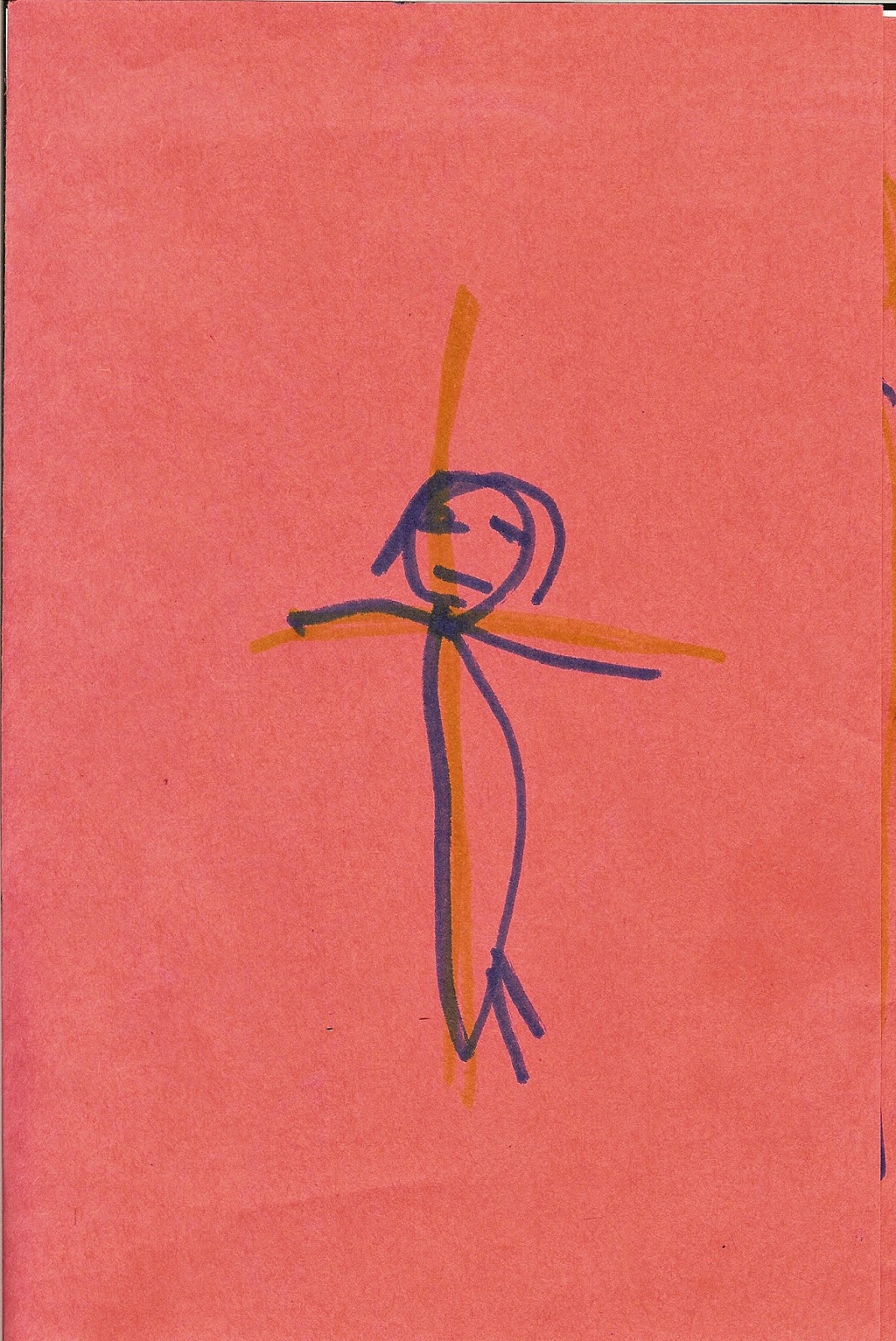
A few years ago my niece was obsessed with Jesus. Even though it was Christmas, she wanted to know more about how Jesus died on the cross. The next year she drew this picture as a Christmas card. I guess for her, the Passion is also the most memorable part of the life of Jesus.
A Just World

I am having deja vu. Before last term, we had not had a student death related to a car accident in over 10 years. Yet once again, another student died in a car accident earlier this week. Like the student last term, this student was very involved and visible in the community, was known for helping others, and was on the verge of graduating with a bright future ahead of her.

We tell students that there is no right or wrong way to grieve. But some coping mechanisms are more hurtful than others. She was probably driving too fast. People shouldn’t drink and drive. Stupid people die. 

When I was a graduate student, one of my favorite theories was the Just World Hypothesis. Because we want to believe in a just world, when something bad happens we assume that the person must have done something to deserve it.

I often hear just world explanations after a sexual assault. She was making out with him on the dance floor. She went back to his room. She didn’t fight it so she must have wanted it.  

The Just World Hypothesis is closely related to the problems with free will and blame. In order to preserve the belief that we control our destiny, we are willing to take responsibility for things that we don’t actually have control over.  

I can understand the need to believe that if you make the right choices you will be safe from harm. I want to believe this, too. Usually my attempts at control manifest themselves in perfectionism and excessive guilt.

I don’t know how much blame a person should be held responsible for. I don’t know how to make sense of all of the suffering in the world. But I know that the more I blame someone, the less compassion I have for them.

So I try to approach suffering in the same way I try to accept my feelings: it doesn’t have to make sense. I don’t have to know the reason why for suffering to exist. And I try to have faith that when something bad happens, I will be strong enough to handle it.

Loyalty

When it comes to sports, I am loyal to a fault.

In a previous post, I talked about the delusional level of optimism that my brothers and I must channel at times to continue to cheer for UVA football. My brother emailed me recently to ask if I wanted to renew our season tickets–which I did. Even though we only won 2 whole games last season.

I captain several tennis leagues every year. And every year, I invite all of the players from the previous season back to the team unless they’ve done something I consider egregious–like not show up for a match. Or not respond to my emails. Or cause drama on or off the court. I can tolerate a player with a losing record, but I won’t tolerate a person who disrespects me or other people.

There are many captains who have the opposite recruiting strategy: they will tolerate a strong but less likeable player but get rid of a nice person who is a weak player.  Because the point of forming a team is to win, after all. I get that. And I’ve had winning teams. But I’ll admit, I sometimes choose loyalty over winning.

I’ve had friends leave my team and play for other captains because of this. I can’t really fault them for wanting to be on a winning team. But I am grateful for the friends who continue to play for me, because it makes our team feel more like a family. In fact, the tennis family that I featured in a previous post are all long-standing members of my mixed doubles team.

This team happens to be my winnningest team, too.  So loyalty does pay off sometimes.

This year, for the first time in 38 years, UVA won the ACC tournament in basketball. And for the first time ever, we were both the regular season and tournament champions. And we did it without any superstar athletes.  Without anyone noticing, really. Because when you win with defense, it’s not flashy.  So we didn’t get as much press as some of the high profile teams in our conference.

I was there when they won the tournament, and what impressed me the most about them–other than how awesome they are–is how humble they are. No one sticking their faces in the camera talking smack about how they proved their haters wrong. Not even any “we’re number one” stuff. No ego at all. Just a joyful celebration of their accomplishment as a team. As a basketball family.

It takes faith at every level to be loyal to a losing team. In the post-game interview, Tony Bennett thanked God for getting his team through the low times. Bennett had faith that a team without a single McDonald’s All-American player could accomplish great things. The players had faith that defense and unselfish play could win championships. And UVA fans had faith that someday, our basketball team could return to the glory days of the Ralph Sampson era.

So this post is dedicated to the 2014 ACC regular season and tournament champs. See you in Texas at the Final Four!

God’s Will

It feels incomplete to talk about blame and free will without also talking about God’s will.  This one is the scariest of the 3 to write about, but I’m committed to being honest, so I’m making myself do it.

When I was in high school, my best friend’s father died of a heart attack in his early 40’s.  During the funeral, his best friend broke down crying while giving the eulogy.  My friend’s mom calmly took his place, saying that she believed her husband’s death was God’s will so she was at peace with it.

That really bothered me.  I was glad that it gave her comfort, but I could not fathom how God could want someone to die.  If deaths are God’s will, how can it be a sin to commit suicide?  Or murder, for that matter.  Or acts of terrorism.  All of these deaths would just be a part of God’s plan; these people were simply fulfilling their roles.  In fact, sin wouldn’t even be possible.

There is someone in our tennis community who is reaching the end of her battle with cancer.  Although I did not know her well, I was struck by how positive and kind she was when I met her last year.  She was in the midst of chemo at the time, and she was my opponent on the court.  And she kicked my ass.  Which was both impressive and upsetting, given my competitive nature.

I have been praying for her and her family, but I struggle with what to ask God for if death is, in fact, part of God’s plan for her.  I know some people don’t believe in God for this reason.  Or if God exists, they don’t want to worship a God who would allow people to suffer.  I wouldn’t go that far.  It is clear from the life of Christ and the teachings of Buddha, and probably most religions, that no one is immune to suffering.

I accept that, but it’s still hard to tolerate.  I try to imagine what it would be like to be her or her loved ones, but I can’t.  My brain won’t let me go there.  It’s too painful.  Too much to bear.  I can’t envision surviving a loss like that, even though I know that somehow I would if I had to.

I do my usual prayer.  Because we’re allowed to ask, even if we don’t always get what we want.  God, if at all possible, please let her have a miraculous recovery.  And then I say a more realistic prayer.  Please minimize their suffering to the extent possible.  Please  surround them with love, to mitigate the pain. 

I am no theologian, but based on the story of Adam and Eve, one thing is for certain: God wants us to have free will.  We, too, have the power to say no.  We can choose not to follow God’s plan.  We can choose not to love God, or not to love at all.

In the midst of tragedies, the people involved always say that they are humbled by the outpouring of love and support from people they don’t even know.  That it does mitigate the pain.  So I will continue to pray for this member of the tennis community and her family.  If love can ease their pain, then I will choose love.

46 Lessons Learned from Blogging

Since the original intent of my blog was to help other people, I thought I’d provide a cheat sheet of the lesson in each post (except for the random ones).  That way, you don’t have to go back and read the whole blog if you don’t want to.  But hopefully you will!

1.  Night Owl Syndrome:  Prejudice against night owls is a form of discrimination that has been perpetuated in part by Ben Franklin.

2.  Massages:  Massages are not as relaxing when you obsess the entire time about how much they cost.

3.  Knitting and Relationships:  Challenge yourself every now and then, but you don’t have to knit a dress.

4.  Positive and Negative Feedback:  It’s easier to believe erroneous negative feedback than it is to accept legitimate positive feedback.

5.  Karaoke Pusher:  Singing in front of other people is a good way to let go of fear.

6.  You Know You’re Filipino If…:  Things that embarrassed you as a kid will make great anecdotes when you get older.

7.  The Courage to be Vulnerable:  Sharing your vulnerabilities with others makes people feel closer to you.

8.  The Unathletic Athlete:  Even if you were picked last in gym class, you can still grow up to be an athlete.

9.  Tennis Courtships:  Someone needs to come up with a website that can help tennis players find a doubles partner.

10.  The Uses of Prayer:  Sometimes God answers your prayers by giving you opportunities rather than results.

11.  Boundaries:  Being Asian makes setting boundaries even more difficult than it already is.

12.  Massages, Part 2:  Don’t drink coffee before a massage–even decaf.

13.  Boundaries, Part 2:  Blogging is a good way to let people know that you don’t want to be told that you’re fat.

14.  Children:  Play with your inner child every now and then.

15.  Can Love Conquer All?  No, but it’s still worth the risk.

16.  Body Image:  Small gains are better than nothing.

17.  Hard Core Fan:  It takes dedication to root for a losing team.

18.  Warriorism:  When things get tough, channel your inner warrior.

19.  Self-Portrait:  You can learn a lot about yourself from doodles.

20.  Solitude:  Sometimes when you think you’re alone, you’re really not.

21.  Self-Acceptance:  We all have different parts of ourselves, many of whom don’t get along.

22.  Meet the Drill Sergeant:  Save your inner drill sergeant for emergencies.

23.  The Inner Critic:  Defy your inner critic every change you get.

24.  Thanksgiving:  Miracles really do happen.

25.  Perfectionism:  Blogging about mistakes can help you accept them.

26.  Stress Management:  Sometimes stress management can be stressful.

27. Self-Care:  Blogging is a good way to put yourself first.

28. Grief:  The best thing we can do for someone who is grieving is to be willing to listen to them talk about their pain.

29.  Yes and No:  Learn to say yes to what you want and no to what you don’t want.

30.  Blogging is My New Boyfriend:  You can’t fail if you never stop trying.

31.  Friendship:  Don’t be afraid to ask for help when you need it.

32.  Empathy:  If you’re high in empathy, choose your friends and partners wisely.

33.  Breakups:  If you’re relationship is ending, try to leave with love rather than hate.

34.  In Times of War:  Make choices you can live with, regardless of the outcome.

35.  Angels:  If you ask people to send you angels when you’re struggling, they will–and it works.

36.  Forgiveness:  For people with a harsh inner critic like me, self-forgiveness is the hardest part.

37.  Gratitude:  Practicing gratitude may not turn your depression into happiness, but do it, anyway.

38.  Love:  Our love may never be perfect, but I think God is OK with that.

39.  Forgetting:  Forgiveness is a process.

40.  Moms:  Moms are often unsung heroes, so thank them every chance you get.

41.  New Year’s Resolutions:  Restating your resolutions every year is not a sign of failure; it demonstrates that you are choosing to live intentionally.

42.  In My Head:  I thought I was weird for thinking so much, but it turns out that it means I’m a writer!

43.  Bipolar and Brilliant:  You can be brilliant and mentally ill, but you can also be dumb and refuse to take your medication.

44.  Night Owl Syndrome, Part 2:  It takes practice to let go of unnecessary guilt.

45.  Competitive Latch-Hooking:  Sometimes the sibling that was your mortal enemy in childhood becomes your most loyal blog follower as an adult.

46.  Honesty and Trust:  Surround yourself with honest people; it takes less energy than being paranoid.


Love

Love is patient, love is kind. It does not envy, it does not boast, it is not proud. It does not dishonor others, it is not self-seeking, it is not easily angered, it keeps no record of wrongs. Love does not delight in evil but rejoices with the truth. It always protects, always trusts, always hopes, always perseveres.
***

I don’t mean to sound blasphemous, but I’ve always had a problem with this definition of love.  I have never been able to love anyone in this way, nor have I ever been loved in this way.  Not from another human being, at least.  This may be the way that God loves us, but for me, this standard minimizes the value of the imperfect love that we offer to one another.

Being with my family for several days is a prime example of how painful and complicated love can be. We have all been impatient, unkind, envious, and proud with one another at some point.  I could go through the entire paragraph, but you get the idea.  Yet I have never questioned my love for my family or their love for me. It is the most enduring love that I have known and that I will know in this lifetime.

Perhaps it is my harsh superego and my perfectionism that tortures me with quotes like this one.  My demons turn what is supposed to be a helpful guideline for how to love into something that makes me feel inadequate and guilty. But I know that I am not the only one who feels this way.  I know many people who berate themselves and others for not being able to give and receive this kind of love.

The messages about love that have been most helpful to me are that God is love, and that we are to love our neighbor as ourselves.  I take this to mean that love for self, others, and God are all the same; you cannot truly experience one without the others.

This should come as no surprise to you if you have been following my blog, but for me the most difficult part is loving myself.  And this is often true for the people I see in therapy, too.  It helps to commit to loving myself when I think of it as a necessary part of the equation.

Surprisingly, blogging has been an opportunity to experience this trinity of love.  As I have mentioned in a previous post, I started this blog with the intention of helping other people.  I was not expecting it to be a way of receiving help.  And I certainly wasn’t expecting it to bring me closer to God.  Yet here is another post that ends with God.

Striving to give and receive this kind of love is still a tall order, but for me, it’s a more hopeful goal than striving to love perfectly.

Gratitude

Over the past few weeks I have been praying for a way to take in what I love about Christmas. Singing Christmas songs.  The lights and decorations.  The food.  Having my entire family together. And reflecting on the significance of having our Savior born in the most humble beginnings.

I looked at the news headlines about the homily Pope Francis gave last night, and true to my prediction, it was a message of acceptance and forgiveness.  The quote that stood out to me was the reminder that Jesus was all-powerful but he made himself vulnerable for us.  There is great strength in vulnerability; it is His vulnerability that redeems us.

In this blog I have made myself vulnerable by sharing all of the thoughts and feelings that I usually keep to myself.  After writing my post on forgiveness and reading people’s responses, that was the most vulnerable I have felt thus far.

People who have never been depressed do not realize what a dark place it is to be in.  For example, “normal” people can make themselves happier by practicing gratitude, by reflecting on people who are less fortunate than themselves, by counting their blessings.  The assumption is that sadness and gratitude are mutually exclusive.

When you are depressed, your demons turn this well-meaning advice into further evidence that you are a bad person for being depressed because you are not able to snap out of it, despite all the things you have to be thankful for.  So it is especially difficult to practice gratitude when you are depressed because it often makes you feel worse.

However, my spiritual guru is the Franciscan Priest Richard Rohr, and one of the most helpful things that he emphasizes is that spirituality is not either/or, as we tend to think in Western religions. It is not good or bad, right or wrong.  Spirituality is both/and.  So I can practice gratitude and still be depressed.  They can both be true, and that’s OK.

Today I am already thankful for many things.  I am thankful that the party wasn’t as overwhelming as I feared it would be.  That the homily last night had a message that was meaningful to me.  That I’ve had meaningful conversations with two of my brothers, and in a few hours my other brother and his family will be here.  I am thankful for the friends who have already sent me texts to wish me Merry Christmas.

And I am thankful for this blog.  I think God gave me this blog because He knew that these next few months would be difficult.  So He gave me a way to share my pain, to reach out to others, and to ask for help.  It really is true that making ourselves vulnerable may be the most powerful thing we can do to experience love and connect with other people.  I think that this is what Jesus would want us to experience most of all on His birthday.

So I am thankful to all of you who have taken the time to read my blog on Christmas Day.  And I thank my friend Sharon for giving me the cartoon below.


Angels

I’ve been thinking about writing a post on angels, but since I’ve been feeling down it didn’t really fit my state of mind. But then “It’s a Wonderful Life” happened to be on last night, so I took that as a sign that I should go ahead and write the post.

For a long time I wasn’t sure what to believe about God. I was raised Catholic, but a lot of the beliefs of the Catholic church were not consist with my idea of God. Although Pope Francis is changing this, to some degree.

I read lots of different books to try to find God. As I mentioned in a previous post, the books on Near Death Experiences (NDE) were the ones that were the most helpful. For one thing, they are poorly written. The authors have clearly never aspired to be writers, and often they didn’t want to write the book at all. So writing a book about their near death experience didn’t seem like a ploy to get published.

The most convincing of these books was “My Descent into Death,” by Howard Storm, because he went to hell before he went to heaven. Who would admit to that? Plus, throughout the book he continued to argue and complain to God and never seemed particularly pious, which made his account seem even more genuine.

Storm dedicates an entire chapter to angels at the end of his book. I have always liked the idea of angels but did not realize they were so numerous and so involved in our lives. I thought we might have a guardian angel and that there were a bunch in heaven, singing and rejoicing when we arrived, but that’s about it.

Storm says that angels always want to intervene and help us but aren’t allowed to do so unless God gives them permission. And when people with NDE’s come back to earth and are depressed about it, usually because they have sustained horrible injuries from their accident that take years to recover from, angels appear to them to give them encouragement.

Even research shows that praying for other people helps. My theory is that when we pray for someone else, God allows angels to intervene. So now most of my prayers include angels. If I’m having a really hard time, I ask God to temporarily send me a few extra angels to get me through. Or if someone I know is suffering, I tell God to send that person one of my angels so they can have extra.

And of course, when UVA is losing, I occasionally resort to prayer and ask God to send an angel to help them win.

The winter is always a hard time for me, because most forms of depression are affected by lack of sunlight. Plus I am still getting used to being alone and having to be proactive if I want to see anyone, and I don’t have much energy to do so. And this holiday I don’t have a lot planned to look forward to. Ordinarily, even if I’m feeling depressed, I can still get into Christmas. But not this year. I haven’t even bought my gifts yet, and usually I am compulsively early about everything.

But there’s still time, and I’m hopeful that at some point something will kick in and I will be able to embrace the holidays with the enthusiasm that I apply to all of the things I love. At least that’s what I pray for.

And if you believe in angels, feel free to ask God to send a couple of extras my way.

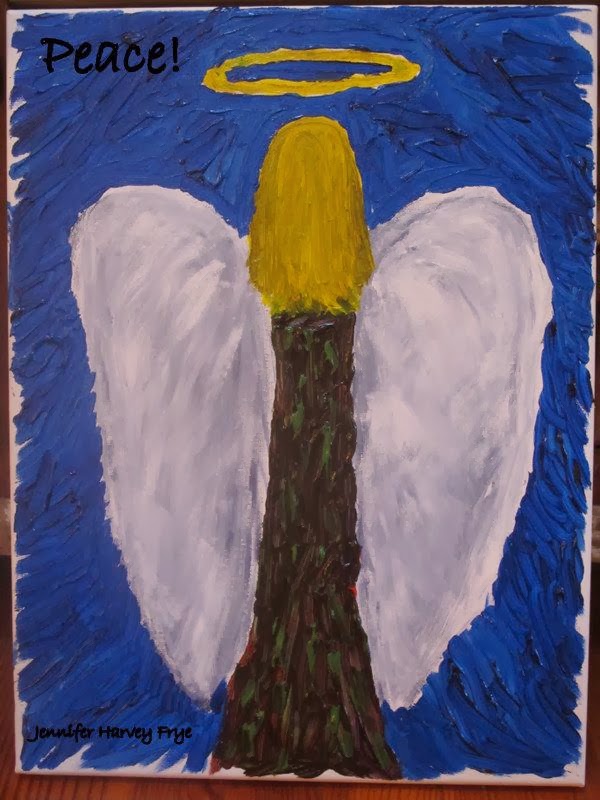
Photo courtesy of Jennifer Harvey Frye

Yes and No

Being alone isn’t as bad as I thought it would be.  Relationships are an area where I take on challenges without asking myself whether it is worth the effort, so it’s a nice change of pace to have energy to expend on myself. 

When I was in school, the reason why I was a good student is that I did what teachers told me to do.  It never occurred to me that not doing the reading or homework and not studying were an option.  I also try to fulfill my job responsibilities because I’m afraid that if I make one mistake I’ll get fired.  

I think it’s partly due to my Catholic upbringing.  I’m a rule-follower to begin with, but I also fear that if I break the rules I will go to hell.  If I call a ball out, I’m afraid I’ll go to hell because I wanted the point so badly.  So usually I just call everything in, which is sometimes to my advantage because my opponent wasn’t expecting to play a ball that was a foot out.

I used to have this prayer where I would ask God to forgive me for all my sins, intentional and unintentional, because I thought, what if I’ve sinned and I didn’t realize it?  Then I couldn’t ask for forgiveness and I might go to hell.  So I figured this prayer covered all the bases.

Most of my relationships weren’t of my choosing.  If someone liked me, I would date him because I thought that would make him happy.  Feeling ambivalent was not a good enough reason to say no because my feelings didn’t count.  And it’s hard for me to end relationships because I’m not allowed to hurt anyone.  Although I often ended up hurting them, anyway.

This is also the reason I became a psychologist and feel compelled to save the world.  If someone is hurting, then it’s my job to help them if I’m able to do so.  It doesn’t matter if I want to do so, whether I like the person or not, how stressed I am, or how much energy I have to expend.

My superhero family members also share this sentiment, as I mentioned in a previous post.  They are even more extreme in terms of putting other people’s needs first, even if it hurts them.  So I really haven’t had good role models for setting limits.

But thanks to this blog, I’m beginning to set limits.  I’ve quit that crazy writing job where I was spending 10-12 hours on articles that gave the most superficial advice possible for $25.  I ended a relationship and am learning to be alone.  I have narrowed down my extra-curricular activities to tennis, knitting that dress for my niece, and writing/promoting my blog.  Which is still a lot, but it’s an improvement for me.

My new rule is to say yes to what I want and no to what I don’t want.  I said this 3 years ago, but sometimes it takes awhile to do what you know you need to do.  So I’m trying not to beat myself up about that. 

So from now on, it’s yes and no.  Hopefully.

Grief

Tonight I went to the memorial for the student who was killed in the car accident a week ago. I didn’t know the student and wanted to have a better sense of who she was and to feel more of the grief that the community is experiencing.

Handling crises is my least favorite part of my job. I don’t do well with things like grief. My emotions are naturally very intense even at baseline, so when there’s a crisis, I shut down. I guess this is my brain’s way of protecting me from being overwhelmed by my feelings. In a way it’s helpful, since I need to be there for the students, but sometimes I’m afraid I’m so emotionally removed that it’s affecting how much support I can provide.

I do feel bad for the parents. I don’t have children but I can imagine how hard it would be to lose a child, how unnatural and unfair that is. I wonder if they will celebrate Christmas this year, and if Christmas will ever be a happy time for them again.

And I feel bad for the driver. He may go to jail for drunk driving, and for the rest of his life he will have to live with the burden of her death. I hope that he finds a way to forgive himself for what happened and find peace.

Often my friends on FB will post something on the birthday of a loved one who has died and say how the sadness never goes away. It’s daunting to imagine living with never-ending pain–a hole in your heart that never gets filled. That’s why death scares me so much.

For awhile I was really into books about near-death experiences. I think I read them as a way to be OK with the idea of death. I found comfort in reading that all of the people who went to heaven and came back to earth thought heaven was so great that they were depressed when they didn’t get to stay.

My favorite part of these books is where they describe how entering heaven is like a pep rally where all of these people, including your loved ones, are there cheering you on and welcoming you. I don’t know if you get to pick your job when you’re in heaven, but I think I would be an awesome greeter. That makes the idea of dying a little easier, too.

The biggest loss I’ve experienced so far is losing my first husband. He didn’t die but we are not in contact and he does not wish to have a relationship with me, so it’s been like a death to me.

I know I’m probably taking this too literally, but sometimes I wonder, if it’s really true that your loved ones greet you when you get to heaven, would he be there to greet me, since we’re no longer married? Or would he just be there for his second wife when she dies? I imagine that when you are in heaven you can be in two places at once and you don’t have to choose which loved ones you will be with like you have to do on earth.

Even though it’s been almost 10 years since we’ve been apart, I still miss him. We shared so much together that every day I encounter something that triggers a memory of him. But at the same time, I am happy with my life and feel fortunate that I will get to know more people than I would have if we had stayed married. So it’s possible to be happy and sad at the same. It’s possible to miss someone but still go on with your life.

I guess since we all experience losses throughout our lives, these losses just become a part of who we are. I have always felt that if I had to do my life all over again, I wouldn’t change anything, because every mistake and every loss has played a role in the person I have become.

Plus I believe that our task in this lifetime is to experience what it means to be human, and suffering and death are a part of the package. Often in therapy clients want me to take away their pain, and I have to tell them that I can’t, but I am willing to sit with them while they are hurting. I guess that is the best gift we can give to anyone who is grieving. So at least I’m getting that part right.

This is my favorite doodle because it looks like a magical land, like Oz, minus the yellow brick road.