Love is patient, love is kind. It does not envy, it does not boast, it is not proud. It does not dishonor others, it is not self-seeking, it is not easily angered, it keeps no record of wrongs. Love does not delight in evil but rejoices with the truth. It always protects, always trusts, always hopes, always perseveres.
***
I don’t mean to sound blasphemous, but I’ve always had a problem with this definition of love. I have never been able to love anyone in this way, nor have I ever been loved in this way. Not from another human being, at least. This may be the way that God loves us, but for me, this standard minimizes the value of the imperfect love that we offer to one another.
Being with my family for several days is a prime example of how painful and complicated love can be. We have all been impatient, unkind, envious, and proud with one another at some point. I could go through the entire paragraph, but you get the idea. Yet I have never questioned my love for my family or their love for me. It is the most enduring love that I have known and that I will know in this lifetime.
Perhaps it is my harsh superego and my perfectionism that tortures me with quotes like this one. My demons turn what is supposed to be a helpful guideline for how to love into something that makes me feel inadequate and guilty. But I know that I am not the only one who feels this way. I know many people who berate themselves and others for not being able to give and receive this kind of love.
The messages about love that have been most helpful to me are that God is love, and that we are to love our neighbor as ourselves. I take this to mean that love for self, others, and God are all the same; you cannot truly experience one without the others.
This should come as no surprise to you if you have been following my blog, but for me the most difficult part is loving myself. And this is often true for the people I see in therapy, too. It helps to commit to loving myself when I think of it as a necessary part of the equation.
Surprisingly, blogging has been an opportunity to experience this trinity of love. As I have mentioned in a previous post, I started this blog with the intention of helping other people. I was not expecting it to be a way of receiving help. And I certainly wasn’t expecting it to bring me closer to God. Yet here is another post that ends with God.
Striving to give and receive this kind of love is still a tall order, but for me, it’s a more hopeful goal than striving to love perfectly.
Over the past few weeks I have been praying for a way to take in what I love about Christmas. Singing Christmas songs. The lights and decorations. The food. Having my entire family together. And reflecting on the significance of having our Savior born in the most humble beginnings.
I looked at the news headlines about the homily Pope Francis gave last night, and true to my prediction, it was a message of acceptance and forgiveness. The quote that stood out to me was the reminder that Jesus was all-powerful but he made himself vulnerable for us. There is great strength in vulnerability; it is His vulnerability that redeems us.
In this blog I have made myself vulnerable by sharing all of the thoughts and feelings that I usually keep to myself. After writing my post on forgiveness and reading people’s responses, that was the most vulnerable I have felt thus far.
People who have never been depressed do not realize what a dark place it is to be in. For example, “normal” people can make themselves happier by practicing gratitude, by reflecting on people who are less fortunate than themselves, by counting their blessings. The assumption is that sadness and gratitude are mutually exclusive.
When you are depressed, your demons turn this well-meaning advice into further evidence that you are a bad person for being depressed because you are not able to snap out of it, despite all the things you have to be thankful for. So it is especially difficult to practice gratitude when you are depressed because it often makes you feel worse.
However, my spiritual guru is the Franciscan Priest Richard Rohr, and one of the most helpful things that he emphasizes is that spirituality is not either/or, as we tend to think in Western religions. It is not good or bad, right or wrong. Spirituality is both/and. So I can practice gratitude and still be depressed. They can both be true, and that’s OK.
Today I am already thankful for many things. I am thankful that the party wasn’t as overwhelming as I feared it would be. That the homily last night had a message that was meaningful to me. That I’ve had meaningful conversations with two of my brothers, and in a few hours my other brother and his family will be here. I am thankful for the friends who have already sent me texts to wish me Merry Christmas.
And I am thankful for this blog. I think God gave me this blog because He knew that these next few months would be difficult. So He gave me a way to share my pain, to reach out to others, and to ask for help. It really is true that making ourselves vulnerable may be the most powerful thing we can do to experience love and connect with other people. I think that this is what Jesus would want us to experience most of all on His birthday.
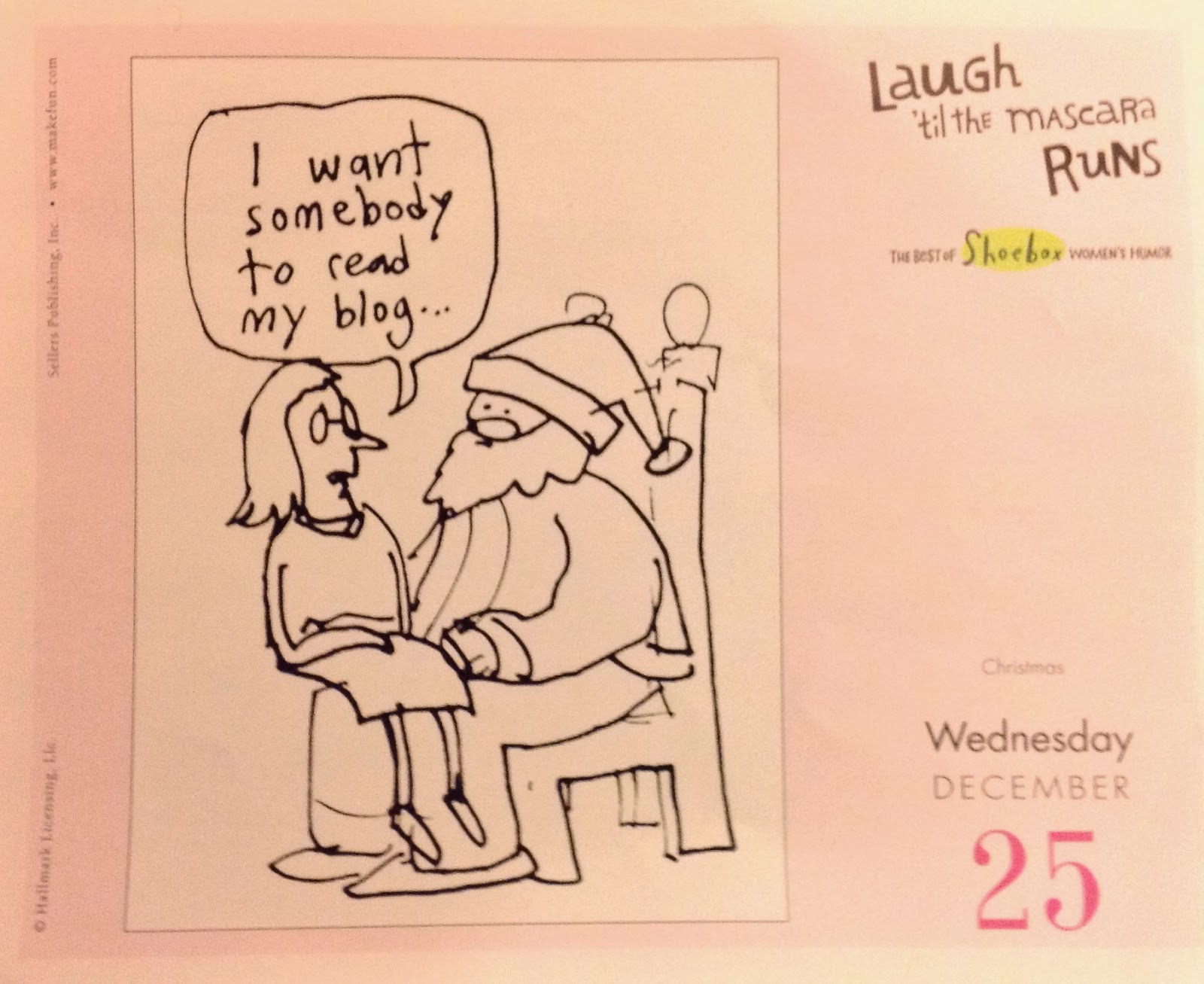
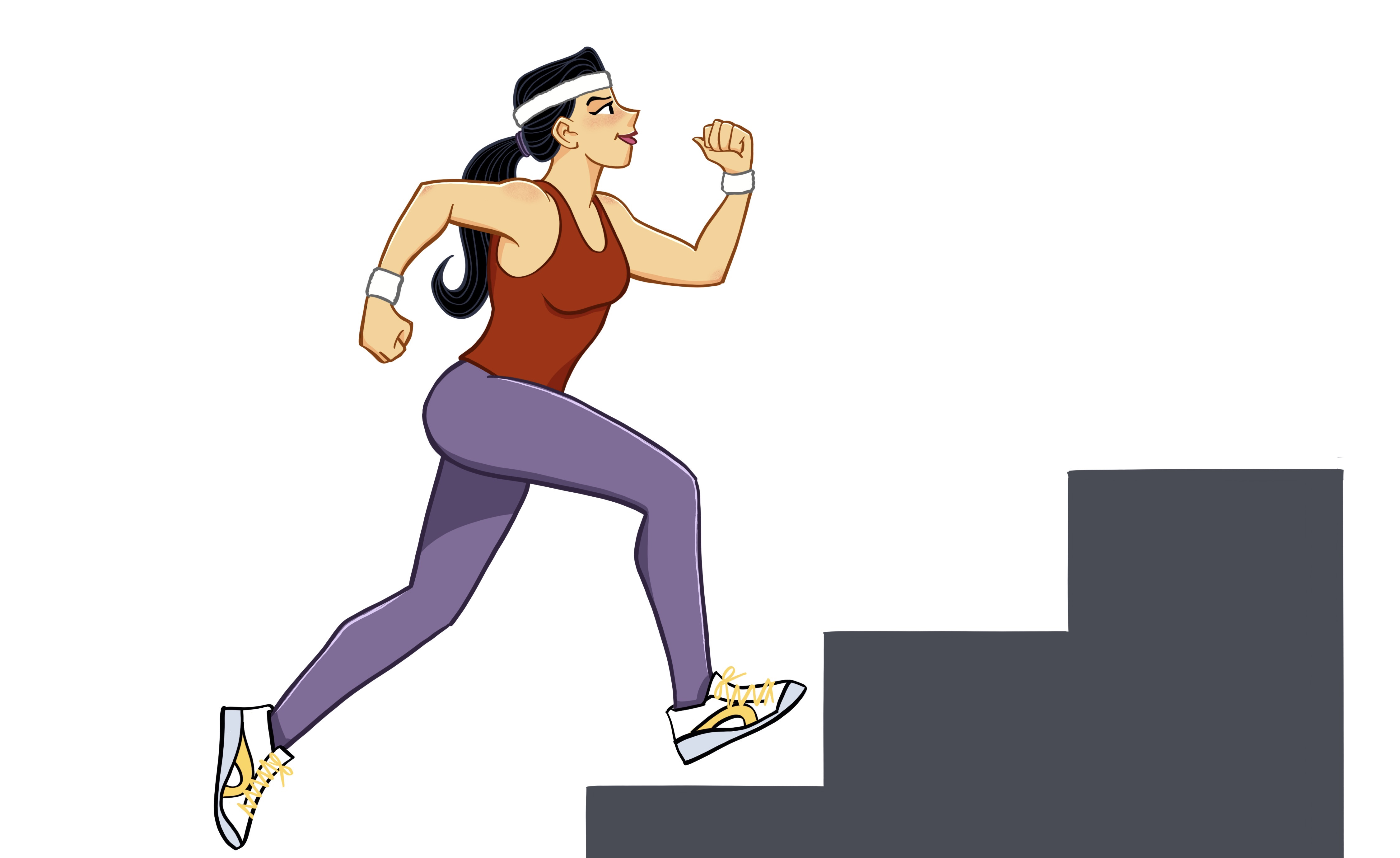
So I am thankful to all of you who have taken the time to read my blog on Christmas Day. And I thank my friend Sharon for giving me the cartoon below.
In Buddhism, one of my favorite meditations is the one on forgiveness. In this meditation, you reflect on the 3 types of forgiveness: asking forgiveness from those whom you have hurt, forgiving those who have hurt you, and forgiving yourself for self-harm. I usually just do one person per category each time I do the meditation.
As I mentioned in a previous post, because of my fear of going to hell, I have no problem asking for forgiveness for real and imagined sins. I also do my best to forgive those who have hurt me because I believe it is a gift to myself to do so. Sometimes the best I can do is to have the intention to forgive, but in Buddhism that is enough. Being willing to plant a seed of forgiveness will suffice, if that’s all you’re ready for.
From my personal and professional experience, self-forgiveness is often the hardest one to practice. One of my parts is a judge who doles out punishments for non-existent crimes. And for crimes that took place when I was 5 and for which there should be a statute of limitations beyond which I should no longer be held accountable. This strict mindset regarding wrongdoings is fairly common for people who struggle with depression and anxiety.
This weekend I had to repeatedly remind myself that it’s not my fault that I’m depressed. I cannot even articulate what I have done wrong, yet somehow I feel I have failed at something. I didn’t wake up early enough. I went to bed too late. I didn’t make enough of an effort to ask for help. I am being too needy. I stayed too long in my previous relationship. I’m not being forgiving enough or letting go of anger fast enough. I’m just doing it wrong. This being human thing.
This is how the internal judge is: it can argue both ways, and either way it’s your fault.
I think that one of the reasons that we neglect to practice self-forgiveness is that it’s not emphasized as much as the other two are. For example, in the Our Father, we ask God to forgive us for our trespasses as we forgive those who trespass against us. I am certain that God would also want us to forgive ourselves, but there’s no line in there explicitly giving us permission to do so.
But I am hopeful that this will change with Pope Francis. I confess, I have never been excited about a pope before, but I believe that Pope Francis is an enlightened being. I believe that Mandela was one, as well. So it’s only fitting that as one enlightened being leaves this world, God gives us another one to maintain equilibrium in the universe. I am hopeful that we will hear more from him about acceptance and forgiveness and less about judgement and sin.
So take that, Judge!
I picked this doodle because it sort of looks like snow.
I’ve been thinking about writing a post on angels, but since I’ve been feeling down it didn’t really fit my state of mind. But then “It’s a Wonderful Life” happened to be on last night, so I took that as a sign that I should go ahead and write the post.
For a long time I wasn’t sure what to believe about God. I was raised Catholic, but a lot of the beliefs of the Catholic church were not consist with my idea of God. Although Pope Francis is changing this, to some degree.
I read lots of different books to try to find God. As I mentioned in a previous post, the books on Near Death Experiences (NDE) were the ones that were the most helpful. For one thing, they are poorly written. The authors have clearly never aspired to be writers, and often they didn’t want to write the book at all. So writing a book about their near death experience didn’t seem like a ploy to get published.
The most convincing of these books was “My Descent into Death,” by Howard Storm, because he went to hell before he went to heaven. Who would admit to that? Plus, throughout the book he continued to argue and complain to God and never seemed particularly pious, which made his account seem even more genuine.
Storm dedicates an entire chapter to angels at the end of his book. I have always liked the idea of angels but did not realize they were so numerous and so involved in our lives. I thought we might have a guardian angel and that there were a bunch in heaven, singing and rejoicing when we arrived, but that’s about it.
Storm says that angels always want to intervene and help us but aren’t allowed to do so unless God gives them permission. And when people with NDE’s come back to earth and are depressed about it, usually because they have sustained horrible injuries from their accident that take years to recover from, angels appear to them to give them encouragement.
Even research shows that praying for other people helps. My theory is that when we pray for someone else, God allows angels to intervene. So now most of my prayers include angels. If I’m having a really hard time, I ask God to temporarily send me a few extra angels to get me through. Or if someone I know is suffering, I tell God to send that person one of my angels so they can have extra.
And of course, when UVA is losing, I occasionally resort to prayer and ask God to send an angel to help them win.
The winter is always a hard time for me, because I have Seasonal Affective Disorder (SAD) as one of my forms of depression. Plus I am still getting used to being alone and having to be proactive if I want to see anyone. And I don’t have much energy to do so. And this holiday I don’t have a lot planned to look forward to. Ordinarily, even if I’m feeling depressed, I can still get into Christmas. But not this year. I haven’t even bought my gifts yet, and usually I am compulsively early about everything.
But there’s still time. I’m hopeful that at some point something will kick in and I will be able to embrace the holidays with the enthusiasm that I apply to all of the things I love. At least that’s what I pray for.
And if you believe in angels, feel free to ask God to send a couple of extras my way.
I find it fascinating to read accounts of the things people do to survive in times of war. I will never forget reading this memoir of a refugee from Korea. She described how one mother threw her baby in the river while she was fleeing. That has become my symbol of survival at all costs–throwing your baby in the river.
One of the things I love about tennis is that you get to see what people would be like in times of war. Competition can bring out the best and worst in people. There are tennis players like Federer and Nadal, who are warriors but also class acts on and off the court.
And then there are players who couldn’t be nicer off the court, but once get them in a losing match, then you’ve got rackets, curse words, and insults flying everywhere. They question every line call. They cheat. They resort to gamesmanship. They do whatever it takes to win, no holds barred. You probably know some of these people. I have no doubt that in a war, these people would have a better chance of surviving than I would.
I read this book called The Noonday Demon where the author interviewed people all over the world to get different perspectives on depression. One of the interviews was with this tribe that fought bitterly in a civil war to survive, but once the war was over many of them committed suicide. I couldn’t understand it. But my husband at the time said that he totally got it, because he had to do whatever it took to survive.
Apparently, the things you have to do to survive make it hard to live with yourself after you’ve won.
I try to play with people who are competitive but are still the same person on and off the court. That’s why in my mixed doubles partner ad, I said I wanted a partner who demonstrates good sportsmanship, has a positive attitude, and never stops fighting for the win. I want to win, but most importantly, I want to be around people whose company I enjoy. And I want to have fun. Because the winning lasts a moment. But it’s the act of playing that is the living part. That’s what really counts. Living to play.
I think that for the most part, I am the person I strive to be on the court. In fact, I find it easier to be the person I want to be in tennis than I do in real life because I’m very intentional about everything I do in tennis. But, in all honesty, because I don’t want to win at all costs, combined with the excessive empathy problem, I’d probably reduce my chances of survival by doing something like helping someone who has no chance of making it.
But then again, we never know how things are going to turn out. We don’t know if we’re going to win or lose, survive or perish–because all the factors aren’t in our control. So I try to make choices that I can live with, regardless of the outcome. And helping someone who may seem like they have no chance to win while trying to survive myself is exactly the kind of person I want to be.
Sometimes you can have too much empathy. People call it compassion fatigue, but I found out during a compassion retreat that it’s actually empathy fatigue. Because empathy knows no boundaries, but compassion has boundaries.
One of the reasons why it seems like I want to save the world (which I don’t–just the people I’ve met) is because I can feel other people’s pain as though it were my own. When they are hurting, I’m hurting. So it’s really for selfish reasons that I help other people; I don’t like being in pain.
When I worked in day care after I graduated from college, the children who had the most difficult time adjusting were the ones who were attached to me. In case you are worried about your children being in day care, rest assured that there were some kids who loved it so much that they didn’t want to go home. They didn’t cry when their parents showed up; they just wanted to keep playing.
But not these kids. These were the kids who cried from the moment their parents dropped them off until they picked them up in the afternoon. And this would go on for weeks. It actually drove me crazy. I didn’t feel positively towards those kids at all. I mean, I didn’t think negative thoughts about them. They just caused me unbearable pain. Which is why I could never understand why they were attached to me.
Now, looking back, because I could feel their pain, I would break the rules and hold them all day because it’s the only thing that comforted them. Back then you weren’t aloud to hold or carry the kids because you didn’t want them to get too attached to you. Which I thought was ridiculous even before I started grad school.
It turns out that being held is one of the best ways to soothe people. So next time you’re feeling upset, ask for a hug from someone you care about. Or do something that feels like a hug, like take a warm bath or wrap yourself up in a weighted blanket.
Sometimes I feel like I’m a receiver that picks up the emotional equivalent of radio waves. I’m bombarded by all of these feelings, all the time. Sometimes I don’t even know where they’re coming from. I wish I could just turn the receiver off every now and then. Or at least turn the volume down. Anything to have some relief from the constant noise.
The best solution I’ve been able to come up with is the yes and no thing–yes to what I want, no to what I don’t want. I need to choose the people who I’m around more carefully. If it’s someone who doesn’t take responsibility for dealing with their own feelings, I need to stay away. I can barely deal with my own feelings.
Maybe it sounds cold and calculated. Or maybe it only sounds mean to me. Maybe for normal people this is status quo in terms of how to keep other people from overwhelming you.
I always tell clients that if it comes down to you and someone else, you have to pick you, because there’s no guarantee that anyone else will. So from now on, I’m going to try to pick me.
Since no one asked me any questions in my recent blog survey, I thought I would just make up some questions and answer them, because I like to pretend I’m being interviewed. Who knows? Maybe I will be interviewed one day.
Q: Do you ever worry that your clients are going to read your blog and decide that you’re too crazy to be their therapist?
A: Yes. All the time. In fact, I recently found out that a parent of one of my clients read my blog on perfectionism, and for a moment it made me reconsider this whole blogging thing. But she didn’t tell her daughter to transfer, so that was encouraging. I’ve had clients transfer to other therapists before, so if they decided to transfer after reading my blog, I guess I can live with that. You can’t be all things to all people. Although I do still try to be.
Q: Are the posts where you write about different parts of yourself based on any particular theory?
A: The idea of conceptualizing our problems into separate parts of ourselves actually comes from two of my favorite theories: narrative therapy and internal family systems therapy. In narrative therapy, a mental disorder is conceptualized as an entity separate from the client. This helps the client and family stay focused on treating the problem rather than blaming the client for not getting better. “Life without Ed,” by Jenni Schaefer, is one of the most well-known books that illustrates how this therapy works with eating disorders.
Internal Family Systems therapy is the other form of treatment that focuses on parts of the client. The main premise is that these parts have become extreme in their efforts to help the person. So for example, the inner critic tries to motivate you to do your best, but in an eating disorder this may mean starving yourself to be thin enough. So in working with this part, you acknowledge that it has good intentions and try to come up with other ways that it can be helpful. Ordinarily, we just feel overwhelmed by self-loathing, so this is a much better alternative.
I think the idea of parts can be useful for anyone as a way to have self-compassion and self-acceptance of the aspects of ourselves that we don’t like. Usually these parts have a sort of archetypal feel to them, which is why people have the experience of thinking exactly like I do. The reality is, this is how everyone thinks. It’s just that no one wants to admit it because they’re afraid that it means they’re crazy.
Q: Have you ever suffered from a mental illness?
A: Yes. I struggle with anxiety all the time. In fact, I have been so consistently anxious all my life that I didn’t realize that it was severe enough to be a disorder until after I got my Ph.D. That’s true for most people, though. We’ve learned to live with anxiety like an annoying partner.
I am also prone to depression and had a fairly severe episode at the same time my dad did about 4 years ago. The other severe bout of depression that I had was when I was 18, and that was the last time my dad was depressed, too. I’ve had a lot of less intense episodes of depression, as well. I probably had dysthymia (a more chronic, lower grade depression) from the age of 13 until I started meds for the first time, which was when I was about 30.
I have to do a lot to make sure that I don’t trigger anxiety and depressive episodes, which is why I obsess so much about sleep, eating, exercise, meds, relaxation, etc. Sometimes it doesn’t matter what I do, because sometimes life is just stressful and overwhelming. But it is scary when I start feeling like I’m going back to that dark place. Particularly with depression. When I’m feeling anxious I can take an Ativan and that’s often enough. When I’m depressed, there’s sometimes nothing I can do in the moment to feel better. I can see why people self-medicate with alcohol and other drugs. It is very painful to be depressed.
Q: You mention that you want to turn your blog into a book. What would the book be about?
A: My plan is to blog until I have 100 posts. Then I’ll pick the most popular posts and turn them into longer anecdotes. That way, even if someone has read my entire blog, they would still have a reason to buy the book. A book would allow me to reach even more people, because then I’d get to make public appearances and have more visibility.
Although I am surprised at how much these posts are helping people already. And if it turns out that I never get my book published, I will reach more people through this blog than I could ever reach through individual therapy alone. Plus blogging is a gift to myself, so I will continue to blog no matter what happens.
But I will get my book published, even if I have to do it myself.
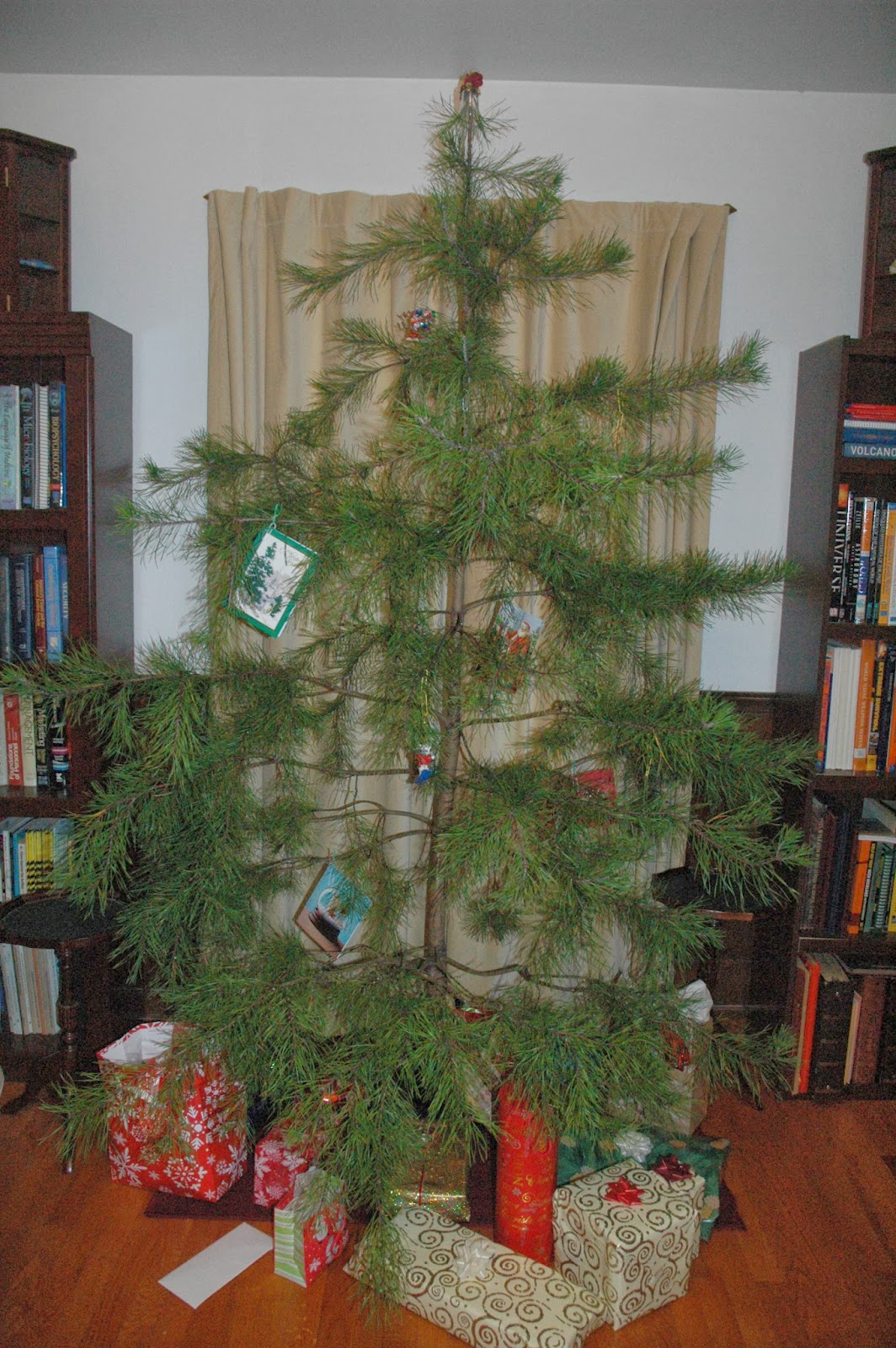
Last night we had our 2nd Annual Charlie Brown Christmas Party. The party was named after last year’s tree, which looked like this:
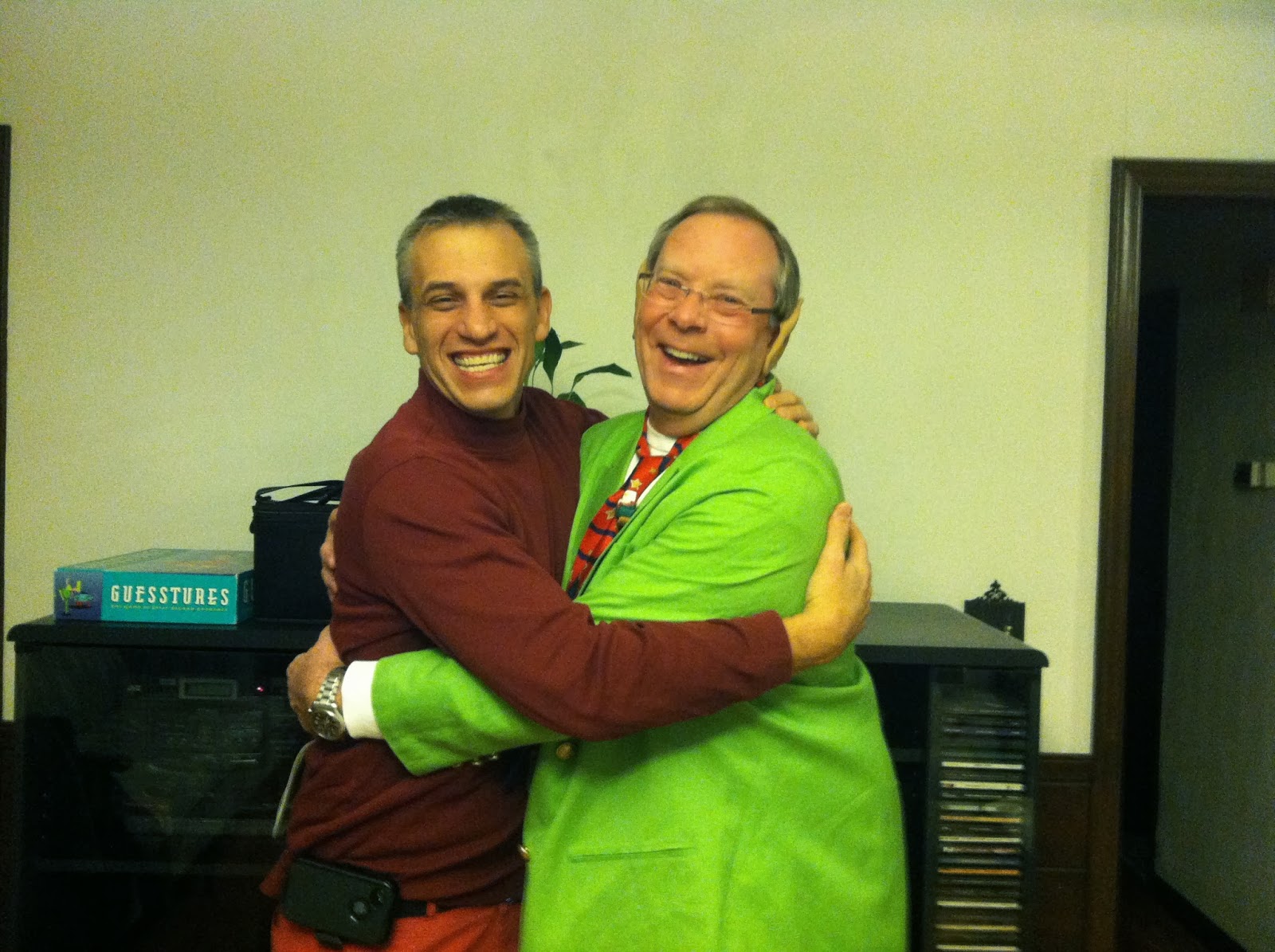
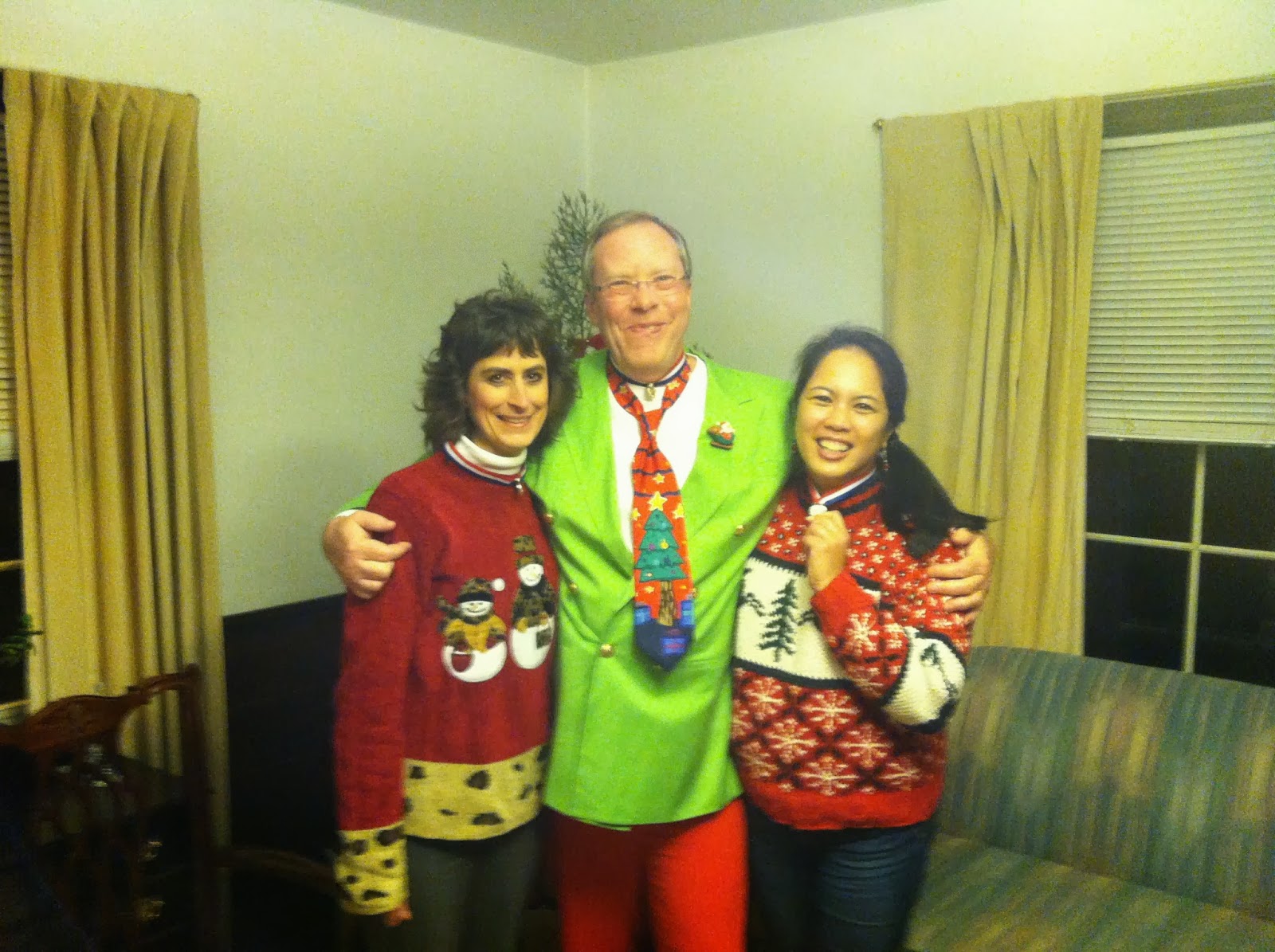
This year the tree was more normal looking but my friends were more comedic, as you can see in this picture:
We even had prizes for Christmas attire: Ugliest sweater, Most Festive, and Prettiest Sweater. Guess which person won each prize from the picture below:
I am so thankful to have such good friends.
In my first marriage my husband and I were everything to each other–just like in love songs and romantic movies–but we didn’t have many friends. Perhaps at some level we feared that if we told people what our relationship was really like, they would see how fragile our marriage was.
I believe that lessons are often learned from tragedy, pain, and hardship–particularly lessons you don’t want to learn. What I learned from that relationship is that no single person can be everything you need. And when you lose that person who has tried to be your everything, you are left with nothing.
So I vowed never to allow myself to be that socially isolated again, and I have done a pretty good job of honoring that commitment. In addition to playing and captaining all of those tennis teams, I also organize most of our social events and play the MC at the parties, making sure that our time is evenly spent between eating, singing karaoke, and playing board games.
However, I am still more inclined to play the role of therapist with my friends than friend in need. And I use all the same excuses that my clients use for not asking for help: I am a burden, a broken record, a person whose feelings may be too much for other people to handle. A person who is too needy, too demanding.
I’ve spent today the way I spend most Saturdays–tired and alone. I did text a few friends. And I talked to my brother. And I’m writing this blog post. So I’m trying to reach out. But it will always be more natural for me to help than to be helped.
Perhaps whenever I have doubts about whether my friends want to be there for me, I can look at the deranged elf pictured above and remind myself that only someone who cared deeply about me would pose for a picture that can be posted for all the world to see.
I always tell people that tennis is my one true love. It’s the only relationship where if there are problems it’s all my fault. How can tennis be wrong? When I first started playing tennis again about 12 years ago, I played 4-5 times a week–sometimes several times a day–and even more in the summer when I’m off. I captain and play every league. I play tournaments. I went to the US Open in August. My TV is almost always on Tennis Channel. I love Roger Federer. My dream job is to be a commentator with the psychological low down.
I love everything about playing. It’s the only exercise I can motivate myself to do and wake up in the morning for. I love the competitive aspect and I love trying to get better at it. I’ve met almost all of my close friends through tennis, and they have become like a second family.
But recently I’ve become a two-timer: blogging is my new boyfriend. And I am immersed in it with all of the obsessive frenzy that I apply to everything. Since I started blogging a few months ago, I spend every free moment thinking about it in some way. In the morning I check my stats to help me wake up. I love that it gives me a reason to write and that I’m achieving my goal of helping people feel better about themselves. I even like the challenge of the business aspect of it–learning more about social media, how to promote my blog.
And there are rewards that I didn’t anticipate. I didn’t expect that I would get so much benefit from writing about my problems and that I would receive so much support for doing so. I didn’t think I would get to have a relationship that is all about me. I didn’t expect that I would connect to other bloggers–that I would look forward to their posts, and they would look forward to mine.
I never expected that starting a blog would be such a great investment in myself.
The funny thing is that for the longest time, my demons would keep me from writing because they’d be sitting there telling me how much I sucked every time I tried. So I would just write in my journal because I didn’t care what it sounded like. But I still thought the content was so mundane, no one would be interested in reading it. Even though it was very interesting to me.
Recently I was looking at my journal entries from this past summer. I had written over and over about how much trouble I was having with sleep and how writing about it wasn’t helping me become a writer at all. And what do you know! My first post was about sleep. So journaling was helping me to become a writer. It was the gateway to blogging.
I have never considered myself an athlete, and my dad sucked the joy out of tennis when I was younger. So falling in love with tennis was a pleasant surprise. But I always knew I wanted to be a writer. It’s harder to pursue something that you care about because the consequences of failing are so much greater in your mind vs when you don’t really care if you end up being good at something or not.
It’s sort of like what it was like for me early in my career. I never expected to be a great tennis player, but I had always wanted to be a psychologist. What if I suck at it? What will I do then? I always wanted to be a writer, too. So what if I suck at writing? How will that book inside me manifest itself without the skill to put it out there?
But I have always said that I can’t fail if I never stop trying. I am thankful that my effort and determination has paid off in this relationship. It’s teaching me a lot about how to have a healthy relationship, in general.
Being alone isn’t as bad as I thought it would be. Relationships are an area where I take on challenges without asking myself whether it is worth the effort, so it’s a nice change of pace to have energy to expend on myself.
When I was in school, the reason why I was a good student is that I did what teachers told me to do. It never occurred to me that not doing the reading or homework and not studying were an option. I also try to fulfill my job responsibilities because I’m afraid that if I make one mistake I’ll get fired.
I think it’s partly due to my Catholic upbringing. I’m a rule-follower to begin with, but I also fear that if I break the rules I will go to hell. If I call a ball out, I’m afraid I’ll go to hell because I wanted the point so badly. So usually I just call everything in, which is sometimes to my advantage because my opponent wasn’t expecting to play a ball that was a foot out.
I used to have this prayer where I would ask God to forgive me for all my sins, intentional and unintentional, because I thought, what if I’ve sinned and I didn’t realize it? Then I couldn’t ask for forgiveness and I might go to hell. So I figured this prayer covered all the bases.
Most of my relationships weren’t of my choosing. If someone liked me, I would date him because I thought that would make him happy. And it was all about making the other person happy. Feeling ambivalent was not a good enough reason to say no because my feelings didn’t count. And it’s hard for me to end relationships because I’m not allowed to hurt anyone. Although I often ended up hurting them, anyway.
This is also the reason I became a psychologist and feel compelled to save the world. If someone is hurting, then it’s my job to help them if I’m able to do so. It doesn’t matter if I want to do so, whether I like the person or not, how stressed I am, or how much energy I have to expend.
My superhero family members also share this sentiment, as I mentioned in a previous post. They are even more extreme in terms of putting other people’s needs first, even if it hurts them. So I really haven’t had good role models for setting limits.
But thanks to this blog, I’m beginning to set limits. I’ve quit that crazy writing job where I was spending 10-12 hours on articles that gave the most superficial advice possible for $25 a pop. I ended a relationship and am learning to be alone. I have narrowed down my extra-curricular activities to tennis, knitting that dress for my niece, and writing/promoting my blog. Which is still a lot, but it’s an improvement for me.
My new rule is to say yes to what I want and no to what I don’t want. I said this 3 years ago, but sometimes it takes awhile to do what you know you need to do. So I’m trying not to beat myself up about that.