Tag Archives: body image

Inner Beauty

6655ECA4-615F-4250-ACA1-12AE5BE0F205There’s a lot of talk these days about redefining beauty to include people who don’t look like supermodels. And more of an emphasis on inner beauty, as indicated by the number of FB posts of people with some kind of physical defect.  (“Like” if you agree! Ignore if you’re a terrible person.)

I’m all for focusing on inner beauty, but this tactic is problematic because, by definition, inner beauty is not something that you can see in a picture. I guess we’re supposed to infer that the person is beautiful on the inside, but that doesn’t tell us what inner beauty actually “looks” like. So I’ve been thinking about people who exemplify inner beauty to me.

When I was in grad school I met this guy who had a cappuccino cart in the hotel lobby where I was on vacation. This was the era before Starbucks, so I had never heard of a cappuccino.  He was thrilled to tell me what it was, how it’s made, and what makes it so great. After that, I bought a cappuccino every day while I was there. And it tasted that much better because of how much he enjoyed making them. I thought it was a thing of beauty to see someone who loved their job that much.

I don’t remember what he looked like.

I had a similar experience once while I was picking up a package at the post office, which always annoys me. There was a long line, too. But the woman behind the counter seemed so happy to give everyone their packages that I couldn’t help but smile. I don’t think it was because she loved her job like Mr. Cappuccino; I think that’s just who she was. And there is something beautiful about someone who can be happy, regardless of what they’re doing.

I don’t remember what she looked like, either.

When I was depressed 5 years ago, I had 2 friends who called me every day to check on me. Ordinarily I can talk up a storm, but I didn’t have a whole lot to say when all I had done that day was lie on the couch and will myself to exist. I don’t remember what we talked about, but I remember that they were there for me.

When I was depressed back in December, I hardly saw anyone because tennis season was over, I was off for winter break, and everyone was busy preparing for the holidays. Once again, I had one friend who checked on me regularly, even though she didn’t really know me that well at the time. Occasionally I would venture out of the house and we would see a movie or have dinner.  If it weren’t for her, I could have easily gone weeks without any human interaction.

I am blessed to have such beautiful friends.

A picture may be worth a thousand words, but sometimes you have to be there to fully appreciate what it means to be in the presence of beauty.
The Me Generation

Everybody’s talking about the Me Generation–including me, because the students that I see in counseling are a product of this generation.  These are the kids who have grown up in an era where no one keeps score in sports.  Everybody is a winner, which is why everyone gets a trophy just for showing up. 

These kids have also been told that they are special and brilliant and deserve great things, whether they’ve earned them or not.  Some researchers argue that these messages are creating a narcissistic epidemic in which today’s youth are superficially connected, attention-seeking, vain, and materialistic. 

And there is some evidence for these claims.  After all, “selfie” was the 2013 word of the year.  People can have hundreds of followers without doing anything particularly interesting.  And the rising popularity of Twitter is evidence that every random thought that someone has throughout the day is newsworthy.

Perhaps it is because I am not a product of the Me Generation that I have been reluctant to participate in social media.  I didn’t want to get caught up in competing over who has the most friends because I knew I would lose.  And as much as I am interested in getting to know people, I don’t really care about when someone is going to the gym or what they had for dinner. 

I also don’t like to have unauthorized pictures of me floating around in cyberspace because I’m afraid I’ll look fat in them.  Plus I don’t know how to strike that pose that all the young people do that’s supposed to make you look more attractive.  Because I don’t like pictures of myself, I’ve only posted about 3 selfies, and they were all with someone else.  That’s more like a selfie+1.  Which is not as narcissistic, if you ask me.

However, my blog has forced me to participate in social media, and I have to admit, it’s not all bad.  Yes, it allows narcissists to have a bigger audience, but it also gives the introvert an opportunity to have a voice.  And sometimes it can accelerate positive social change.  Before, there might have been one person on the playground strong enough to stand up to a bully.  Now, there can be millions of them.

Personally, social media has allowed me to stay in touch with people who I would have never heard from before FB.  And I have connected with people through blogging who I would have never met otherwise.  Plus, if Pope Francis can take a selfie, it can’t be that narcissistic.

Critics of the Me Generation claim that all of the unconditional acceptance that psychologists recommend is to blame for this narcissistic epidemic.  I don’t think that’s accurate.  In a previous post I talked about the difference between self-esteem and self-worth.  Self-esteem is about accomplishments and self-worth is about inherent value.  Focusing on trophies, appearance, and success are ways to instill inflated self-esteem, but not self-worth. 

Instead of telling kids that they are all winners, we should be telling kids that they are still worthwhile, even when they lose.  Even when they become old and gray.  Even when their 15 minutes of fame are up. 

Until that happens, we haven’t truly taught the next generation what it means to believe in themselves.

Judgment

There are certain personality types that are sensitive to being judged, and I have one of them.  It takes very little criticism for me to feel ashamed that I have done something wrong.  Sometimes I interpret neutral comments as criticism.  And in some cases, I’ve even interpreted positive feedback as criticism.

Once my first husband was talking about a picture of Alicia Keys and commented on how she had big hips.  I replied with, Are you calling me fat?  Which really annoyed him.  I kind of thought it was funny but true.  Even if I get what is intended to be a compliment about having an athletic build, I take this to mean that I look fat.  This is why it’s better to refrain from comments about women’s bodies in general.

Although I have never had an eating disorder, I can relate to being obsessed about my body.  I also have a similar personality to the types of people who develop anorexia.  I am prone to anxiety and depression.  I am perfectionistic.  I am highly motivated to avoid harming others, even if it means hurting myself.  And I am so sensitive to criticism that I never forget a mistake.

This is why I am drawn to Buddhism–especially the practices of mindfulness and compassion.  I find comfort in the idea of letting go of what I “should” be thinking, feeling, and doing.  That I can accept whatever is true of myself at this point in time, without judgment or criticism–even if it’s something that I hope to change.

I often point out to clients when they are using judgment words to describe their feelings.  For example, if you say I feel pathetic, the word pathetic is not a feeling.  There is no emoticon for pathetic.  Sometimes it’s actually hard to come up with a feeling word.  Usually when you can’t think of one, you’re probably feeling ashamed.

Even when we’re successful in describing our feelings, we often get judged for them.  For example, if I say I feel depressed, someone might say You shouldn’t feel that way.  You should be happy because you have so much going for you.  This is meant to make me feel better about myself, and perhaps it works for some people, but it never works for me.

Sometimes I have tried to point out to the person that they are judging me, but people who judge others are often sensitive to being judged.  So they usually get defensive and say they were just trying to be helpful–that I’m being too sensitive.  So then I judge myself for being too sensitive.

But I am all about controlling what I can control.  Today, I realized that I can’t control whether someone else chooses to practice nonjudgmental acceptance of my feelings.  I can only control what I say to myself.

I can also choose not to share my feelings with people who judge me.  I think I’m going to start doing that, too.

Addiction

I’ve been thinking a lot about addictions lately.  Even before Phillip Seymour Hoffman’s death.  I have never been the addictive type.  My history is so clean I would have made a great political candidate, if I didn’t dislike politics so much.  But Richard Rohr, my spiritual guru, says that everyone is addicted to something.  So I’m trying to be honest with myself about what that might be.

At times my hobbies have been like addictions.  When I first started knitting, I would crank out so much stuff that I made all my Christmas gifts in a month and still had scarves to give away.  Same thing with making jewelry.  I sold a lot of what I made, but all my profits went towards buying more beads.   And I can sing Karaoke for hours.  I hosted a small Karaoke party over the summer and we sang for 6 hours straight.

But knitters tend to be fanatical bunch.  Jewelry makers can be, too.  And for a Filipino, my Karaoke usage is average, at best.  Plus these hobbies tend to go in phases.  I’m in a knitting phase now.  I would describe my interest in these activities as obsessive rather than addictive.

The next addiction candidates would be tennis and sugar.  These two things are a consistent presence in my day-to-day life, and I cannot imagine living without either of them indefinitely.  Giving them up would require some kind of intensive inpatient treatment program, and even then the probability of relapse would be high.

But playing tennis and consuming desserts has not significantly impaired my functioning, and I’ve been able to cut back.  I am only playing 3-4 times a week to prevent injury.  And I don’t eat 3-4 desserts a day any more.  So I would classify myself as a heavy user but not an addict.

As I was thinking about this post, one of my FB friends messaged me and asked me to write something about codependence.  And that’s when it hit me:  I am addicted to unhealthy relationships.  Ostensibly because I want to help people, but needing to be needed is a form of addiction, too.   In the post on solitude I talked about how ashamed I feel for tolerating so much crappiness to avoid being alone.

Based on my experience as a therapist, I know that many people have the same problem.  Often clients come in for a relationship addiction.  Their friends and family are sick of listening to them.  They know they should break it off, but they can’t.  They live in secrecy because they’re still in contact with the other person.  If someone came up with a detox program for unhealthy relationships, they could probably make a fortune.

I guess in a way I have completed my own self-imposed detox program.  And for the first time in 30 years, I did not use another relationship to ease the pain.  I rank this accomplishment right up there with defending my dissertation.  Maybe even higher.  Because after my dissertation I got depressed because there was nothing left for me to accomplish.  But as far as relationships are concerned, it’s all up from here.

Interestingly, I started this blog right before the breakup.  It wasn’t conscious, but I guess at some level I decided that the energy I was investing in my relationship would be better spent writing.  And blogging helped me tremendously during the breakup process.  I don’t think I could have made it this far without it.

So until someone comes up with a detox program for unhealthy relationships, I would highly recommend intensive blogging as a treatment strategy.

Listen Carefully

Last night I gave a presentation to some students about how to provide support to those who have been affected by the accident last November.  My advice is simple yet difficult to do:  listen carefully.

Most of the time we’re too focused on ourselves to listen to what others are saying.  We’re thinking about what we want to say, what we don’t want to say, whether the other person is listening to what we’re saying, what we’re going to do once this conversation ends.  You get the idea.

As I got better at listening, I noticed that people put out feelers about important aspects of themselves, just to test the waters–to see if anyone notices.

Once I was watching my ex play in a basketball tournament, and I had to sit with a bunch of wives I didn’t know who were also watching their spouses play.  I was having the usual conversation when I meet someone new.  What do you do for a living?  I’m a psychologist.  Oh, I bet you’re psychoanalyzing me right now!  Yup.  I’ve got you all figured out.

This was not the response she expected.  But she still asked more questions.  Do you specialize in anything?  Eating disorders, multicultural identity, positive psychology.  Interesting!  I had an eating disorder once.

Of course this got my attention.  It was my turn to ask questions.  At first I worried that she would be offended by my prying into her mental health history, but it was the exact opposite.   She had never told her story to anyone.  Back then no one talked about eating disorders.  Bulimia wasn’t even a diagnosis.  She wanted someone to hear what she went through.

This is always the response I get when I follow up on those feelers that people throw out there.

There’s nothing magical about being a good listener.  Anyone can do it.  The best way to get better at it is to pay closer attention to yourself.  We spend so much time trying to will ourselves to think, feel, and do what we think we should think, feel, and do that we don’t really know ourselves.  This is often what I do therapy:  teach people how to observe themselves without judgment.

It’s not easy to do.  It takes practice.  This blog is one of the ways that I practice listening to myself, and you can see how hard it is for me to do so in a nonjudgmental way.  But I am trying to treat myself the way I would treat anyone who I care about deeply, and I suggest that you do the same.

Because hopefully you are someone who you care about deeply.

As Seen on TV

In my post on midlife, I talked about how I formed my plan for coping with aging by watching TV commercials.  Sadly, I also used TV ads as a guide for how to be normal.
 
I have always been rule-abiding.  Hence, the good grades, the fear of going to hell, the obsessing about following guidelines for sleep and stress management.  And because I grew up in a small town in the middle of nowhere, I was sensitive to the fact that my Filipino family did things differently from other people.  To children, different means bad, and I didn’t want to be bad.
 
Remember those Aqua-Fresh commercials, with the stripes for extra cleaning action and breath freshening?  I made my mom buy that toothpaste.  And I tried to swirl it on my toothbrush exactly like they did in the commercials.  My mom scolded me for using too much toothpaste.
 
Now that I think about it, this was probably a ploy to get you to use more toothpaste so that you would run out sooner.
 
My first husband–the one who referred to himself as a poor, half-breed, bastard–was also sensitive to being different.  He, too, was influenced by the Aqua-Fresh commercials and also tried to create the swirl that used too much toothpaste.  This is sufficient evidence to convince me of the detrimental psychological effects that TV commercials can have on children.
 
You would think that knowledge of these detrimental effects would make me immune to their ploys.  But no.  I still owned the Ab Crunch.  I still use Oil of Olay.  I hear that Crest is coming out with a chocolate-flavored toothpaste.  At least I’m not falling for that one.
 
Often the makers of these products justify their ads by saying that they’re just giving consumers what they want.  No one wants to see fat, ugly, old people.  Those images don’t sell products!  Since I did research on body image, I can say with some authority that advertising may not have created our insecurities, but they definitely exacerbate them.
 
And there really isn’t a good solution to this problem.  Avoiding advertising is like avoiding oxygen; ads are ubiquitous.  The best I have been able to do is to limit how much advertising I expose myself to.  I no longer buy beauty magazines.  I primarily watch TV for sports and the news.  I don’t pay much attention to celebrities.
 
As a result, I didn’t know who Honey Boo Boo and Kim Kardashian were for the longest time, but media illiteracy is a small price to pay for self-acceptance.


Self-portrait

Unlike the men in my family who can draw and sculpt and make replicas of batman masks out of construction paper, I am not artistically-inclined. I can’t even draw a straight line. Or a round circle. I knit, but you just have to follow a pattern.  And I make jewelry, but for some reason I don’t think that counts, either. And I was an English major and love to write, but I don’t think I’m creative enough to write a novel, so I just write about myself.

This past weekend I went to an eating disorders conference because that’s what I specialize in. This year I decided to do all the touchy-feely workshops rather than the research ones. My favorite workshop was the one on art therapy. We had to do 6 different drawings of a bunch of doodles. Then we had to pick the 2 that we felt the most strongly about. Then we had to tear out the shape of our body for the #1 pick and glue it to the #2 pick. This was supposed to tell us something about ourselves.

I’m all about symbolic expression, but I was a little skeptical that this exercise could reveal anything meaningful about me. But then she showed us examples of self-portraits from eating disordered patients, and it was remarkable how much they revealed their struggles with their bodies, food, and emotions. Then she asked for volunteers to show their art work.

Ordinarily I would be too self-conscious to show my work, even if it is just a bunch of doodles. But I really wanted to get some feedback about my self-portrait. I thought that it might have something to do with being stressed out, since there was so much going on outside of me in the picture–almost like colorful asteroids knocking me over. And I had just gotten the rejection email minutes before the workshop, so I figured that must have played a role, but I wasn’t sure how.

After the workshop I asked her for some feedback, and then I spent some time looking at my self-portrait. I can’t explain how I came to this conclusion, but the drawing made me realize that I needed to stop doing the freelance writing job–which really fascinates me.

Maybe creativity is like athleticism: we think it’s some innate ability that we either have or we don’t, but maybe it’s possible to get better at it. She recommended that we take time out every day to play by doodling pictures, and I thought that was a great idea. I have been doing it every night before I go to bed. If there’s any chance that it can help me get my blog turned into a book by enhancing my creativity, then I’m all for it! I have no idea whether it’s working, but it does make me feel like a kid again.

I am so proud of my self-portrait that I’ve shown it to a few friends, and one of them said that it’s multicolored/multifaceted, like me. I really love that interpretation! I am open to other interpretations, too, if you have one.

Body Image

When I was 0-22 years old, I never worried about my weight.  I was naturally thin and my parents were always telling me that I ate like a bird.  But then something happened when I graduated from college:  my clothes no longer fit.

At first I thought, no big deal.  I’ll just start exercising, since I never did.  But I continued to gain weight.  So then I thought, I’ll just exercise every day and watch what I eat.  Still gained weight, but more slowly.  Finally, I resorted to obsessing about being fat 24-7, exercising every day, and watching what I ate.  Again, very slow weight gain plus a lot of suffering.  Maybe my metabolism started slowing down at 23.

Ironically, all of that time that I was gaining weight, I was still pretty thin.  Until I reached 40.  Now I look like I thought I did all of those years that I obsessed about being fat.  I know I’m not fat, but I’ve gained enough weight that my dad told me that I needed to eat less and he mailed me some appetite suppressants.  And I would still like to lose weight, although I’m not as motived as I was when I was younger. 

I specialize in eating disorders so I never do fad diets, starve myself, throw up, or anything else that would make me a poor role model.  Plus I love food.  So here are the middle-aged strategies I’ve tried for weight loss, based on effectiveness:

Not Effective:

  • Buy a gym membership and never use it.  I know a lot of people do this, but I obsess about money and I used to go to the gym every day, so I really thought it might work for me.
  • Obsess all day about exercising and when you get home fall asleep on the couch instead. 
  • Try to eat the recommended 1500 calories for weight loss and then binge at the end of the day because you’re starving.
  • Stare at your gut in the mirror every time you go to the bathroom.
  • Eat fast food for dinner because you hate grocery shopping and cooking.

Effective:

  • Play tennis as many times a week as your body will allow. 
  • Use a pedometer and obsess about getting steps.
  • Don’t look in the mirror.
  • Don’t look at any pictures or videos of yourself and only take head shots.
  • Look at pictures of other people your age who have gained weight so that you realize that this is just a part of getting older.
  • Cut 500 calories out of your 3,000 calorie diet.
  • Go on the GERD diet where you have to cut out all of the things you love to eat and avoid eating 3 hours before bedtime and before exercising. 

I am happy to say that I’m slowly losing weight at the rate of about .25 pounds every 2 months.  No one is going to use me as a poster child for weight loss, but as I say to my clients, something is better than nothing.

Boundaries

When I was in grad school, everyone talked about how important it was to have good boundaries.  At first I thought, boundaries?  What are those?  I guess that was a sign that I didn’t have good ones.

In my defense, Asian cultures have a different definition of boundaries than American culture.  For example, it’s perfectly acceptable for any Filipino adult to tell you that you’ve gained weight and look fat now, that you should have a baby, that maybe you look fat because you’re about to have a baby?  OK then you’re just fat.  This is one of the downsides of having all of those aunts and uncles that aren’t actually related to you.

These kinds of conversations are difficult for many people, and this is where therapists are supposed to be helpful.  In assertiveness training, you learn how to say things like, it hurts my feelings when you say things like that.  Or I’m not comfortable with this conversation. 

However, in Asian cultures, you are expected to be respectful of your elders, so they can say whatever they want to you, but you really don’t get to say whatever you want to them in response.  I have found this difficult to explain to my therapists.  Sure you can!  Just tell them.  No big deal.  Except it is a big deal. 

In fact, it’s because of this power differential that people engage in passive-aggressive behavior.  You’re not allowed to say, well you’ve gained 20 lbs. yourself!  I guess we’re both fat.  Instead you might do something like ask in your most sincere voice, how is your son doing?  The one who got a DUI?  Is he out of rehab yet?  Then they get to be the ones who feel bad about themselves.

Another option is to be completely passive and not go to any Filipino functions.  Or leave early.  Or hide in some room somewhere with your siblings who also don’t want to have to answer rude questions and only come out for food.  This is actually the route that I’m more likely to take.

This weekend I am going to a mandatory family gathering.  Since it’s so hard for all of my brothers and me to come home at the same time, my parents have decided that they are going to force us all to come home for my nephew’s birthday, and no amount of inconvenience is an acceptable excuse. 

I’m nervous about it because my dad keeps asking me if I’ve lost weight (I have not) and if I’m taking the appetite suppressants he gave me (I am).  I talked to my brother this weekend and my dad is telling him the same thing–that he’s fat and needs to eat less.  I think this sudden interest in our weight gain is because he has gained about 20 lbs., but like I said, I’m not allowed to point that out.

I am sure that there is some way to set boundaries even in Asian cultures, but I haven’t yet figured out how to do so.  So I’m just going to grab my food and hide out in the TV room and play with my niece.

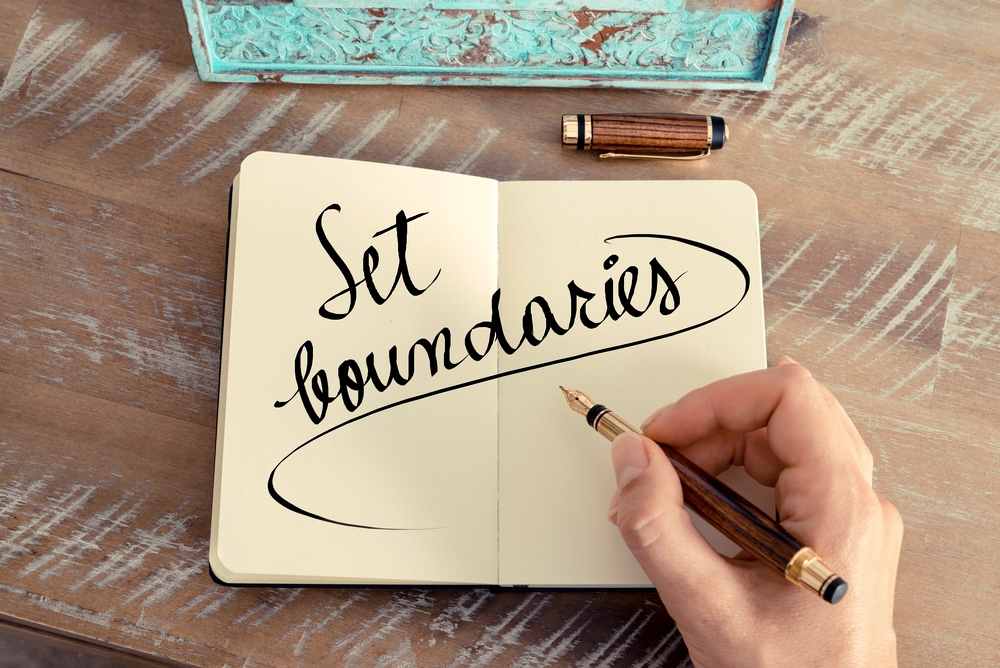
Retro effect and toned image of a woman hand writing a note with a fountain pen on a notebook. Handwritten text Set Boundaries as success and evolution concept image