Tag Archives: Depression

On the Road to Enlightenment, Part 2

25c0e1bebdd359ffd1966e7a37a1714b

So I finished reading “Lovingkindness,” and I’ve concluded that people who dedicate their lives to meditation must not have mental illnesses. This is not to say that I did not get anything out of the book. I loved the book, and I have recommended it to several clients. It’s just that I think you have to have a certain level of mental stability to become enlightened.

When I went to this conference on trauma, Ron Siegel, another mindfulness guru, practically said the same thing. He said that you need to be fairly mentally stable to go on a silent retreat because you realize how much your mood is affected much more by random thoughts than anything that is going on in the external world. When you’re depressed and anxious, those random thoughts can be fairly persecutory, so to be left alone with them without anyone to tell you that they’re not real could be a major mental health hazard.

I’ve been feeling depressed this past week. It shouldn’t come as a surprise, because this is what happens at the end of every term. I should be used to it by now. But how do you get used to the pain? To your brain telling you all of these things that aren’t true? Every time feels like the first time. Maybe that’s why it takes so long for me to admit it’s depression. I keep thinking it’s something else. Something real. Something that might go away if only this thing happens. Or this thing. Why are these things not helping? Oh. It’s because I’m depressed and nothing helps. Nothing stops the pain.

I played tennis today and even that didn’t help. However, it was an unusually frustrating experience because it was so windy. You think you can go out there and do your thing like you always do, but no. The wind has other ideas. The wind is like, you think you have a good serve? See if you can get the ball over the net if I’m in you’re face. You’re not strong enough. I bet you thought that ball was going to be 2 feet out, didn’t you? WRONG! You lose the point. So we ended up stopping early.

I told my friend I needed to write a blog post and she said I should write one about the wind. How it can be a metaphor for something. And the wind actually is a pretty good metaphor for depression. It makes you feel like you suck. Like you don’t know how to play tennis at all. All of your strengths are stripped away from you, and no matter how hard you try to overcome it, you cannot play your game. And during that 2 hours while I was playing in the wind, that’s exactly how I felt about being depressed. I was trying to be in moment, out in the sun, spending time with my friends. I was trying to enjoy myself, be thankful, focus on nothing but the ball. All things that come natural to me when I’m not depressed. But my demons, like the wind, just kept telling me how much I sucked.

There really is so little you can do to stop the pain in the moment when you’re feeling depressed, so I tried to practice self-compassion. To be kind to myself. I ate lunch. I read old journal entries, because I find them hilarious and prophetic. I wrote in my journal. Tried to watch tennis. And then finally I took half an Ativan and took a nap. And now I’m writing a blog post. And I do feel a little better.

I guess if practicing lovingkindness and self-compassion can at least help me battle my demons, that in itself makes it worth the effort.


I Understand Why they Call It Practice

It’s been a year since 1000 Voices Speak for Compassion was created. In honor of its one year anniversary, the topic of the month is to write about what participating in 1000 Voices has meant to us. I love “year in review” posts, and I love writing about compassion, so this topic is right up my alley.

In the past year, I have made a concerted effort to practice self-compassion, and while it continues to be challenging, it is the strategy that has been most effective in battling my demons. I’ve learned from studying compassion, listening to clients in therapy, and observing my own mind, that our instinctive response to coping with pain and suffering is to be unkind to ourselves. To minimize our suffering. To shame ourselves out of our pain. To chastise ourselves for being crazy, selfish, and petty. It’s ironic that, although we all want to be happy and feel good about ourselves, our default is to see ourselves as being flawed and unworthy.

This instinctive response to be self-critical is so strong that it often takes a while for me to come up with a self-compassionate response. Take today, for example. Another day where I’ve slept in and done nothing. Even though other people have probably done things like wake up early, gotten out of bed, tended to their spouses and children, and done some productive things.

I’ve gotten better at not berating myself, which reduces some of my suffering, but I still struggle with coming up with something loving to say to myself. But today I thought of one. Today, I thought that, for someone who struggles with depression, I’m actually a fairly productive person. And this made me feel strong instead of weak. In fact, I’m writing this blog post right now, since I’m feeling better about myself. Granted, I’m still doing it from my bed, but I can have compassion for myself for that, too.

Practicing self-compassion has changed the way I do therapy, because almost every client can identify that self-critical voice. Most of the time it says unkind things about us all day long, and we do nothing to stop it because it seems so natural and it feels true. So I teach clients how to practice mindfulness so that they can become aware of these thoughts without judgment or criticism. And then I teach them to have compassion for their feelings. This is pain; this is suffering. It does not make you crazy or weak; it makes you human. It is not your fault that you have come into the world this way, with this vulnerability; you did not choose it. And given that you are already in pain, let’s focus on whatever is in your control to make yourself feel better.

I understand why you practice self-compassion. There is no finish line. It’s not something that you master and then you can stop doing it. It’s like doing cardio for strengthening your heart, or lifting weights for your muscles. It is a lifetime activity.

The good thing about blogging is that it’s the psychological equivalent of looking in the mirror at the gym and seeing that your workouts are paying off. Hey! I am talking to myself differently! I am kinder to myself! It’s working! So thank you, 1000 Voices of Compassion, for providing me with this opportunity to strengthen my capacity to love.

For more posts on compassion, you can access the link-up here.

You can also find posts on Twitter @1000Speak.

I Must Be Feeling Better

pie.jpg

About 2 months ago I wrote a post about feeling depressed again. I knew I was at risk of it because it was winter, and we were at our busiest time of the semester at work, and I had spent an extended period of time with my family over Thanksgiving. But often when I am in the midst of something difficult, I try so hard to be positive that I do not fully process how miserable I am in the moment–like when I hurt my back.

But that day in December I could no longer deny it–I was officially depressed. Evidenced by the fact that I was not looking forward to our cookie exchange party. Because I really like sweets. If I had been my “normal” self, I would have been singing the Cookie Monster song. You know the one. C is for cookie, that’s good enough for me! Oh, cookie cookie cookie starts with C! 

In fact, not singing out loud in public is also a sign that I’m probably depressed.

Don’t get me wrong–I still went to the party and I still ate a bunch of cookies. And I brought home a bunch of cookies and ate those, too. But I was much less joyful about it than I ordinarily would be.

The good news is, I’m better now. Because last night my friends and I went out to dinner at O’Charley’s after our tennis match, and our waitress told us that it was free pie Wednesday.

Initially, we were in a state of disbelief. It’s what? We get a free pie? Are you serious? That is awesome! Is this a limited time offer? So you mean every Wednesday we can get free pie? How long have you worked here? You’re sure it’s not going to end? If we stay here all day do we get more than one piece?

And then throughout the night I would spontaneously yell out “free pie Wednesdays!” I told my brother when he called me last night. And this morning I texted my friends who were there to remind them about free pie Wednesdays. Although I’m pretty sure they remembered.

This is what my normal state is like. Celebration of sweets to an annoying degree. But come on! Free pie! That’s the best promotion I’ve ever heard of. Still, had it been a couple of months ago, I would have been much less exuberant. I mean, I still would have gotten it and eaten my pie, but I might not have kept yelling “free pie Wednesdays!” every few minutes.

And then a couple of weeks ago I ordered some new tennis shoes and did not realize that they glow in the dark until we turned out the lights at the indoor tennis facility where we play–the one that is closing at the end of the month–and they were glowing in the dark. I couldn’t believe it. I was like, these are the most awesome tennis shoes ever!

Since then, I’ve been thinking about starting glow tennis. All of the lines and the net and the balls would glow in the dark. Plus, in addition to shoes, we could have glow-in-the-dark clothing, hats, wrist and head bands, overgrips, and strings. This would be a great way to get kids interested in tennis. And it would save electricity. There may be a slightly increased risk of injury from running around in the dark, but we could get everyone to sign a waiver and tell them to play at their own risk. No one listens to those warnings, anyway. Like running at the pool. Or diving in the shallow end.

And I could make a bunch of money if it were successful. Heck, I wouldn’t even need to win the lottery anymore. And I would get to wear my new shoes. And then after playing glow tennis I can go to O’Charley’s and eat free pie.

The only problem is, this semester may be busier than last semester, so I may be headed for a mental breakdown again in a few weeks. Knowing this in advance does not always make it possible for me to prevent it because, despite all of the work that I put into maintaining my mental state, some things are not in my control.

But in this moment, I am happy, so I’m just going to enjoy it for as long as it lasts. And wear my new shoes. And eat free pie on Wednesdays.

shoes


Is Optimism Always a Good Thing?


You know how when you ask people how their holiday was and they say it was good? Well, I didn’t. I wasn’t trying to complain or anything. I just like to be honest.

My back was hurting for 3 weeks, which means I did very little over the break. The worst part was that I couldn’t play tennis. It may sound extreme to some people, but my mental health was severely compromised. I tried to practice gratitude, patience, self-compassion, and all that, but the truth is, without tennis, life hardly seems worth living.

That’s why I spent 2 and 1/2 weeks in denial about how bad my back was hurting. Which means I tried to play 3 times. The tennis sucked and I wasn’t able to move at all. I couldn’t even swing. The last 2 times actually made my back worse.

Why would I continue to try to play, knowing that I couldn’t move? Knowing that it might slow my recovery down? Because I was so determined to get better that I was completely out of touch with reality. I was almost delusional.

Sometimes I beat myself up over this. Many of my relationships have failed because of this same delusional optimism. I’ve relapsed into depression because I was unrealistic about how much I could take on. I’ve wasted countless hours trying to fix some mistake in my knitting rather than cutting my losses and ripping the thing out. (Unless you knit, you probably don’t appreciate how obsessive this is, but it is a serious waste of time.)

But at the same time, my optimism is what allows me to enjoy tennis, even when I lose badly. It’s why listening to people’s problems all day doesn’t get me down. It’s why I’ve been able to knit dresses.

Plus, even if it’s unrealistic, unbridled optimism can give us something to look forward to. Like, even if the chance of winning the jackpot is 1 in a billion, isn’t it fun to imagine what you would do with the money? To debate whether you would take the payout and calculate how much you’d have after taxes or whether you’d spread the payments out over 20 years?

I’ve actually been thinking about buying lottery tickets because the indoor facility where we play in the winter has closed, and without tennis I really do get depressed. So I fantasize about winning the lottery and building a facility, where I would build it, how many courts it would have, whether I would also have outdoor courts. Maybe I’ll even include a pro shop. Then I could buy cute tennis outfits wholesale and save some money. Not that I would need to save money since I would have won the lottery.

Do you see how much more enjoyable this obsession is rather than thinking about how I am going to be depressed and out of shape without tennis? Even if I don’t get to play, either way. And really, what’s a couple of dollars every week if it keeps hope alive?

Plus, someone has to win the lottery. So someone’s optimism paid off. Why can’t it be me?


Walking the Line

79ce5a94399967d103b667c199bf0398

They say there’s a fine line between creativity and insanity. I would actually draw the line between sanity and insanity, with creativity and insanity on the same side. Sane people would be on the other side of the line. The further you get from the line, the more extreme you become.

For example, people who are creative might be the depressed artists who use writing, painting, music, or whatever to express their pain. But the further you get from the line, the more likely you are to lose touch with reality. The more likely you are to think that things like suicide might be a good idea.

People who are on the sane side might not have experienced depression, but they can imagine what it might be like and have empathy for people who are depressed. The further you get from the line, the more likely you are to believe that depression isn’t real. It’s just an excuse that lazy people use to avoid taking responsibility for their lives.

I would say that most of the time I’m pretty good at walking the line, but sometimes I get pulled over to the insanity side. Usually because I’m feeling someone else’s pain. Because my emotions are pretty intense already. So once they are combined with someone else’s feelings, it becomes too much. Then my demons seize upon my vulnerable state and try to convince me that my pain will never end. Why go on living? Follow me into the woods. You’ll be free from your pain over here.

Writing requires being able to walk the line. I have lots of entries in my journal from the times when I first started to feel depressed but none during the times when I was in the depths of despair. Because at that point, all my energy was focused on survival. If I wrote at all when I was happy, I usually didn’t have much to say because I was too busy enjoying life to have time for introspection.

I’ve been trying to keep my balance over the past month, but sometimes I have to cross over to the insanity side to bring people back. It’s a risk to my mental health, but what can I do? It’s like going into a burning building to save someone you love. How can you stand there and watch it burn down without at least trying?

Maybe it takes more than one person to bring people back to the sane side. Maybe you have to form a human chain like you do in a tug of war, where someone is anchored at the line. That way the person who has to go deep into the woods won’t get lost. They have people who are holding on to them, pulling for them, making sure they’re able to get back. That way demons can’t win.

So maybe I need to start recruiting for a team, just like I do in tennis. Find a few sane people, some people who can walk the line, and a few who are adventurous enough to cross the line so I can save someone who is lost.

If only I could find some sane people.


Still Depressed

Image-1

People have been so kind to reach out to me after I published my last post, expressing their hope that I’m feeling better. I wish I could say I do feel better. That it was just a one day thing and I’m no longer feeling depressed. I feel like I’m disappointing everyone.

It’s not like I’m depressed every minute of every day. I made it through work and survived being on call. I played tennis. I went to dinner with friends. I seemed like a normal person when I was around other people.

I continue to be frustrated that all of my efforts to prevent depression have not worked. Maybe if I hadn’t stayed up to watch Federer and Nadal play on Saturday night it would have made a difference. Except I didn’t wake up until 1:30 in the afternoon, so I wasn’t that tired at 2 a.m. And it’s not every day that you get to see Federer and Nadal play, even if it was only a set.

Last night I had a realization that helped me to not beat myself up over all of the things I could have done differently. And that is, it’s not my fault. It’s not my fault that I am prone to depression. Not my fault that I am particularly vulnerable at this time of the year. That I am not able to handle the client overload as well as my colleagues. That my family stresses me out. That I’m not perfect in doing all of the things that are supposed to help with depression. This was the most helpful lesson in Tara Brach’s book Radical Self-Acceptance and Paul Gilbert’s The Compassionate Mind. I’m glad that I remembered it for some reason.

The other realization I had last night was something I learned in the self-compassion retreat that I attended last May. And that is, trying harder doesn’t eliminate pain and suffering. It is not for a lack of effort on my part that I feel the way I do. As much as I like to think that if I just work hard enough I can make everything better, life is filled with pain and suffering, no matter how hard you work. And while this did not make my pain go away, it helped me to accept it more and to beat up on myself less.

I have appealed to God for some salve for my wounds. Something to make the pain more tolerable. But I feel guilty for asking, given all of the things that are going on in the world. All of the people killed in Paris, San Bernardino, Sandy Hook, and other places. All the people who have terminal illnesses. All of the people who are hurting worse than me. Sometimes thinking about these people helps to put my suffering into perspective, but that is not the case at the moment. Right now I can barely tolerate my own suffering. So for now I’ll just have to focus on me.

But I am learning through my practice of self-compassion that it’s OK to focus on me. My pain counts, too. I can wish for my own well-being for as long as I need to.

Perhaps if God has any angels left over after he sends them out to all of those other people, he can send an extra one to me. Just for a little while, until I feel better. An angel in training, even, like Clarence in “It’s a Wonderful Life.” And if you believe in God and angels, please feel free to pray that God will send one my way.

Waking Up is the Hardest Part. But All of It Pretty Much Sucks.

IMG_0551.JPG

Despite my best efforts not to get depressed during this time of the year, I woke up with a full-fledged depressed mood. Not like, oh no! I think I might be getting depressed! Maybe I can sleep it off. More like, I don’t want to get out of bed. I don’t want to do anything. I don’t even think I want to go to our cookie exchange party.

If you knew me well, then you’d know that this is a clear sign that something is wrong. Not to want to go eat a bunch of cookies. That’s up there with not wanting to play tennis.

You never think that you have a good enough reason to be depressed. Yes, I am seeing a bazillion clients, but so are my colleagues. And yes, I spent 5 days entertaining my parents, which was about 4 days more than I usually spend. But normal people entertain their families all the time. And yes, I was sick last week, but so what? Lots of people get sick without getting depressed.

Plus, there was nothing I could do to prevent these things from happening. The client overload. The extended time with family. The sickness. These things happen every year during this time. Which makes it all seem so pointless, this trying not to get depressed stuff.

I tried really, really hard to control the things that are in my control. I have not reversed my sleep cycle. I religiously take my drugs. Get sunlight or sit in front of my light box. Meditate. Journal. Pray. Practice mindfulness. Spend time with friends. Knit. Read. Play tennis in moderation. I say no more often. Practice self-compassion. I am practically the poster child of good mental health. And yet, here I am, feeling depressed like I always do at this time of year.

Waking up feeling depressed is a lot like having a flashback of some traumatic experience. Oh no! Not this again! I am filled with terror. Because when you’re sick, you know it will suck but you have a pretty good sense of when it will end, and there are drugs that can alleviate some of your suffering. But with depression, you never know. It could be a few hours. It could be a few days. Or weeks. Or months. And I’m already taking the drugs that are supposed to help. But sometimes the depression slips through the cracks of my mood disordered brain, anyway.

I am trying my best to practice self-care. To alleviate whatever suffering is in my control. Trying to find some balance between being kind and gentle with myself but still making myself go to the doctor, get some work done, go to the party. Because I know it will help.

I feel better at the moment, but I’m still feeling a little panicked. Because tomorrow I don’t know how I will feel when I wake up. Maybe I’ll be fine. Or maybe it will be a Herculean effort to get out of bed and go to work.

I guess I’ll tell myself what I tell my clients. That it feels bad now, but at some point, I will feel differently. I might even feel better when I wake up tomorrow.

We’ll see what happens.

Moving Beyond Post-Apocalyptic Strategies for Motivation

Brene Brown

When I’m teaching clients how to practice self-compassion, I tell them that they cannot rely on using fear and shame to motivate themselves. And I should know, because I do it all the time.

If you read my blog, then you know I often say things like, other people have spouses and children and are still able to go to the grocery store and make dinner. So what the hell is your problem? This has the effect of making me feel like crap, but it doesn’t do much to make me get off the couch, even if I am hungry.

With my clients, I’ll use examples like, why do you keep watching episodes of The Walking Dead? Get in there and work on that paper! Do you want to fail? Because that’s exactly what is going to happen!

The problem with fear-based motivation is that, even when it works, which is usually a few hours before the paper is due, you still won’t feel good about yourself. Because your inner critic will say, well, if you had started the paper earlier, you would have done a much better job. 

So my brother is still anxious and depressed. His primary motivational strategy to get himself to go to work is the zombie apocalypse. How do you think you’re going to save your family when the world is ending when you can’t even log in? It worked for a while, but you can only motivate yourself with fear for so long.

What people don’t realize when they create a crisis to motivate themselves is that we don’t always fight. Sometimes we take flight or freeze. And once we’ve shut down, no amount of fear can make us act. So we get stuck in this vicious cycle of shame in which we avoid everyone and everything.

Fortunately, a recent episode of The Walking Dead echoed these same sentiments, which added to my credibility. Since I don’t watch it, I’ll quote his epiphany:

Even Rick Grimes has had to take a break from berserk mode on the show. He became a man of peace for an entire season when he realized how misguided his young son had become; someone who was too quick to resort to violence & unwilling to give diplomacy a chance. It served a lesson relatable to life—if even our heroes during the zombie apocalypse cannot remain in crisis mode, then it certainly can’t be a winning formula for us during normal times. My problem is I’ve motivated myself through such extreme emotions—anger, resentment, fear—for so long, that I’m left with no clue as to how I can jump-start my resolve right now.

So what do we do if we’re not going to motivate ourselves with fear? We motivate ourselves with love. So obvious when we think about how we motivate the people we care about, but it rarely occurs to us to do so with ourselves.

Unless you’re some enlightened being like the Dalai Lama or Pope Francis. I’m sure they motivate themselves with love.

This morning was the first day that I did not want to get out of bed. It’s that time of year when it happens, shortly after daylight savings time ends. So I tried to practice what I preach and thought about how I could make it easier to get up and get ready. I played my favorite song. Turned up the heat. Talked to myself in a loving way. And today it worked.

Maybe it won’t always work. It’s a long time until spring, after all. But even when being loving doesn’t get me out of bed, it still uses up a lot less energy than berating myself.

5 Things Not to Say to a Depressed Person

Depression is not a choice

Despite the attempts to raise awareness of mental health issues and reduce stigma, people still say hurtful things to people who are depressed. Not because they are mean or uncaring. I think it’s actually because we are not taught more compassionate ways to respond to pain, so we say whatever we think will get the person to stop hurting. Because it hurts to be in the presence of someone who is hurting.

Here are some of the worst offenders:

  1. I don’t believe in depression. I’m not even sure what this means. It’s one thing to say that you don’t believe in ghosts, or God, or the theory of evolution. But how can you say you don’t believe in an illness? No one says I don’t believe in heart disease. That’s not chest pain. Just go take some Rolaids and stop your whining.
  2. Suck it up. Because we value stoicism, we think anyone who copes with their pain by pushing through is strong, and anyone who acknowledges their depression is weak. Maybe even wallowing in their pain. So just get out of bed and go to work. No one wants to hear about how you’re feeling.
  3. Think of all the less fortunate. There are people who don’t have the basic necessities like food, water, and shelter. People who live in war-torn countries. And here you are being all negative just because you don’t feel good. You have nothing to complain about.
  4. Be thankful. This one is similar to #3. In this case, rather than comparing yourself to others, you are encouraged to count your blessings so that you can see that you actually have no reason to be depressed. You just have a bad attitude.
  5. You just want to be depressed. I actually had a boyfriend tell me this when I was in college. Because it was so much fun being in my room, unable to go to class or get dressed or answer the phone and to think about suicide all the time. I was having a ball. I hope I broke up with him after he said that.

Hearing these statements from the people we turn to for support can be even more hurtful than the symptoms of depression themselves. Because we already think that we’re lazy, weak, and pathetic. We already beat ourselves up for having no good reason to be depressed. We already feel like failures.

But if you’ve said some of these things, don’t be too hard on yourself. This is how we’ve been taught to respond to pain, so it’s not your fault. It doesn’t make you a bad person.

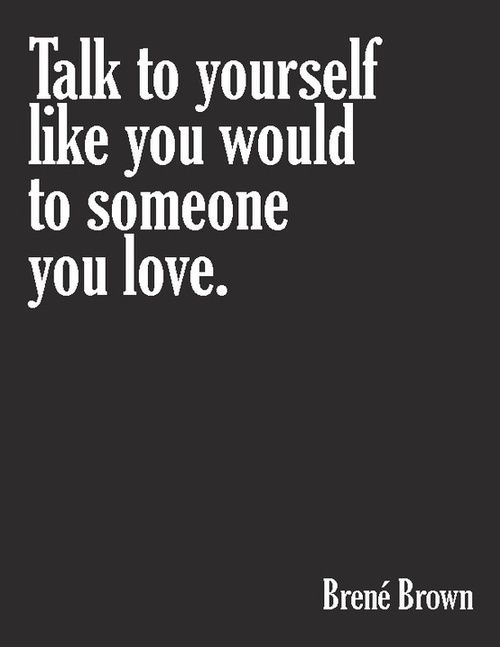
One of the things I do in therapy is to teach clients how to practice self-compassion, which in turns teaches them to have compassion for other people’s pain. It’s a surprisingly unnatural thing to do, trying to come up with loving statements to say to ourselves. Which is weird, because you’d think this is what we’d want to hear.

Here are some suggestions:

  1. The only proof I need that I am in pain is that I’m hurting. You don’t have to earn the right do be depressed by having a traumatic childhood or some recent loss. The pain itself is all the evidence you need that you are depressed.
  2. I will be with my own pain for as long as it lasts. Because this is what we do for people who we care about. We sit with them while they are hurting.
  3. My pain counts, too. In the self-compassion retreat I attended, I learned that I can focus on giving myself compassion for as long as I need to before sending it to someone else. I can focus on my pain first.
  4. I can be thankful but still be in pain. Practicing gratitude is helpful, but it is not some magical solution that will make our pain go away. Thankful people with good lives still get depressed.
  5. What can I do to alleviate some of your suffering? Would it help to eat some breakfast? Turn on some music? Call a friend? These are much better alternatives than screaming at yourself for not being able to get out of bed.

Compassion takes practice, just like anything else. So be gentle with yourself as you try to come up with compassionate statements for yourself and for others.

Cultivating Hope

2be20cd4757eb5d27cd52ec2631d22e0

Despite my struggles with anxiety and depression, I actually feel like I have been blessed with a good life. In fact, this is true for many people with anxiety and depression. Yet instead of feeling like a blessing, our demons use our good fortune against us. We don’t deserve to be depressed and anxious. We haven’t earned it.

I am often accused of trying to save the world, and I have to admit, I don’t see why that is such a terrible thing. Other than the fact that it’s impossible to achieve. But moving up to 4.0 in my tennis rating may also be impossible to achieve, and I still try to do that. And I will live if it never happens.

Sometimes I think I try to help other people because of something akin to survivor guilt. God has always answered my prayers. I know that many people don’t feel that way, and I am not going to dismiss their bad fortune by saying they deserve it or that they’re not trying hard enough or whatever. I don’t really know how to make sense of all the unfairness in the world.

But I feel like the least I can do is to make good use of my good fortune. I can use my time on earth to alleviate other people’s suffering. Help them to believe they can make it to the other side of pain.

I’m not going to pretend that this is purely motived by altruism. At some level I’m saying, look God! I’m doing all these good things! Please let me continue to be blessed with good fortune. And a part of me feels like I have to pay God back for all that I have been given. Theoretically, I get the idea of grace; I’m just not sure I deserve it.

I think that’s why I have been drawn to practicing compassion. Surely a practice whose very name includes pain and suffering must teach you how to get rid of it. Which is why when I did the self-compassion retreat, I was disappointed to learn that practicing self-compassion does not actually get rid of pain. Damn!

I kind of already knew that. I tell clients this all the time. That our goal is to learn how to sit with our pain, be kind to it, wait patiently for it to pass. But obviously, at some level, I was still secretly hoping I could get rid of it.

I have gone through enough episodes of despair to know that, despite the fact that it may feel as though my pain will never end, it eventually does. That didn’t do much to make the pain go away in the moment. And sometimes the wait seemed endless. But I guess I must have always had hope. And practicing self-compassion seems to help me to cultivate hope, which has made pain and suffering a little easier to bear.

Maybe that’s why there was hope at the bottom of Pandora’s box. (Which was actually a jar.) Even if all of the evils of the world are unleashed upon us, having hope may be enough to survive them.