Tag Archives: mental illness

Self-Worth

For the first 35 years of my life, my self-esteem was primarily based on grades. I made good grades, so you would think that meant I had high self-esteem, but I didn’t. This is true of any external measure of worth: the positive feeling you get from an accomplishment is short-lived. You get a hit of dopamine and feel some pleasure, but the dopamine also makes you want more, so you need another good grade to keep feeling good. But I didn’t know that at the time. 

I remember when I was in my first year of grad school, another student had just defended his dissertation. He rented a limo and decorated it as though he had just gotten married and was driving around town, honking his horn. I thought that was a great idea and that I would do the same thing to celebrate once I got my Ph.D.

But that wasn’t what it was like at all. I thought that I would feel smarter or whole or something. Instead I felt…exactly the same. Maybe even worse. Because by this point, I realized that there was no goal I could accomplish that was going to make me feel better about myself. I had reached all my goals; there was nowhere else to go. So I got depressed instead.

These days I don’t talk about self-esteem at all in therapy. Instead I try to convince clients that they are inherently worthwhile, regardless of their accomplishments. This is a tough sell in our culture. Initially they say they don’t believe in inherent worth.  They see themselves as a stock whose value rises and falls depending on their performance.

But like I said in my last post, for an agreeable person, I’m pretty good at arguing. And this is one of those arguments where I know I’m right. So I use whatever it takes to convince them of their worth.

I tell them that we feed and care for our pets all the time–not just when they’re good. We put up bird feeders because we like looking at them. They haven’t done anything to earn them. People chain themselves to trees, try to save the earth, polar bears, whales, and bald eagles because they believe that being alive is sacred, and we need to protect life. Our life can’t be worth less than any of these things.

Many of them do start to believe it, not so much because of my compelling arguments, but because I believe in them. Deep down we all know that we are inherently worthwhile; we just need someone to tell us that we can trust that part of ourselves.

So if you didn’t have anyone to tell you to trust that part of yourself before, you do now. Because I believe in you.

In Need

I don’t like the word needy. I much prefer the word crazy to needy. Crazy can have many meanings, and not all of them are negative. Sometimes crazy can be a compliment. At least that’s how I interpret it when I’m feeling good about myself. Neediness, on the other hand, is never a compliment.

I admit I am sensitive to the word because I have been accused of being too needy, too demanding. I have tried to correct for this, but I don’t know how to distinguish my unreasonable demands from my needs.

I’ve tried to deal with it by giving my partner the benefit of the doubt. If he couldn’t give me what I needed, then perhaps it was a demand that I mistook for a need. How important is meaningful conversation anyway, really? How much contact is actually necessary for the survival of the relationship?

This approach hasn’t gotten me very far. I seem to have overshot my mark. My therapist tells me that I cannot disavow my needs in order to make my relationships work. Sounds good to me. But how do you separate the needs that are necessary for survival from the ones that make people accuse you of being needy?

Let’s say that you came across a boy who you met in the woods while hiking one day, like the wild boy of Aveyron. You feel bad for him so you invite him over for dinner. But he’s really hungry, so he eats all the food in your house and still wants more. Obviously, you wouldn’t blame the kid for this. You wouldn’t accuse him of being too hungry, because it’s not his fault he was abandoned in the woods to fend for himself.

Psychological needs are no different. Neediness is the product of prolonged emotional starvation. You may not be able to give the person what they need to feel satisfied, but that’s not their fault. It’s not yours, either.

But it feels like it should be someone’s fault, doesn’t it? Someone should take the blame!

I prefer to reframe a needy person as someone who is in need. Perhaps their needs are so great that I can’t help them. That’s OK; I don’t have to be able to help everyone–although I do still try.

I am trying to think of myself as someone in need, too. I am just learning what these needs are, because I’ve spent my life focusing on other people. There are a lot of them, and they have gone unfulfilled for a long time. I’m not blaming anyone for this, but I’m trying not to blame myself, either.

I’m just trying to make my way out of the woods.

46 Lessons Learned from Blogging

Since the original intent of my blog was to help people, I thought I’d provide a cheat sheet of the lesson in each post (except for the random ones).  That way, you don’t have to go back and read the whole blog if you don’t want to. But hopefully you still will!

1.  Night Owl Syndrome:  Prejudice against night owls is a form of discrimination that has been perpetuated in part by Ben Franklin.

2.  Massages:  Massages are not as relaxing when you obsess the entire time about how much they cost.

3.  Knitting and Relationships:  Challenge yourself every now and then, but you don’t have to knit a dress.

4.  Positive and Negative Feedback:  It’s easier to believe erroneous negative feedback than it is to accept legitimate positive feedback.

5.  Karaoke Pusher:  Singing in front of other people is a good way to let go of fear.

6.  You Know You’re Filipino If…:  Things that embarrassed you as a kid will make great anecdotes when you get older.

7.  The Courage to be Vulnerable:  Sharing your vulnerabilities with others makes people feel closer to you.

8.  The Unathletic Athlete:  Even if you were picked last in gym class, you can still grow up to be an athlete.

9.  Tennis Courtships:  Someone needs to come up with a website that can help tennis players find a doubles partner.

10.  The Uses of Prayer:  Sometimes God answers your prayers by giving you opportunities rather than results.

11.  Boundaries:  Being Asian makes setting boundaries even more difficult than it already is.

12.  Massages, Part 2:  Don’t drink coffee before a massage–even decaf.

13.  Boundaries, Part 2:  Blogging is a good way to let people know that you don’t want to be told that you’re fat.

14.  Children:  Play with your inner child every now and then.

15.  Can Love Conquer All?  No, but it’s still worth the risk.

16.  Body Image:  Small gains are better than nothing.

17.  Hard Core Fan:  It takes dedication to root for a losing team.

18.  Warriorism:  When things get tough, channel your inner warrior.

19.  Self-Portrait:  You can learn a lot about yourself from doodles.

20.  Solitude:  Sometimes when you think you’re alone, you’re really not.

21.  Self-Acceptance:  We all have different parts of ourselves, many of whom don’t get along.

22.  Meet the Drill Sergeant:  Save your inner drill sergeant for emergencies.

23.  The Inner Critic:  Defy your inner critic every chance you get.

24.  Thanksgiving:  Miracles really do happen.

25.  Perfectionism:  Blogging about mistakes can help you accept them.

26.  Stress Management:  Sometimes stress management can be stressful.

27. Self-Care:  Blogging is a good way to put yourself first.

28. Grief:  The best thing we can do for someone who is grieving is to be willing to listen to them talk about their pain.

29.  Yes and No:  Learn to say yes to what you want and no to what you don’t want.

30.  Blogging is My New Boyfriend:  You can’t fail if you never stop trying.

31.  Friendship:  Don’t be afraid to ask for help when you need it.

32.  Empathy:  If you’re high in empathy, choose your friends and partners wisely.

33.  Breakups:  If your relationship is ending, try to leave with love rather than hate.

34.  In Times of War:  Make choices you can live with, regardless of the outcome.

35.  Angels:  If you ask people to send you angels when you’re struggling, they will–and it works.

36.  Forgiveness:  For people with a harsh inner critic like me, self-forgiveness is the hardest part.

37.  Gratitude:  Practicing gratitude may not turn your depression into happiness, but do it, anyway.

38.  Love:  Our love may never be perfect, but I think God is OK with that.

39.  Forgetting:  Forgiveness is a process.

40.  Moms:  Moms are often unsung heroes, so thank them every chance you get.

41.  New Year’s Resolutions:  Restating your resolutions every year is not a sign of failure; it demonstrates that you are choosing to live intentionally.

42.  In My Head:  I thought I was weird for thinking so much, but it turns out that it means I’m a writer!

43.  Bipolar and Brilliant:  You can be brilliant and mentally ill, but you can also be dumb and refuse to take your medication.

44.  Night Owl Syndrome, Part 2:  It takes practice to let go of unnecessary guilt.

45.  Competitive Latch-Hooking:  Sometimes the sibling that was your mortal enemy in childhood becomes your most loyal blog follower as an adult.

46.  Honesty and Trust:  Surround yourself with honest people; it takes less energy than being paranoid.


Night Owl Syndrome, Part 2

I started this blog with a post about the stress of trying to regulate my sleep cycle.  Particularly since it was the beginning of the year and I had been off for 3 months–plenty of time to revert to my more natural night owl state.
 
I am in the same predicament this week, except that my sleep cycle is even more out of whack than usual.  In addition to the normal job stress and abrupt transition into having nothing to do at the end of the term, I was also dealing with the fallout from the student death and extended periods of loneliness and isolation.  I fell into a pattern of going to bed at 4 am and waking up at 4 pm, with a few hours of wakefulness in between.  And as usual, I was racked with guilt and self-loathing about this.
 
My dad and two of my brothers are also night owls.  While my family was together over Christmas, my dad hardly slept at all, and when he did it was well past 2 am.  One of my brothers went to bed around 6 am.  The other brother woke up around 6 pm.  Yet they did not appear to be racked with the same guilt and self-loathing as me.
 
Which is the reason why I originally started this blog.  Accepting who I am, including my obsessive tendencies, problems with guilt, and wacky sleep schedule, takes continuous practice.  If I neglect to do it, I fall prey to depression and anxiety.
 
And writing about how I was feeling during that period definitely helped.  It was cathartic.  It helped me to remember what I tell my clients. It provided me support, positive feedback, and extra angels.  And some of the most depressing posts were among the most popular ones, so I know I’m not alone.
 
Perhaps I should start recommending blogging as an important component of self-care.  Right up there with sleep, exercise, food, and mindfulness.
 
Last night I went to bed before 1 am without having to rely on extra Ativan.  And I woke up at 7 am because I had a doctor’s appointment.  That’s as close to a “normal” sleep cycle as it gets for me.  So going back to work has been a good thing.  Still,  if I didn’t have to go back this week, I wouldn’t have.
 
Fortunately, sometimes you are forced to do things that are good for you, whether you want to or not.


Bipolar and Brilliant

I just finished Haldol and Hyacinths, by Melody Moezzi, and it is one of the best memoirs on bipolar disorder that I have ever read. A lawyer and human rights activist, Moezzi talks about how her passion and aspirations come from the same place that her mania and psychosis come from, and sometimes it is difficult to separate the two.  

In An Unquiet Mind, the gold standard of bipolar memoirs, psychologist Kay Redfield Jamison says the same thing: that she was the most productive and most brilliant on the way to mania–until she became psychotic.

From personal experience I would argue that it’s true that for some people, it’s a thin line between brilliance and mania. I have never reached the heights of brilliance and mania that Moezzi and Jamison describe, but I know what it’s like to walk that line between productivity and emotional instability. Most of the time I stay on the side where I know the rules and try to follow them as obsessively as possible.

But there have been periods where I have had one foot in this world and one foot in the other. A world where the lines between black and white, good and bad, and reality and fantasy are blurred. I have had some of my best insights at those times, but I was also the most reckless during those periods. It is both freeing and dangerous. At those times, I pay close attention to where I’m standing and do my best to maintain my balance.

My impulsivity primarily expresses itself as impulsive shopping of inexpensive but unnecessary things, poor decision making in dating, and excessive exclamation point usage when writing in my journal. Nothing that would put me in the hospital, but a notable change from my usual behavior, which is usually over controlled. Ordinarily, I would never use multiple exclamation points in one journal entry.

Four of the six people in my family are bipolar. The kind of people who light up a room when they walk in. People are drawn to them when they are manic. At least in the beginning, But at some point, the light becomes blinding, and they can no longer see how they are hurting themselves and other people with their actions.

Sometimes people with bipolar disorder don’t want to take their meds because they don’t want to dull their creative side, kill their buzz. And it’s true that when you’ve reached the peak of mania the drugs you take are meant to put out the fire, so they dampen everything for awhile. And who wants to feel dampened when you were on a natural high?

But there’s a lot you can do to keep from crossing that line. There are a lot of things that are in your control. You can be honest about your diagnosis. You can be compliant with treatment. You can pay attention to the warning signs and intervene right away. You can practice self-care.

It often takes a person with bipolar disorder many years before they can reach this place of self-acceptance, as these authors demonstrate. But they also demonstrate that you can still be brilliant when you’re stable. Which is the best of both worlds, really.

Gratitude

Over the past few weeks I have been praying for a way to take in what I love about Christmas. Singing Christmas songs. The lights and decorations. The food. Having my entire family together. And reflecting on the significance of having our Savior born in the most humble beginnings.

I looked at the news headlines about the homily Pope Francis gave last night, and true to my prediction, it was a message of acceptance and forgiveness. The quote that stood out to me was the reminder that Jesus was all-powerful but he made himself vulnerable for us. There is great strength in vulnerability; it is His vulnerability that redeems us.

In this blog I have made myself vulnerable by sharing all of the thoughts and feelings that I usually keep to myself. After writing my post on forgiveness and reading people’s responses, that was the most vulnerable I have felt thus far.

People who have never been depressed do not realize what a dark place it is to be in. For example, “normal” people can make themselves happier by practicing gratitude, by reflecting on people who are less fortunate than themselves, by counting their blessings. The assumption is that sadness and gratitude are mutually exclusive.

When you are depressed, your demons turn this well-meaning advice into further evidence that you are a bad person for being depressed because you are not able to snap out of it, despite all the things you have to be thankful for. So it is especially difficult to practice gratitude when you are depressed because it often makes you feel worse.

However, my spiritual guru is the Franciscan Priest Richard Rohr, and one of the most helpful things that he emphasizes is that spirituality is not either/or, as we tend to think in Western religions. It is not good or bad, right or wrong. Spirituality is both/and.  So I can practice gratitude and still be depressed. They can both be true, and that’s OK.

Today I am already thankful for many things. I am thankful that the party wasn’t as overwhelming as I feared it would be.  That the homily last night had a message that was meaningful to me. That I’ve had meaningful conversations with two of my brothers, and in a few hours my other brother and his family will be here. I am thankful for the friends who have already sent me texts to wish me Merry Christmas.

And I am thankful for this blog. I think God gave me this blog because He knew that these next few months would be difficult. So He gave me a way to share my pain, to reach out to others, and to ask for help. It really is true that making ourselves vulnerable may be the most powerful thing we can do to experience love and connect with other people. I think that this is what Jesus would want us to experience most of all on His birthday.

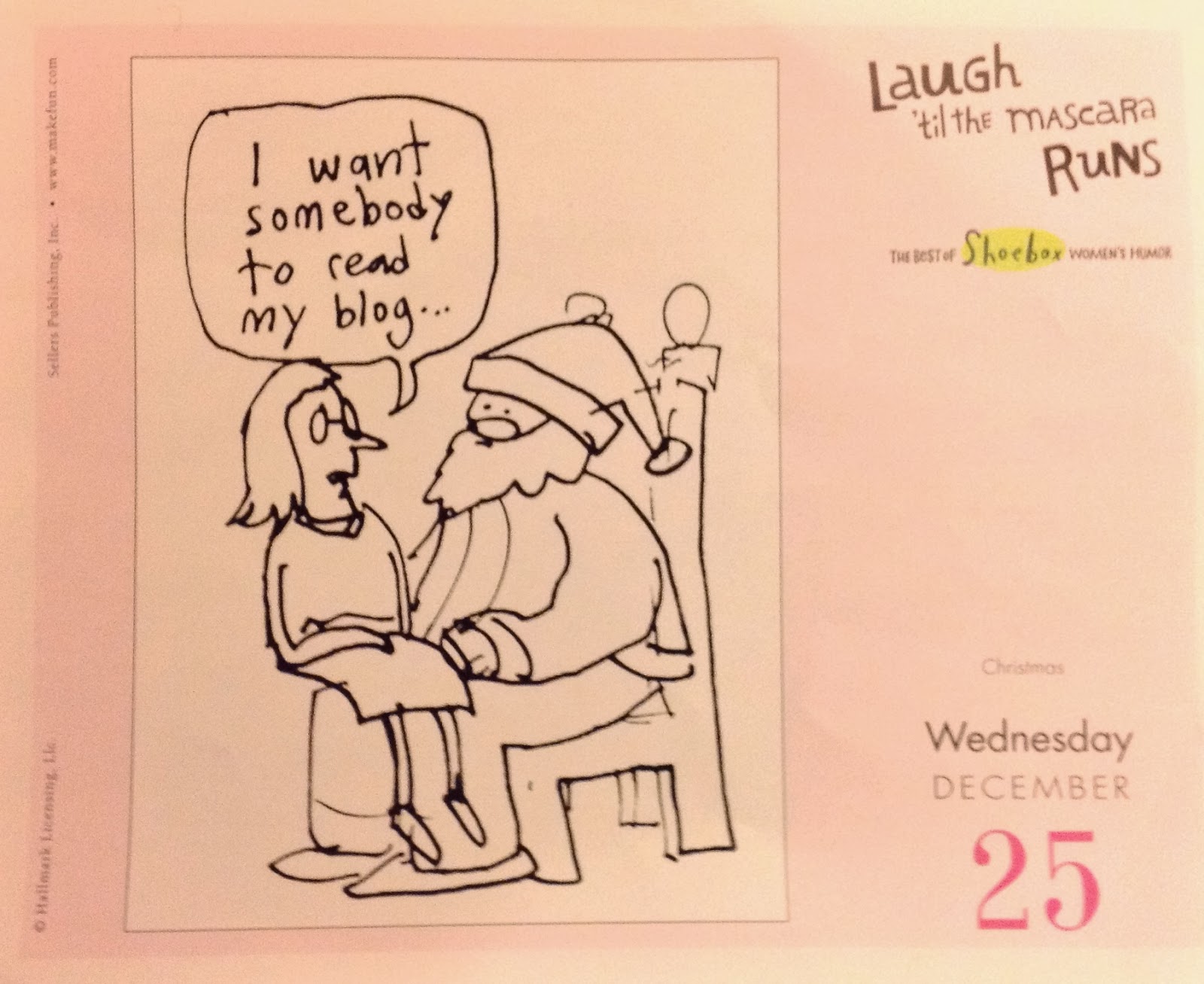
So I am thankful to all of you who have taken the time to read my blog on Christmas Day. And I thank my friend Sharon for giving me the cartoon below.


Q & A

Since no one asked me any questions in my recent blog survey, I thought I would just make up some questions and answer them, because I like to pretend I’m being interviewed. Who knows?  Maybe I will be interviewed one day.

Q:  Do you ever worry that your clients are going to read your blog and decide that you’re too crazy to be their therapist?

A:  Yes. All the time. In fact, I recently found out that a parent of one of my clients read my blog on perfectionism, and for a moment it made me reconsider this whole blogging thing. But she didn’t tell her daughter to transfer, so that was encouraging.  I’ve had clients transfer to other therapists before, so if they decided to transfer after reading my blog, I guess I can live with that. You can’t be all things to all people. Although I do still try to be.

Q:  Are the posts where you write about different parts of yourself based on any particular theory?

A:  The idea of conceptualizing our problems into separate parts of ourselves actually comes from two of my favorite theories: narrative therapy and internal family systems therapy.  In narrative therapy, a mental disorder is conceptualized as an entity separate from the client. This helps the client and family stay focused on treating the problem rather than blaming the client for not getting better. “Life without Ed,” by Jenni Schaefer, is one of the most well-known books that illustrates how this therapy works with eating disorders.

Internal Family Systems therapy is the other form of treatment that focuses on parts of the client. The main premise is that these parts have become extreme in their efforts to help the person. So for example, the inner critic tries to motivate you to do your best, but in an eating disorder this may mean starving yourself to be thin enough. So in working with this part, you acknowledge that it has good intentions and try to come up with other ways that it can be helpful. Ordinarily, we just feel overwhelmed by self-loathing, so this is a much better alternative.

I think the idea of parts can be useful for anyone as a way to have self-compassion and self-acceptance of the aspects of ourselves that we don’t like. Usually these parts have a sort of archetypal feel to them, which is why people have the experience of thinking exactly like I do. The reality is, this is how everyone thinks. It’s just that no one wants to admit it because they’re afraid that it means they’re crazy.

Q:  Have you ever suffered from a mental illness?

A:  Yes. I struggle with anxiety all the time. In fact, I have been so consistently anxious all my life that I didn’t realize that it was severe enough to be a disorder until after I got my Ph.D. That’s true for most people, though. We’ve learned to live with anxiety like an annoying partner.

I am also prone to depression and had a fairly severe episode at the same time my dad did about 4 years ago.  The other severe bout of depression that I had was when I was 18, and that was the last time my dad was depressed, too. I’ve had a lot of less intense episodes of depression, as well. I probably had dysthymia (a more chronic, lower grade depression) from the age of 13 until I started meds for the first time, which was when I was about 30.

I have to do a lot to make sure that I don’t trigger anxiety and depressive episodes, which is why I obsess so much about sleep, eating, exercise, meds, relaxation, etc. Sometimes it doesn’t matter what I do, because sometimes life is just stressful and overwhelming. But it is scary when I start feeling like I’m going back to that dark place. Particularly with depression. When I’m feeling anxious I can take an Ativan and that’s often enough. When I’m depressed, there’s sometimes nothing I can do in the moment to feel better. I can see why people self-medicate with alcohol and other drugs. It is very painful to be depressed.

Q:  You mention that you want to turn your blog into a book. What would the book be about?

A:  My plan is to blog until I have 100 posts. Then I’ll pick the most popular posts and turn them into longer anecdotes. That way, even if someone has read my entire blog, they would still have a reason to buy the book. A book would allow me to reach even more people, because then I’d get to make public appearances and have more visibility.

Although I am surprised at how much these posts are helping people already. And if it turns out that I never get my book published, I will reach more people through this blog than I could ever reach through individual therapy alone. Plus blogging is a gift to myself, so I will continue to blog no matter what happens.

But I will get my book published, even if I have to do it myself.

Self-Care

Remember how I said I was following all the stress management guidelines and still feeling overwhelmed? Well that day there was a car accident with 11 students involved, 1 who died and 3 who are still in critical condition. The entire college community is grieving, and we have been slammed at the counseling center.

Every day, multiple times a day, I preach the importance of self-care, which includes:

  • Sleep: I get at least 6 hours but could use more.
  • Eating:  I never skip a meal and eat relatively healthy.
  • Exercise:  I try to play tennis 3x/week and stretch before bedtime.
  • Down Time:  I give myself plenty of down time. One of the perks of living alone.
  • Putting your needs first:  I am terrible at this.

In my defense, most helping professionals are pathologically helpful and run the risk of burnout. In fact, if there were an award for Most Likely to Help Other People Until You Collapse, everyone in my family would be competing for first place.

I forced my dad to read the blog about him, and after he read it he admitted that spending decades on call 24-7, covering every physician who went out of town over the holidays while we stayed home, probably contributed to his depression. When my dad was sick, my mom saw both of their patients and took care of my dad. My brother recently had sinus surgery and was told to take off at least a week from work but went back after 3 days. Two of my brothers had to move as far away from home as possible to keep from being used for emotional purposes.

So relatively speaking, I’m actually a slacker in my family.

I have been feeling the loss of not having someone to come home to, someone who I can talk to about my day. I have made an effort to reach out to friends, and they have been incredibly helpful, but it doesn’t take the place of having that person who knows everything that’s going on with you on a day-to-day basis–whether they want to or not.

So I’m doing what I can to take care of myself. I went to dinner with friends last night. I was dead tired but it was a rare opportunity to see my tennis mom, who recently abandoned me by moving to South Carolina. She reminded me of the hazards of my “save the world” mentality. I defended myself by saying that I’m not trying to save the world–just the people I meet. It just so happens that I’m meeting a lot of people right now.

And I’m going to a movie tonight after I go into work to facilitate a debriefing session. I’m a little worried about being too drained afterwards but I’m making an effort to do something other than sit at home alone all weekend.

And I’m writing this blog. This is the one place where everything gets to be about me. I get to talk as much as I want without being interrupted, there are people who are interested in what I have to say, and the feedback is almost always positive. And for this I am thankful.

Thanksgiving

There was a time when I questioned whether miracles really occur.  I could not understand why God would intervene in some people’s lives but not others in a way that appealed to my sense of justice.  Now I realize that you don’t have to understand why for something to be true.

As I await my parents’ arrival, I can’t help but remember when they came to my house for Thanksgiving two years ago.  At the time, my mom was obsessed with learning how to type to prepare for the dreaded electronic medical records implementation. 

My dad was still in the midst of the worst depression he’d ever experienced.  He was somewhat better than he had been two years prior, but still a shell of the larger-than-life person I had known all my life.  Still, in his compromised state he decided that he, too, would practice typing.  I was encouraged by this, because in his darker moments he barely had the motivation to exist.

Several hours later, he asked me for help.  When I looked at what he was working on, I saw that he had been trying to log on to his email account all of that time.  I wanted to cry.  But at the same time, I admired his determination to master the computer, even though he was no longer practicing medicine and did not have to worry about electronic medical records, and even though his cognitive abilities were greatly diminished. 

I write a lot of blog posts about my affinity for challenges.  It is definitely something that has been instilled in me by my parents, whose favorite motivational poster says “Don’t quit.”  On that day two years ago I was thankful that the depression had not destroyed my dad’s fight.  He was still a warrior, albeit a wounded one.

Last year around Thanksgiving, somehow the depression completely lifted after 3 years, even though nothing had changed in his meds.  It’s as though his personality finally broke through and he was exactly the way he had always been, which was essentially in a sustained hypomanic state.  It was truly like seeing someone come back to life. 

These days, he is constantly on FB, commenting on people’s pictures and posting copies of every photo album my parents own.  In fact, the only reason he is not on FB right now is because he is on his way to Knoxville.

My dad’s recovery is nothing short of a miracle, and every time I think of him I say a prayer of thanks–even though he tells me that I need to lose weight and gives me appetite suppressants.  Actually, he read that post, so now he tells me I look good.  So I’m thankful for blogs, too!

And wouldn’t you know that my parents showed up right as I finish this blog post.  God has perfect timing. 

I even have a picture for you today.

Meet the Inner Critic

While I spend a lot of my time with the drill sergeant, the inner critic is my constant companion.  The two of them are great friends and they often like to show up together. The drill sergeant will tell me what I should be doing, and the inner critic will give a running commentary of what a terrible job I’m doing.

Take this morning, for example. I finally felt well enough to get out of bed and eat, so I was looking forward to making some coffee and oatmeal. I even had enough energy last night to do the dishes. One of the dishes was that plate that goes in the microwave that lets the food rotate while it cooks. So I was putting that plate back in the microwave, and I guess I must have hit the front glass on the door because the entire front of the microwave shattered, spraying shards everywhere. 

The drill sergeant and inner critic had a field day with this. Look at what you’ve done! You’re so uncoordinated, you can’t even put the plate in the microwave without destroying the whole thing. Now you have to clean up all the glass and you better make sure there isn’t a single shard anywhere. And now you’re going to have to buy a new microwave so don’t think that you have any spending money this month.

I am trying to practice acceptance of this part of myself but this one is tough because it just seems abusive. It seems like the inner critic wants me to be perfect so that nothing bad ever happens, but that doesn’t make me feel any compassion toward it. I guess I need to think about this one some more.

The best I have been able to do is to channel my inner optimist to counteract the inner critic.  I’ve needed her a lot the last few days since I’ve been sick at home alone with no one to check on me. Plus now I have two light bulbs out, so my place is even darker than it was last weekend.

So the optimist jumps right in whenever the inner critic talks and says things like, well at least the glass didn’t get in your eyes and blind you. Or you could have gotten cut badly and had to go to the emergency room. And now you have a good excuse to call your friend over to change your light bulbs because he will have to install the microwave, too. So really it all worked out for the best. 

Tomorrow I’m going microwave shopping. I’ve talked to my friend and he’s going to come over next Sunday and play handyman for me. And I finally felt well enough today to play tennis and even had dinner with a friend. All in all, after a shaky start, it did ending up being a pretty good day.

So take that, inner critic!