Tag Archives: obsessiveness

It’s Not Me. It’s You, Part 2

Eleven years ago I wrote my first blog post about anger. That was a tough one to write about because I felt so ashamed of my anger. That I had it at all. That I couldn’t control it. That it didn’t make any sense. And I was angry that when I tried to get support, whatever people said wasn’t helpful.

I didn’t say specifically in the post what my friends said, but since the same thing is happening right now, I’m guessing it was something like, stop being angry. You’re making me uncomfortable. Go over there somewhere so I don’t have to feel it.

I’m not one to attack someone. But if you attack me by telling me something like I don’t know what I’m talking about because I’m just a psychologist and you’re a physician, you should start running now.

Because this is what my dad told me when I became a psychologist. Stuff like, because you’re just a sorry ass psychologist instead of an M.D., you can’t even afford a Mercedes Benz. Because that’s what’s important in life.

He has Narcissistic Personality Disorder (NPD), Bipolar Disorder, trauma, and Traumatic Brain Injury (TBI). Ironically, the TBI is because he was trying to save his Mercedes Benz when it was rolling down a hill backwards and he jumped in to hit the brakes.

These conditions are all examples of Autism. Or Neurodiversity. Or as I like to call it, good ol’ neurospiciness.

Neurospicy people become very easily dysregulated and have a very difficult time knowing what to do to self-soothe. Because they have no idea what they are feeling or what’s triggering them.

Recently I’ve been told 3 times by 3 different physicians that I don’t know what I’m talking about because I am a psychologist and not an M.D. At least that’s how I heard it. But it’s certainly possible that it was something like that and I got triggered and then became dysregulated. Because it was traumatic, hearing that over and over again.

Anyhoo, it inspired me to look up stats on ChatGPT related to clinical psychologists and physicians. Did you know that the percentage of people who say they want to be M.D.s and succeed in doing so is only 6%? So physicians are also neurospicy, but on the opposite end of the spectrum, toward the brilliant end.

Being brilliant is technically “abnormal” too, based on statistical infrequency. But since we value brilliance, we don’t call it a disorder. Disorders are just for things that people do that we don’t like.

It can all get kind of political, really. So I prefer not to pathologize anyone. I tell my clients that we are all just human beings, being imperfect, feeling all the feelings on the spectrum of humanity, doing the best we can trying to figure out how to do this very hard thing called life.

I couldn’t find an equivalent stat for licensed clinical psychologists, but the closest one was that only 7% of the people who apply to research-based clinical psychology Ph.D. programs are accepted. However, you still have to defend your dissertation and pass the licensure exam. So 5%, maybe? Also neurospicy individuals.

People with NPD like my dad are too ashamed to admit to any vulnerable feelings, especially hurt and shame, so they project them onto other people. It’s not me! It’s you! And then they get angry and want to beat it out of you.

When one of my brothers was learning his multiplication tables, my dad was inexplicably enraged that our younger brother, who later turned out to be a genius (also neurospicy), could learn them faster than he could. So my dad told my multiplication-deficient brother that if he didn’t learn them by the time he got home, he would be in trouble. Because there’s nothing like the fear of punishment to enhance someone’s capacity to learn.

Not surprisingly, he couldn’t learn them in the next few hours. So my dad yelled at him, which I could only hear from the other room, but it was enough to make me cry and remember to this day. Then he took him into the bedroom and beat him, which was far worse than whatever I could hear.

When we were young adults, my dad was reflecting on this incident, perhaps out of guilt, and his excuse was that he was afraid that our brother might have a mental disability. Because when our mom was pregnant, she and 2 other female residents in medicine got the measles or something, and the 2 other mothers had children with cognitive disabilities.

Decades later, my dad tells me in a rare conversation of vulnerability and honesty that he was teased for being stupid and “retarded” because he couldn’t read. Which was because he had dyslexia, but that term probably didn’t exist back then. His dad beat him and screamed at him so loudly that all of the neighbors could here it because in the Philippines they don’t have windows.

My therapist thinks that he thought if it were his genes that made my brother have difficulty learning, that would make it his fault. I never really understood why couples argue about whose side of the family this “problem” comes from. It’s not like you get to choose your genes. Or your family, for that matter.

When you don’t want to identify with the aggressor, you think, I’m just never going to get angry. I’m going to be this semi-human stoic superhero! So instead, their anger goes underground. Their drill sergeant and inner critic tell them to “toughen up,” “pull yourself up by your bootstraps,” and carry on, as mentioned in the blog post written by a previous client.

Women also have to suppress their anger because it’s frowned upon in women. Just look at what happened to Elphaba. So instead you try to be a people pleaser and blame yourself for everything. Which is ideal for narcissists.

I think it would be much better if we empowered each other by telling people what they’re good at rather than making people feel bad for not being what you want them to be. But it takes more effort to empower than it does to judge.

But trying not to get angry doesn’t work. You may say you don’t feel it, but it’s coming out, anyway, in ways that you don’t even know about. That’s the kind of denial in passivity. Your anger is hidden from you, but you feel very hurt and undeserving.

I had 3 men angry at me yesterday. The first one actually thanked me when I explained to him that I would rather him tell me that he’s hurt so that I could apologize right away. I told him that anger and hurt go together. That often people prefer to identify with one but not the other, so the other one goes underground. So in reality, we’re hurt and angry at the same time. So he and I are good.

But I was so paranoid after he told me that I hurt him that I sent a flurry of texts, checking to see if I offended anyone, apologizing to everyone just in case.

My partner blamed me for repeating what he said because that’s not what he meant to say and I should have known what he meant before he took 20 minutes to explain it and why are we still talking about this! I’m just going to leave.

So I was like, well, OK, but…can I give you your Christmas gifts since we may never see each other again?

But he called to check on me tonight. So that’s something. He has ADHD so he’s neurospicy.

With my brother, I initiated the conversation because of the aforementioned paranoia. I apologized for being passive-aggressive and saying mean things that he doesn’t deserve to hear. I’m just going to own up to my anger and be honest so that I stop making snide comments.

It turns out he was waaaaayyyy angrier at me and has been holding a grudge against me for something that happened over 4 years ago. Because I didn’t know he wanted me to help him put my kitchen table together. Because he didn’t ask me to. I should have known without him having to say it. I was just weaponizing my incompetence to waste his time, which I clearly thought was less valuable than mine. So APOLOGY NOT ACCEPTED!

Whoa!

Please, people, if you’re feeling hurt or angry, just tell the person. You’re not benefiting anyone by trying not to feel. If he had just said, come help me so that I can show you how to read instructions for furniture that comes from China that are on one page with no words, and the parts come in bags that don’t correspond to the numbers, and the “instructions” are arrows, I would have said, good idea!

By the way, I found this out right before I had to lead a meditation. I was honest about it and said hey, I’m dysregulated and I may cry, but I’m glad we’re meditating together.

Then I got my massage, but it was essentially a therapy session, because I had to pull myself together somehow since I was about to see my partner, my brother, and his wife. I wanted to give her a good tip for just listening and giving me a hug because it was essentially a therapy session with a light massage for self-soothing and connection. Which was exactly what I needed in that moment.

But then, when she tried to run my card, for the fifth time in the past month, some hacker associated with Al-Qaeda had tried to use both my cards that day. If you have an Apple credit card, they will automatically reject even the smallest suspicious activity and change your number on the spot. So I used that card.

But for the other one, I had to call my credit card company again and have them re-issue a credit card again. But you can’t call them back from the number from which they called you. You have to pull out your credit card, look at the back, and call the number for U.S. cardholders. And they ask you really stupid questions about stuff that shows up on their side but not yours and ask you if you can see it, even though they just told you that you can’t. As well as things like, did you make a purchase a week an a half ago for $6 using Apple Pay? And then they say, OK we’ll send this out to you in a few days, so I hope you have another card or money in your account!

I did this credit card thing prior to getting ready for our dinner party. Because I was crying and hysterical, my partner asked me if I was sure I wanted to do this. My drill sergeant was like, yes, you do! You have to make this work! So at first I said yes. And then I thought, no. I don’t have to do this if I don’t want to. I can do whatever I want. So I called them to say I wasn’t up to it and to apologize.

Then I talked to my sister-in-law, since my brother was obviously furious with me, and I told her I had to cancel dinner. I was so upset I couldn’t do it for them. I had grand plans of using fancy china. I had put my Christmas decorations up. I was going to move my space heater to wherever they were sitting because the last time they were at my house they were cold. Because I’m always sweating since everything is triggering my fight/flight response. My partner had already been cooking for over an hour. And because they asked him to prepare a meal rather than hosting us, for weeks he had been planning out the meal, trying to make it just right, and trying to pick something they would like.

I hadn’t even gotten through the list of all the horrible things that had happened to me that day so far. But she thought this was a good time to tell me that I’m out of control, too loud, and too argumentative. And that I should seek psychiatric help. And go back on the meds that made me get surgery for GERD, throw up on the court, give up tennis, sing horribly, and wreck my vocal cords.

She’s a pediatrician. My brother, too. I asked her some differential diagnosis questions about mania, and she admitted that she didn’t know the criteria. But she still knows better than I do about what I need.

Apparently, they had been talking to my best friend behind my back and they all decided that this is what’s best for me. Because over Thanksgiving, when I got into an argument with my brother because he told me I didn’t know what I was talking about because I was a psychologist. And I hadn’t talked to my best friend in over 2 weeks. So none of them had any idea about the horrible things that had happened before this horrible day, because they don’t bother to check on me, even though they were obviously concerned. Unless this counted as their check-in.

I was blindsided and confused. Had they been holding on to their feelings about the argument since Thanksgiving? Is that why she had to tell me at that very moment, no matter how poorly timed it was? Was my apology to my brother interpreted as anger and argumentativeness? Was that the last straw? Had their plan been to come over and ambush me during dinner?

That added the most horrible thing to my list of horrible things that day.

By then, I was so dysregulated that my partner was confused by what they could have said to make me so upset. Seeing me in that state caused him to became dysregulated. Because it reminded him of what it was like when his family argued and he just wanted to make it all stop. So we argued for several painful hours, unable to connect and enjoy each other’s company, no matter how hard we tried. And even though we hadn’t seen each other for weeks and he is leaving for home to celebrate the holidays with his family tomorrow.

And I never even got to eat dinner.

Still, I advocated for myself on the phone. I addressed every issue that she brought up one by one. I told her that I checked in with every person to ask them if they were bothered by my behavior, and they said no, it didn’t bother them. They think I’m great. I told her I’ll talk to my therapist, and if she thinks I should talk to my psychiatrist, I will. I have an appointment with her this week.

But she said that wasn’t good enough. Because I guess they’re the ones who were bothered by my behavior. She trusts the psychiatrist who we share, who is an M.D., and has known me for about 4 years and sees me every 6 months, more than she trusts my therapist, who is a clinical psychologist that I have seen routinely for the past 26 years.

Neither of them are in therapy because they don’t have any problems. She even went out of her way to tell me they have a good marriage. Which was also confusing, since I had know idea what that had to do with me needing to see a psychiatrist.

Those are 2 of the 3 physicians I referenced earlier.

The other interaction with a physician happened during a gathering that was specifically organized so that all my friends in Roanoke could see me. I did something similar with him that I did with my brother over Thanksgiving. I gave him evidence that he’s neurodivergent on the brilliant end after an impromptu question to ChatGPT about how many people who start off pre-med graduate pre-med. Because even though I didn’t know the answer, I know from 19 years of working in a counseling center that the answer is, not many. ChatGPT said 16%. And I said it in the exact same way–loudly, in an argumentative manner, and angrily. Because he said dismissively, you psychologists think everyone is neurodivergent.

I also told him that our current administration and the majority of Americans are clearly not neurodivergent, based on the current laws and lawsuits.

His reaction was to tell me that everyone loved me and he wanted to give me a big kiss. Which was also confusing and disorienting, but not dysregulating. I also texted his wife the next day, who had hosted the party for me, to ask her if I was out of line. Because even being really happy to see your friends can be dysregulating. She said not at all. I love your energy. You’re so smart and I learn so much from listening to you. And I love having someone to scream at the TV with me during a UVA game.

To “support me,” my best friend and partner told me not to be mad that they’re mad that I’m mad because they really care about me. To me, that sounded a lot more like supporting them.

So after a whole day of crying yesterday because nobody wanted to listen to me or believe me, and everyone projected their anger onto me–except my friend who thanked me for the insight–I decided to take a self-care day today, talk to my therapist, and take a break by distancing myself from my stress, like my family suggested. And they are the only stress I am dealing with at the moment.

Oh wait. The other stressor is that I can’t sleep. Which is activating my fight or flight response. So I am running on adrenaline. So I’m actually looking forward to talking to my psychiatrist now.

Serendipitously, at this very moment, I’m listening to a continuing education presentation on when psychologists should make referrals, which is very basic and boring (except for the slide on new meds). She just said that when someone isn’t sleeping, they’re in crisis.

And I’m writing a blog post about it. Because that’s what I did in that last anger post and I said it helped. And I guess this one is helping, too, by giving me something else to focus on. Because taking deep dives into something is also a form of self-soothing for someone who is obsessive-compulsive (also neurospicy).
Feeling Fragile

fullsizeoutput_3f29

You know what I feel like? I feel like that vase in the Brady Bunch. The one that the Brady Bunch Boys broke while they were playing football in the house, which they weren’t supposed to be doing. And then they glued it back together so their parents wouldn’t know. But there were little pieces missing, so when Carol used it for flowers and poured water in it, it started leaking. Because it was barely held together.

That’s what I feel like.

Even though I’m off for the summer, I’ve been really stressed. I didn’t realize how badly until I went to get a massage yesterday. Ordinarily I don’t get one in the summer because I don’t need to, but I noticed that my shoulder was tight and I couldn’t get it to release, even though I stretch every day, sometimes twice a day. But she said my whole body was tight. Was worried that she might be hurting me.

And usually it does hurt when I’m tight. But I was obsessing so much about how much it cost, how I need to start doing yoga. Can I make it to the class tonight? Tomorrow? But I want to do strength training! No, your body needs stretching, Christy! Listen to what your body needs! Hey, stop obsessing! This is costing $100! Focus on relaxing your muscles! Pay attention!

So I didn’t even really register the pain.

I’ve been doing a lot more than I would ordinarily do in the summer. I’ve decided to do Talkspace, which is an online therapy platform. Because, you know, my regular job isn’t really stressful enough. But I might be buying a new place.

On the one hand, it’s interesting to see how they work out all the legal and ethical issues that come up with online therapy. And there are a lot of things that I like about it. I think I could get pretty good at it. But it has been a lot of work just to do the training, and I haven’t even started seeing clients yet. I’m in the middle of my first test, but I have to record this 2 minute introductory video that requires me to memorize my script and dress professionally and put makeup on. When I usually just wear workout clothes and don’t even brush my hair. So I decided to procrastinate and write a blog post first.

And apparently everyone fails this first simulation. So I go back and forth between telling myself that it doesn’t have to be perfect, it’s OK if I fail, to channeling my inner warrior and being like, I will win! I will pass it on the first try, gosh darn it! So it’s been this exhausting emotional roller coaster of feelings.

And if that isn’t enough stress, I’ve also decided to sell my house, because of the two people living in the space for one thing. I don’t know for sure if it will sell, and if it sells, I don’t know for sure it will be enough to cover the downpayment for the townhouse I want to buy. So my mind goes back and forth between figuring out how I can rearrange things here if it doesn’t sell to thinking about all of the things I’ll have to do if it does sell. Oh, and I have to keep the place clean. And get my brother to keep his space clean, which is even harder. So another emotional roller coaster.

This isn’t the first time I’ve been in a situation where I felt overwhelmed. Where I had no idea how I was going to handle it all, how things could possibly get better. There were my two divorces. My brother moving in with me. The depression I went through 9 years ago. The 4 other houses I’ve bought. Eventually I just had to put my faith in God. I didn’t have to figure it all out. I didn’t have to envision how it would work for it work. I just had to trust that God would take care of me. And he always has. So that’s what I’m trying to do.

Oh, and I take my Ativan. Because that’s what my psychiatrist told me to do when I’m obsessing. Which is also helpful.

I’m Obsessing

Worrier

I’ve written several blog posts about being obsessive (Obsessiveness, If There were a Prize For Most Likely to Obsess Over Nothing I Would Totally Win, Perception is Reality), and I haven’t written one in a while, so I thought I’d give you an update on whether I’m cured.

The answer is…no. I’m not cured. My brain has a mind of its own, and it really likes to think about the same things. Over and over. All the time.

Yesterday I was particularly obsessive for some reason. I repeated some items that I needed to write down on my grocery list over and over while I was trying to take a nap because I didn’t want to forget them. Which was really conducive to sleep, as you can imagine. Getting up and writing down the items would have been the obvious solution, but for some reason obsessing seemed like the easier choice.

And then there are those important decisions about the future that plague me like, what am I going to eat for lunch 3 days from now? Should I wear jeans on Friday? Should I weigh myself, since the results will probably be depressing? How can I stop from weighing myself, given that I’m obsessive? Should I risk eating chocolate today? Or am I willing to throw up over it?

The good news is, there are things that help me to obsess less. Medication helps. The other day I was remembering how often people use to tell me that they heard wonderful things about meds and I should really try them. I realize now that I was annoying the hell out of them and they wanted me to do something about it. And I have to admit, sometimes I annoy myself. But I am much less annoying than I used to be. So that’s something.

Practicing mindfulness and self-compassion helps. When I am in the midst of an obsessive episode, logic and reasoning are a waste of time. Telling myself to stop doesn’t do much, either. So I tell myself that I’m just obsessing. This is what the mind does. It’s not my fault. I’m doing the best that I can. It’s painful, but at some point it will subside. And then I try to be nice to myself until it does, no matter how long that takes.

Tennis helps. Regardless of whether I win or lose, I feel better afterwards. My mindset shifts, and the things I obsessed about all day become a distant, irrational memory. I had a meditation instructor tell me that I like tennis because it’s a way of practicing mindfulness, so maybe tennis is the most effective way of practicing mindfulness for me.

Blogging helps. The act of writing down all of the things I’m thinking about is therapeutic. It’s a way of listening to myself rather than trying to cut myself off, telling myself I don’t want to hear it. And sometimes people read these posts and like them. Sometimes they even comment on them. So that’s more people who are listening, which makes me feel really good.

So if you have an obsessive loved one, listening is truly one of the most healing gifts you can give. They’ll be much happier with you than if you give them advice or tell them they’re annoying you and they should just stop talking. You don’t even need professional training to do it well. It may not cure the problem, and it is a strategy that is always at your disposal if you remember to use it.

And then you can refer them to this blog post and they will feel much less crazy.


If There Were a Prize for Most Likely to Obsess Over Nothing, I Would Totally Win

b54a5671d82fb0a8d8db88db7c909c6f

Next week I am going to a week-long meditation retreat on self-compassion in California, and I am freaking out about it. I didn’t realize the meditation part would be such a prominent component of the training until after I signed up. After I found out that they recommend that I pack a zafu meditation pillow–which I had to buy–and a yoga mat. And that I need yoga-type clothing.

I do meditate every day, but more of the 5 minute variety before I go to bed. Not the sit-on-the-floor-on-a-zafu-pillow-and-meditate-for-a week kind of meditation.

I am anxious about the typical things that would make someone not choose a meditation retreat, like not being able to get on my phone, iPad, or computer. And flying. And what impact the severe drought in California will have on my trip.

But I am also obsessing about seemingly insignificant and therefore maddening things like, will I be able to sleep if I can’t recline my bed because of my stupid GERD? Would a zafu pillow, a yoga mat, a GERD pillow, and yoga-type clothing all fit into my suitcase? I could bring a gigantic suitcase, but would they think I’m high maintenance?

Do I even have yoga-type clothing? If I wear tennis stuff, would that be weird? Do I need long-sleeve shirts? What will the temperature be? Because sometimes even when it’s hot outside it can be cold inside because of the air conditioning. Although maybe they don’t crank up the air conditioner at a meditation retreat, even when it’s hot. If it is hot.

The list goes on, but you get the idea.

Intellectually, I know people who have chosen to go on a self-compassion retreat probably aren’t going to be judging me for my luggage or for wearing the wrong thing, but I can’t stop obsessing, nonetheless. Which is why I signed up for this retreat.

But I realized something last night that helped me to accept my obsessiveness. I was watching this biography on one of the up-and-coming tennis players, and I noticed that all of the great athletes were super competitive and full of energy even when they were kids. Their parents had to get them involved in something at all times so they wouldn’t explode.

Obsessing is the mental equivalent of a hyperactive child. Sometimes I do it because I’m anxious, but sometimes it’s just because I need something to think about. Even if it’s just what I’m going to have for dinner tomorrow. Or what order I should do my errands in. Or how many inches I should take off when I get my hair cut. There’s all this energy in my brain, and the only way to burn it off is to obsess.

So maybe if I could channel my obsessing into something useful, like those hyperactive kids who became world-class athletes did, I could become famous, too. Maybe I could use my powers for good instead of evil. Well, not evil. But something more productive. So I wrote this blog post to see if that would help. Although I’m pretty sure I’m just going to obsess about the stats after I publish it.

If anyone has ideas about useful ways to channel my obsessive energy, I am open to suggestions.

In This Moment

touchn2btouched.tumblr.com

I’ve always been reluctant to tell people what kind of music I like, because it’s pretty mainstream. In fact, I’ll make that #11 on my list–my preference for Top 40. Some of my friends have criticized me for what they consider my poor taste in music: it’s so unoriginal. So superficial.

And it’s true that the lyrics usually aren’t profound, but sometimes they still touch upon universal feelings. That’s why even the sappiest of love songs can be appealing when you have a broken heart.

Yesterday on my drive home the song “Daylight,” by Maroon 5, came on the radio. Every time I hear this song I think of one of the long distance relationships I was in during high school. My boyfriend went to college 5 hours away, so we didn’t see each other often. And when we did see each other, I was so anxious by Saturday about him leaving on Sunday that I couldn’t enjoy our time together. No amount of reasoning could stop me from obsessing.

That’s what happens when you have an anxiety disorder. The things that other people find difficult, like saying good-bye, are intolerable. Adam Levine can still hold her close for one night, even if he’ll have to go in the daylight. I, on the other hand, would obsess about how sad I was going to be when that moment came and would end up ruining the whole evening.

Despite the intensity of my negative feelings, I have often chosen relationships that have been characterized by a high level of drama. Which doesn’t make any sense, I know. You would think that I wanted to be miserable. But love is like a drug–especially in the early stages–what with all the obsession and longing and all. Even though the cons outweigh the pros, you get addicted, anyway, because it’s not a rational process.

My relationships were like an addiction in that I craved connection, but no amount of contact was ever enough. And I would experience withdrawal during even the smallest periods of separation, yet I still preferred long-distance relationships.

That’s why I’m proud of myself for not being in a relationship. I’m learning how to tolerate my fear of being alone. And I’m learning how to live without the addiction of drama. And my behavior doesn’t seem as crazy and contradictory–in relationships, at least.

Other things have helped with my anxiety, too. I resisted meds for a long time, even though people begged me to take them for their sake, if not for mine. But I have to admit, even though I don’t like taking them, they make my anxiety bearable.

I also have a therapist who I can call when I’m freaking out. I meditate, which has helped me tolerate my feelings. And I practice mindfulness as often as possible.

One of my favorite mindfulness mantras is any sentence that begins with “in this moment.” In this moment, I am anxious. It’s hard to breathe. I am in pain. But in the next moment, I will feel differently.

And I always do.

It’s Just a Memory

64a7aa8d1fd2d0d5b821488632f544c2

When you’re a therapist, you need to have a good memory, because clients expect you to remember everything they’ve ever said. I’m not trying to brag or anything, but I actually exceed clients’ expectations in this department. They often ask me if I take detailed notes, which I don’t. Sometimes I don’t even look at the note from the last session before I see them.

While I’m thankful for being blessed with a good memory, there are serious drawbacks, because it’s almost like having PTSD. For big things, like when I hydroplaned on the freeway and crashed into the median going backwards. Or any memory during the 4 year period when my dad was depressed. But also for little things, like every fight I’ve ever had with someone. Or anything traumatic that has happened to other people, because of the whole hyperempath thing.

That means when these memories come up, all of the feelings come back. I get anxious every time I pass the site of my accident on the way to work. I cry when I remember that my dad barely had the will to live. I’m angry whenever I remember the lies my ex-boyfriend told me. And I feel physical pain whenever I remember seeing someone getting injured.

And since I’m also obsessive, once the memory comes up, it’s hard to get it out of my head. I keep replaying the scene, even though it just upsets me more. And it’s really, really hard to stop obsessing, even with the help of medication.

Sometimes I’m so sick of listening to myself I literally yell “Stop obsessing!” Even though in a previous post I wrote about how self-talk with words like stop, don’t, no, etc. don’t work. Plus it’s not a very compassionate thing to say to yourself.

The other thing I say to calm myself down is “It’s OK; everything’s going to be OK.” All freaking day long. But it only works if I mean it and I’m not just trying to shut myself up. It’s all in the tone of voice. But then saying it becomes a compulsion, so I get annoyed that I have to repeat it hundreds of times a day.

One of the more effective things I say to myself is “you don’t have to think about that right now while you’re trying to sleep/in session with this client/driving to work. You can think about it later if you want to.” For some reason, if I don’t forbid myself from saying it, I can let the thought go more easily.

And my latest strategy, which is the most helpful to date, is to say, “It’s just a memory of something painful. You don’t have to think about it ever again, if you don’t want to.” Again, giving myself permission not to think about it, rather than telling myself I can’t, seems to be more effective.

I guess the lesson is, whatever you choose to say to yourself, say it with compassion; it will work a lot better.

Roadmaps

Road maps

I have a special guest blogger today! She is one of the members of our Body Image Support Group, and I am so thankful that she is a part of it. In almost every session, I find an excuse to make her share her list of reasons for why she did not want to count calories because I love the list so much. I asked her if she would be willing to write a post for my blog so that all of those readers out there who struggle with mental illness can see that there is light at the end of the tunnel, regardless of how long that tunnel may seem.

***

It is a sad truth in our society that many people struggle with eating disorders. Moreover, just like any other mental illness, its spectrum is broad and deep. It is a big city that some people travel to and then leave after a short stay, while some set up residence in its limits and never leave. It is also full of invisible smog that suffocates and kills. I know this place like I know myself. I wore that citizenship like a second skin for nearly ten years of my young life.

I know the city like I grew up there, because in many ways, I did. My mind spent its adolescence wandering the streets of self-hatred and the alleys of obsession. It was easy to forget that anything else existed. I did make half-hearted attempts to recover once or twice in my teenage years, but these trips weren’t long—my permanent address remained the same.

It wasn’t until two things happened to me in college that set in motion my decision to leave and permanently depart from the city of this illness. One: I found my passion, writing. Two: I started going to therapy. Writing became a creative, constructive obsession that helped me face and make meaning from my eating disorder. Therapy allowed it to bubble to the surface and become something that was a crucial roadblock in my development of an authentic self, rather than a part of my identity as a person. These elements combined to free my mind to the rest of the world. As a result, I have opened up more to my peers, my surroundings, and the prevalence of eating disorders and their immense harm at my small university and in Western culture.

Therapy and creative writing both helped me put my eating disorder into words. In doing so, I realized that not only could I put it into words, but I could also fight it with words. Language—what we tell others, what we tell ourselves, what we see and choose to believe as truth—is the most powerful tool there is.

Here’s one of the ways that positive, empowered, truthful language has saved me: as I neared the end of the recovery process this summer, as I learned to love my body and myself, one thing that I had to work extremely hard on was not counting calories. Even as I had gained weight, even after I abandoned my eating disorder, my mind still wanted to walk on its sidewalks—they are straight, even, and predictable. They are safe.

Yet, a bigger part of me knew that I was lying to myself, that counting calories is like living in the suburbs of a city to which I never want to return. I had to force my brain to stop counting calories, and it was one of the hardest things that I have ever done. It was mentally difficult not because of emotions or intellectual depth, but rather because the sheer force of habit is a brick wall that is nearly impossible to scale. But I did it. One thing that helped—or perhaps, the main thing—was the creation of this list. The list started as a statement that I heard from a friend, and it developed over several weeks. The list is a roadmap for departure from my eating disorder, a map that only gives directions one way. The day that I decided to stop counting calories for good was the day I was truly recovered.

Reading this list every morning became a ritual that replaced the obsession of calorie counting. It nourished my mind like the food and love that I had gone for so long without. As I continue to think about combating unrealistic standards for women and other causes of my and many others’ body image struggles, I keep this list in mind. Though at this point I do consider myself fully recovered, this list reminds me the importance of not turning back. In continuing to write about eating disorders and other issues, the empowerment of this list remains with me, too. The list is specific to me, but it also isn’t.  It is my hope that it can resonate with others, too.

  • Because my body isn’t a project.
  • Because my body has a voice.
  • Because I am not my mom.
  • Because I might have daughters.
  • Because my body deserves kindness.
  • Because I want to be able to say honestly, “I am over my eating disorder.”
  • Because food isn’t a reward or a punishment.
  • Because being skinny doesn’t get the kind of love or attention that I truly want or need.
  • Because being skinny doesn’t result in anything that is good for my mind or my soul.
  • Because I can’t think about other things or be my best self if I don’t eat enough.
  • Because I shouldn’t waste thoughts on calories.
  • Because I need and deserve nourishment.
  • Because I expect others to respect and to be kind to my body, so I should respect and be kind to my body, too.
  • Because growth is necessary.
  • Because life is short.
  • Because even if it feels impossible, the alternative isn’t an option that I can live with. Life is for living, not controlling. I can eat what I want.
  • Because no one else really cares what my body looks like.
  • Because I am a strong woman.
  • Because it is a mental, chemical problem that I can’t just wish or talk away.
  • Because I am a hard worker.
  • Because counting calories and controlling food never results in ANYTHING valuable.
  • Because thinness is not part of my identity. Neither is smallness.
  • Because I would disappoint people who might respect or believe in me.
  • Because I don’t want to trigger someone else.
  • Because it’s not just about eating disorders, it’s about inequality, which I can fight IF I start by confronting myself.
  • Because the pain of change is better than the pain of staying the same.
  • Because I believe in change. I believe that people can change for the better.

Annie Persons is a senior English major and Creative Writing minor at Washington and Lee University. She enjoys writing and hopes to teach one day.

Angels and Demons

spoonflower.com

spoonflower.com

I thought of something I can say to the part of me that tells me I’m undeserving. In fact, I say it all the time. It’s “Shut up demons! You don’t know me!”

People usually think of that little devil on our shoulder as the part of us that tells us to do something bad, like “Go kill that person!” Plus some less extreme things, like “Call that ball out! You’ll win the game!” From a mental health perspective, the devil tells clients to do things like “Get black out drunk instead of staying in to study. And then miss your therapy session so you don’t have to talk about it.”

Sometimes that little devil will disguise itself as the angel and will try to make us believe that we are doing something good when we are actually hurting ourselves. Things like “There are people starving in the world, and here you are eating all of this food that someone else needs more than you. You really shouldn’t be eating at all.” Those are the most insidious messages of all.

When I was depressed I went around yelling at my demons all the time. They were constantly telling me that I should kill myself for stupid reasons. But I didn’t want to die. I knew it wasn’t coming from me. So I would literally go around the house telling the demons to shut up. Which I found hilarious.

My psychiatrist, on the other hand, did not appreciate my sense of humor. When I told him I had started yelling at my demons, he did that stereotypical psychiatrist thing where he just looked down and wrote something on his legal pad. Probably something like “She’s f@%ing crazy!” But whatever. It worked. All that warrior training paid off.

I was really tired on Sunday and Monday. I had been obsessing about my Halloween party for weeks because I have an anxiety disorder. I am in the midst of the busiest part of the semester and rarely have an hour to myself, unless someone doesn’t show up. I’m playing on two tennis teams and am captaining one of them. And the weekend before I drove 4 hours to watch my beloved UVA team blow another lead to lose the game, which was both tiring and depressing.

So for once, when I needed to sleep all day on Sunday and a good part of the day on Monday, I did so without beating myself up about it. Without trying to will myself to be productive. Without telling myself how pathetic I am for being so tired, when the average human being wouldn’t be. Instead, I tried to take care of myself. I would ask myself things like, “What do you need right now? Are you hungry? Do you need to go back to sleep? Would it help to take Advil? How can I make you feel better?”

Sometimes the little angel on our shoulder tells us not to do bad things. But more often, in my case at least, it encourages me to be more loving to myself. So I’m going to counteract messages about being undeserving with love. And by yelling at my demons.

The Ebola Rule

IMG_0434

I just spent $1000 on a new water heater. Yay! Not.

Yesterday I slept in because I was exhausted. By the time I willed myself to get up and take a shower, there was no hot water. Which was puzzling, because I live by myself and I’m pretty sure I didn’t use any hot water in my sleep. So I had to take a cold shower–which is probably not a big deal to all of you rugged, outdoor types who do stuff like bathe in rivers, but it is to me.

In order to put a stop to the part of me that was whining about how I’m being punished for sleeping in by having to take a cold shower, I reminded myself that it’s not like I have the ebola virus. I know Richard Carlson’s immensely popular self-help book Don’t Sweat the Small Stuff claims that it’s all small stuff, but that’s not true. Ebola is a big deal. But in his defense, I don’t think he knew about ebola back then.

By the time I got home last night, I was hoping that the hot water problem miraculously resolved itself, but it did not. So I looked at my water heater and saw that it was leaking, which was probably not a good thing. But since I know nothing about water heaters, I called my ex, my neighbor, and my brother just to make sure, and woke up at least one of them in the process. Which I kind of feel bad about, but who goes to bed at 9:30? My ex, that’s who.

So then I was hoping that it was going to be some simple solution like flip this switch or turn this knob and it will all be OK. But no. I had to get a new hot water heater, plus a few other adjustments that are required by law. Something about having the gas line at least 18 inches from the pilot light. Which the plumber wasn’t able to do because of how they built the space. I wasn’t really listening that closely because then I would obsess about how I could have died in a gas explosion all this time.

Because I obsess about not having enough money for emergencies, I reminded myself of the ebola rule again while I was writing the check. I have refined it a bit since yesterday. It goes something like this:

Step 1: Do you have ebola?

If Yes: Oh my gosh! You are so screwed! Get to the hospital!

If No: Get over it and pay the man $1000.

So that’s what I did.

I realize that this may not seem like a deep and meaningful post to many of you, but the ebola rule helped me to put this little inconvenience into perspective, so it was kind of an epiphany for me.

What Love is

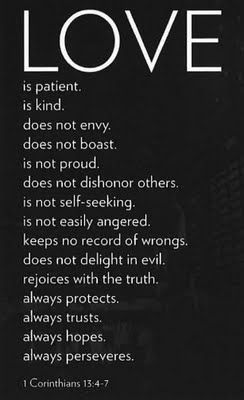
You know that famous quote on love that they always recite at weddings? The one that starts with “love is patient, love is kind…?” I wrote a post about this Bible verse, but in my quest to discover whether I’ve ever known love, I thought I would revisit it.

Let me preface this exploration by saying that I am not usually the type who interprets the Bible literally, but since a lot of people agree on this definition of love, I figured it’s as good of a place as any to start.

So there are 15 things that love is supposed to be, and I would say that I exhibit 11 out of 15 of them on a good day. Which would be a 73. Which is a C. And as you know, a C is failing in my book.

I have problems with envy, anger, keeping record of wrongs, and selfishness. Selfishness, in particular, is the hardest one for me to improve upon. I try to be reasonable, but the truth is, I don’t want anyone to get over me. I don’t want anyone to be happier without me, even if I am happier without them. Even if I never hope to be with them again. And even though they want me to be happy.

In my defense, this verse doesn’t explicitly say that love is not selfish. It says that love is not self-seeking. This may be splitting hairs, but that’s what obsessive people do. Wanting to be loved the most is clearly selfish, but is it self-seeking? And if so, what is it that I am seeking?

I guess I want to be the most special person they’ve ever known. I want to be able to hold up that gigantic foam finger that says “We’re #1!” that sports fans wear, even when their team sucks. Except it would say “I’m #1!” So, even if it is narcissistic, our culture clearly condones the desire to be the best as socially acceptable, even when it’s delusional.

But that just sounds like a rationalization for my selfishness, so it doesn’t really alleviate my guilt. Plus maybe we, as a culture, shouldn’t be so focused on being the best, either.

But that is for another blog post.

Oh! I just thought of something that helps me to redeem myself!

So you know how I want to be a famous writer and have a best seller and make a lot of money some day? Well despite my desire for fame and fortune, I often pray that my brother’s blog on “The Walking Dead” will be more successful than mine. That he will be the one who knows fame and fortune. Because I will be happy regardless of what happens with my blog, but it would make him really, really happy to have some external validation of his talent. And I want him to be happy.

See? I am capable of putting someone else’s happiness before my own. I do know what love is after all. Because this is how much I love my family.

Love is