Category Archives: Psychology

It’s Not Me. It’s You, Part 2

Eleven years ago I wrote my first blog post about anger. That was a tough one to write about because I felt so ashamed of my anger. That I had it at all. That I couldn’t control it. That it didn’t make any sense. And I was angry that when I tried to get support, whatever people said wasn’t helpful.

I didn’t say specifically in the post what my friends said, but since the same thing is happening right now, I’m guessing it was something like, stop being angry. You’re making me uncomfortable. Go over there somewhere so I don’t have to feel it.

I’m not one to attack someone. But if you attack me by telling me something like I don’t know what I’m talking about because I’m just a psychologist and you’re a physician, you should start running now.

Because this is what my dad told me when I became a psychologist. Stuff like, because you’re just a sorry ass psychologist instead of an M.D., you can’t even afford a Mercedes Benz. Because that’s what’s important in life.

He has Narcissistic Personality Disorder (NPD), Bipolar Disorder, trauma, and Traumatic Brain Injury (TBI). Ironically, the TBI is because he was trying to save his Mercedes Benz when it was rolling down a hill backwards and he jumped in to hit the brakes.

These conditions are all examples of Autism. Or Neurodiversity. Or as I like to call it, good ol’ neurospiciness.

Neurospicy people become very easily dysregulated and have a very difficult time knowing what to do to self-soothe. Because they have no idea what they are feeling or what’s triggering them.

Recently I’ve been told 3 times by 3 different physicians that I don’t know what I’m talking about because I am a psychologist and not an M.D. At least that’s how I heard it. But it’s certainly possible that it was something like that and I got triggered and then became dysregulated. Because it was traumatic, hearing that over and over again.

Anyhoo, it inspired me to look up stats on ChatGPT related to clinical psychologists and physicians. Did you know that the percentage of people who say they want to be M.D.s and succeed in doing so is only 6%? So physicians are also neurospicy, but on the opposite end of the spectrum, toward the brilliant end.

Being brilliant is technically “abnormal” too, based on statistical infrequency. But since we value brilliance, we don’t call it a disorder. Disorders are just for things that people do that we don’t like.

It can all get kind of political, really. So I prefer not to pathologize anyone. I tell my clients that we are all just human beings, being imperfect, feeling all the feelings on the spectrum of humanity, doing the best we can trying to figure out how to do this very hard thing called life.

I couldn’t find an equivalent stat for licensed clinical psychologists, but the closest one was that only 7% of the people who apply to research-based clinical psychology Ph.D. programs are accepted. However, you still have to defend your dissertation and pass the licensure exam. So 5%, maybe? Also neurospicy individuals.

People with NPD like my dad are too ashamed to admit to any vulnerable feelings, especially hurt and shame, so they project them onto other people. It’s not me! It’s you! And then they get angry and want to beat it out of you.

When one of my brothers was learning his multiplication tables, my dad was inexplicably enraged that our younger brother, who later turned out to be a genius (also neurospicy), could learn them faster than he could. So my dad told my multiplication-deficient brother that if he didn’t learn them by the time he got home, he would be in trouble. Because there’s nothing like the fear of punishment to enhance someone’s capacity to learn.

Not surprisingly, he couldn’t learn them in the next few hours. So my dad yelled at him, which I could only hear from the other room, but it was enough to make me cry and remember to this day. Then he took him into the bedroom and beat him, which was far worse than whatever I could hear.

When we were young adults, my dad was reflecting on this incident, perhaps out of guilt, and his excuse was that he was afraid that our brother might have a mental disability. Because when our mom was pregnant, she and 2 other female residents in medicine got the measles or something, and the 2 other mothers had children with cognitive disabilities.

Decades later, my dad tells me in a rare conversation of vulnerability and honesty that he was teased for being stupid and “retarded” because he couldn’t read. Which was because he had dyslexia, but that term probably didn’t exist back then. His dad beat him and screamed at him so loudly that all of the neighbors could here it because in the Philippines they don’t have windows.

My therapist thinks that he thought if it were his genes that made my brother have difficulty learning, that would make it his fault. I never really understood why couples argue about whose side of the family this “problem” comes from. It’s not like you get to choose your genes. Or your family, for that matter.

When you don’t want to identify with the aggressor, you think, I’m just never going to get angry. I’m going to be this semi-human stoic superhero! So instead, their anger goes underground. Their drill sergeant and inner critic tell them to “toughen up,” “pull yourself up by your bootstraps,” and carry on, as mentioned in the blog post written by a previous client.

Women also have to suppress their anger because it’s frowned upon in women. Just look at what happened to Elphaba. So instead you try to be a people pleaser and blame yourself for everything. Which is ideal for narcissists.

I think it would be much better if we empowered each other by telling people what they’re good at rather than making people feel bad for not being what you want them to be. But it takes more effort to empower than it does to judge.

But trying not to get angry doesn’t work. You may say you don’t feel it, but it’s coming out, anyway, in ways that you don’t even know about. That’s the kind of denial in passivity. Your anger is hidden from you, but you feel very hurt and undeserving.

I had 3 men angry at me yesterday. The first one actually thanked me when I explained to him that I would rather him tell me that he’s hurt so that I could apologize right away. I told him that anger and hurt go together. That often people prefer to identify with one but not the other, so the other one goes underground. So in reality, we’re hurt and angry at the same time. So he and I are good.

But I was so paranoid after he told me that I hurt him that I sent a flurry of texts, checking to see if I offended anyone, apologizing to everyone just in case.

My partner blamed me for repeating what he said because that’s not what he meant to say and I should have known what he meant before he took 20 minutes to explain it and why are we still talking about this! I’m just going to leave.

So I was like, well, OK, but…can I give you your Christmas gifts since we may never see each other again?

But he called to check on me tonight. So that’s something. He has ADHD so he’s neurospicy.

With my brother, I initiated the conversation because of the aforementioned paranoia. I apologized for being passive-aggressive and saying mean things that he doesn’t deserve to hear. I’m just going to own up to my anger and be honest so that I stop making snide comments.

It turns out he was waaaaayyyy angrier at me and has been holding a grudge against me for something that happened over 4 years ago. Because I didn’t know he wanted me to help him put my kitchen table together. Because he didn’t ask me to. I should have known without him having to say it. I was just weaponizing my incompetence to waste his time, which I clearly thought was less valuable than mine. So APOLOGY NOT ACCEPTED!

Whoa!

Please, people, if you’re feeling hurt or angry, just tell the person. You’re not benefiting anyone by trying not to feel. If he had just said, come help me so that I can show you how to read instructions for furniture that comes from China that are on one page with no words, and the parts come in bags that don’t correspond to the numbers, and the “instructions” are arrows, I would have said, good idea!

By the way, I found this out right before I had to lead a meditation. I was honest about it and said hey, I’m dysregulated and I may cry, but I’m glad we’re meditating together.

Then I got my massage, but it was essentially a therapy session, because I had to pull myself together somehow since I was about to see my partner, my brother, and his wife. I wanted to give her a good tip for just listening and giving me a hug because it was essentially a therapy session with a light massage for self-soothing and connection. Which was exactly what I needed in that moment.

But then, when she tried to run my card, for the fifth time in the past month, some hacker associated with Al-Qaeda had tried to use both my cards that day. If you have an Apple credit card, they will automatically reject even the smallest suspicious activity and change your number on the spot. So I used that card.

But for the other one, I had to call my credit card company again and have them re-issue a credit card again. But you can’t call them back from the number from which they called you. You have to pull out your credit card, look at the back, and call the number for U.S. cardholders. And they ask you really stupid questions about stuff that shows up on their side but not yours and ask you if you can see it, even though they just told you that you can’t. As well as things like, did you make a purchase a week an a half ago for $6 using Apple Pay? And then they say, OK we’ll send this out to you in a few days, so I hope you have another card or money in your account!

I did this credit card thing prior to getting ready for our dinner party. Because I was crying and hysterical, my partner asked me if I was sure I wanted to do this. My drill sergeant was like, yes, you do! You have to make this work! So at first I said yes. And then I thought, no. I don’t have to do this if I don’t want to. I can do whatever I want. So I called them to say I wasn’t up to it and to apologize.

Then I talked to my sister-in-law, since my brother was obviously furious with me, and I told her I had to cancel dinner. I was so upset I couldn’t do it for them. I had grand plans of using fancy china. I had put my Christmas decorations up. I was going to move my space heater to wherever they were sitting because the last time they were at my house they were cold. Because I’m always sweating since everything is triggering my fight/flight response. My partner had already been cooking for over an hour. And because they asked him to prepare a meal rather than hosting us, for weeks he had been planning out the meal, trying to make it just right, and trying to pick something they would like.

I hadn’t even gotten through the list of all the horrible things that had happened to me that day so far. But she thought this was a good time to tell me that I’m out of control, too loud, and too argumentative. And that I should seek psychiatric help. And go back on the meds that made me get surgery for GERD, throw up on the court, give up tennis, sing horribly, and wreck my vocal cords.

She’s a pediatrician. My brother, too. I asked her some differential diagnosis questions about mania, and she admitted that she didn’t know the criteria. But she still knows better than I do about what I need.

Apparently, they had been talking to my best friend behind my back and they all decided that this is what’s best for me. Because over Thanksgiving, when I got into an argument with my brother because he told me I didn’t know what I was talking about because I was a psychologist. And I hadn’t talked to my best friend in over 2 weeks. So none of them had any idea about the horrible things that had happened before this horrible day, because they don’t bother to check on me, even though they were obviously concerned. Unless this counted as their check-in.

I was blindsided and confused. Had they been holding on to their feelings about the argument since Thanksgiving? Is that why she had to tell me at that very moment, no matter how poorly timed it was? Was my apology to my brother interpreted as anger and argumentativeness? Was that the last straw? Had their plan been to come over and ambush me during dinner?

That added the most horrible thing to my list of horrible things that day.

By then, I was so dysregulated that my partner was confused by what they could have said to make me so upset. Seeing me in that state caused him to became dysregulated. Because it reminded him of what it was like when his family argued and he just wanted to make it all stop. So we argued for several painful hours, unable to connect and enjoy each other’s company, no matter how hard we tried. And even though we hadn’t seen each other for weeks and he is leaving for home to celebrate the holidays with his family tomorrow.

And I never even got to eat dinner.

Still, I advocated for myself on the phone. I addressed every issue that she brought up one by one. I told her that I checked in with every person to ask them if they were bothered by my behavior, and they said no, it didn’t bother them. They think I’m great. I told her I’ll talk to my therapist, and if she thinks I should talk to my psychiatrist, I will. I have an appointment with her this week.

But she said that wasn’t good enough. Because I guess they’re the ones who were bothered by my behavior. She trusts the psychiatrist who we share, who is an M.D., and has known me for about 4 years and sees me every 6 months, more than she trusts my therapist, who is a clinical psychologist that I have seen routinely for the past 26 years.

Neither of them are in therapy because they don’t have any problems. She even went out of her way to tell me they have a good marriage. Which was also confusing, since I had know idea what that had to do with me needing to see a psychiatrist.

Those are 2 of the 3 physicians I referenced earlier.

The other interaction with a physician happened during a gathering that was specifically organized so that all my friends in Roanoke could see me. I did something similar with him that I did with my brother over Thanksgiving. I gave him evidence that he’s neurodivergent on the brilliant end after an impromptu question to ChatGPT about how many people who start off pre-med graduate pre-med. Because even though I didn’t know the answer, I know from 19 years of working in a counseling center that the answer is, not many. ChatGPT said 16%. And I said it in the exact same way–loudly, in an argumentative manner, and angrily. Because he said dismissively, you psychologists think everyone is neurodivergent.

I also told him that our current administration and the majority of Americans are clearly not neurodivergent, based on the current laws and lawsuits.

His reaction was to tell me that everyone loved me and he wanted to give me a big kiss. Which was also confusing and disorienting, but not dysregulating. I also texted his wife the next day, who had hosted the party for me, to ask her if I was out of line. Because even being really happy to see your friends can be dysregulating. She said not at all. I love your energy. You’re so smart and I learn so much from listening to you. And I love having someone to scream at the TV with me during a UVA game.

To “support me,” my best friend and partner told me not to be mad that they’re mad that I’m mad because they really care about me. To me, that sounded a lot more like supporting them.

So after a whole day of crying yesterday because nobody wanted to listen to me or believe me, and everyone projected their anger onto me–except my friend who thanked me for the insight–I decided to take a self-care day today, talk to my therapist, and take a break by distancing myself from my stress, like my family suggested. And they are the only stress I am dealing with at the moment.

Oh wait. The other stressor is that I can’t sleep. Which is activating my fight or flight response. So I am running on adrenaline. So I’m actually looking forward to talking to my psychiatrist now.

Serendipitously, at this very moment, I’m listening to a continuing education presentation on when psychologists should make referrals, which is very basic and boring (except for the slide on new meds). She just said that when someone isn’t sleeping, they’re in crisis.

And I’m writing a blog post about it. Because that’s what I did in that last anger post and I said it helped. And I guess this one is helping, too, by giving me something else to focus on. Because taking deep dives into something is also a form of self-soothing for someone who is obsessive-compulsive (also neurospicy).

Why Wicked Has Become My Favorite Movie

Photo by Alexander Grey on Pexels.com

I have a big announcement to make. Since 1999, my favorite movie has been The Matrix. In fact, I have referenced the scene in which Neo can read the code at the end of the movie 7 times in my blog. Well, 8 times if you include this post.

In addition, its themes of how we are destroying the earth, the rise of AI, the power of our thoughts in shaping our reality, and the importance of letting go of our fears so that we can fly are additional reasons for why I love this movie.

Moreover, from a cinematic perspective, the choreography of the fight scenes is still amazing. The chemistry between Neo and Trinity is palpable. This was the first movie to use the 365 degree camera, which made the special effects revolutionary and still entertaining to this day, despite all of the advances in CGI.

The movie Wicked shares many similarities to The Matrix.

  1. Both movies portray neurospicy people who sense that there is something wrong with the world that they live in and feel uncomfortable in it.
  2. They are both singled out for greatness and come from another world to save this new world–a common theme in many of my favorite movies like Kung Fu Panda, The Lego Movie, Avatar, and Star Wars.
  3. They both have amazing cinematography.
  4. They both have amazing choreography.
  5. In both sequels, the protagonists fly.
  6. In the end, both characters die. Sort of. (See Matrix Resurrections below.)
  7. There is a lot of chemistry among the cast. The cast of Wicked has even been teased in the media of being codependent.

The reasons that I now have to bump Wicked up to #1 are fourfold:

  1. There were more choreographed scenes in Wicked.
  2. In the genre of musicals turned into movies,
    • the singing in Wicked is as good as the musical. Unlike Les Miserables, which also had A list actors, but they did not match the vocal powers of the singers in any musical version and was therefore a disappointment to most Les Miz fans.
    • The choreography was better than in the musical Wicked, because on Broadway you have to be able to sing, dance, and act, while a movie can pick people who are just great dancers.
    • The chorus was larger, since movies can have a bigger cast.
    • The orchestra was much larger than what an orchestra pit under the stage of a theater can hold.
    • (I realize these subcategories are cheating in terms of saying the reasons are fourfold, but they all refer to musicals turned movies and therefore need to be grouped together.)
  3. The sequel Wicked: For Good is even better than the original, and Wicked, Part 1 was awesome! The Matrix, on the other hand, far outshined the other movies in The Matrix Trilogy. Although The Matrix Resurrections is my second favorite movie because it is the most similar to the original movie and also adds the theme of alternative universes, in which there are 3:
    • The universe in which Neo has created a popular video game called The Matrix and Trinity is a soccer mom.
    • The universe of the original Matrix
    • The universe in which the new Agent is controlling Earth, which is a different Matrix.
  4. While those who have freed themselves from the Matrix are clearly neurodivergent, the movie Wicked has become a tribute to neurodivergence.
    • It has a diverse cast.
    • It highlights the ways in which people who are different are ridiculed, bullied, traumatized, and terrorized.
    • Neurodivergent people are turned into villains while the true evil people mask as heroes who are doing good for their communities.
    • Neurodivergent people have compassion for other people, animals, plants, and the earth instead of being motivated by self-interest.
    • Neurodivergent people feel compelled to do what’s right, even if it means risking their lives.
    • Neurodivergent people tell the truth, sometimes bluntly, even if their honesty will be used against them.
    • (Again, sort of cheating, but for the same reason.)

The movie Wicked is a proclamation that neurodivergence (differently wired brains) is not only good, but it actually makes the world a better place. We cannot evolve without neurospicy people who push us to be better versions of ourselves and of what humanity can be, if we let them. So thanks to everyone involved in the making of Wicked. And for reminding us that the neurospicy people of the world truly add flavor to what would otherwise be a bland existence.

Guess What? I’m Neurodivergent!

I see a lot of women diagnosed with ADHD in adulthood because they had managed to compensate and succeed with considerable effort, despite having the disorder. It took a while for adults with ADHD to be noticed at all, since the stereotype of ADHD is the boy who can’t sit still in his seat and runs to the window when an ambulance passes by. But it’s even more difficult to diagnose in women because they usually don’t have the hyperactive symptoms that lead to recklessness, impulsivity, and sensation-seeking.

Now in the literature the same phenomenon is happening with people on the autism spectrum. In fact, Autism, ADHD, and Bipolar Disorder are all a part of a larger category called neurodivergence. If that word calls to mind the movie or novel Divergent, it’s actually kind of fitting. People who were different in some way were isolated and seen as a potential danger or threat to society. Not so different from what many people think now.

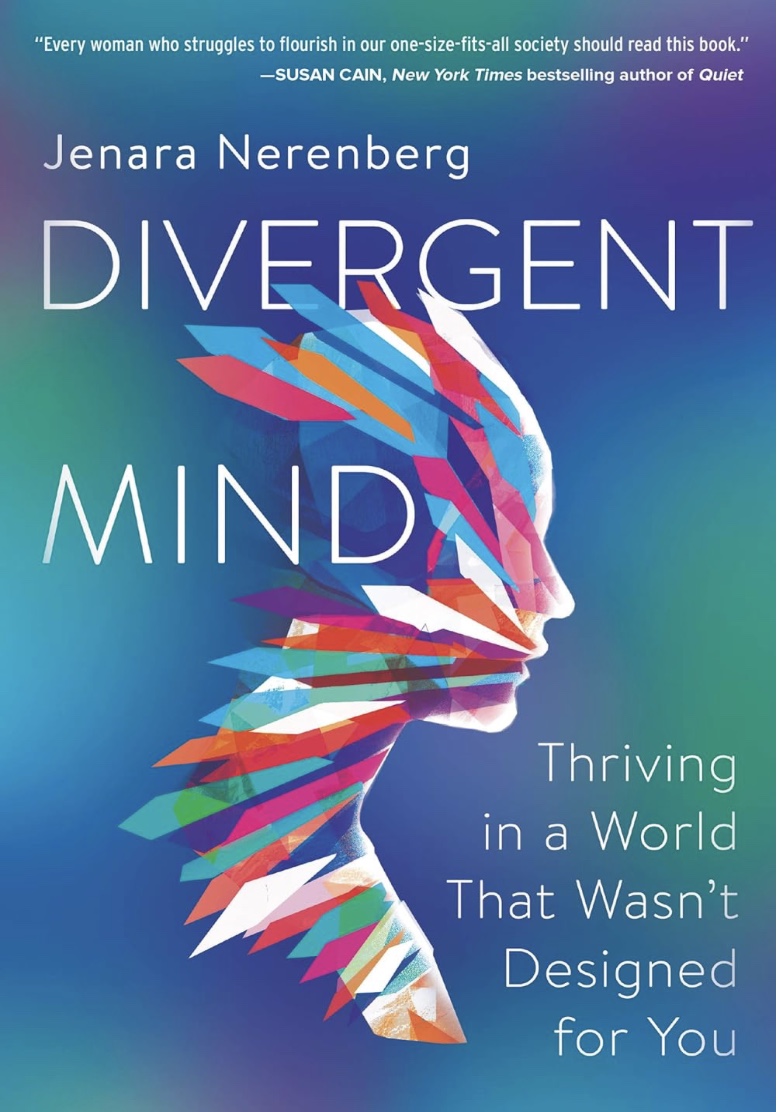
What’s strange, though, is that many of these women who show traits of being on the spectrum want to be formally diagnosed with Autism. I would explain to them that it wouldn’t really benefit them now because they are adults, and they no longer get accommodations, IEP’s, early intervention programs, and other resources that neurodivergent children can take advantage of. But after reading Divergent Mind, now I do. They wanted to know that their experiences are a known entity with a label and that other people share their sensitivities.

Because I have so many of these clients, I decided to read the book Divergent Mind. And it literally blew my mind. Like, I could feel the neurons in my brain firing, making connections between bits of information I have gathered throughout my life. It was like the equivalent of runner’s high, but a kind of intellectual high that you get when you have a Eureka moment. Or like Neo in the Matrix when he could finally read the code.

Nerenberg describes neurodivergence as simply cognitive differences rather than mental disorders. And there are lots of characteristics of neurodivergence that aren’t considered abnormal but make it difficult for people to navigate the world, nonetheless. Often they are diagnosed with depression or anxiety, because living in a neurotypical world sucks the life out of them. Or they are in a constant hypervigilant state.

The geniuses I went to high school with (you know who you are) are also neurodivergent. But since it’s not a bad thing to be brilliant, no one includes them in this category.

I kind of figured my whole family was neurodivergent, because half of them have bipolar disorder and the other half have anxiety. Some of them have both. I have known for some time that I am a highly sensitive person (HSP) because I read The Highly Sensitive Person decades ago.

In particular, I have mirror synesthesia. I can’t watch horror films because when someone’s arm gets cut off with a chainsaw, it hurts my arm. And I don’t like reading or watching anything that depicts the Holocaust in great detail, because their pain overwhelms me.

I also have a sensory processing disorder (SPD). My brother once told me I had supersonic smell. I don’t like the tickers on ESPN because I get distracted by them and stop watching the game. I don’t like hugs. I’m constantly adjusting the volume on the TV because music makes it louder.

I have insensitivities in proprioception, which means I have difficulty judging my body in space. Consequently, I have bruises all over my arms and legs and have no idea where they came from. Or perhaps because of my sensitivities I don’t have enough bandwidth to calculate my dimensions in space.

I have the same problem with interoception, which is why hunger and depression feel the same to me. And anxiety and having to pee feel the same. I tighten all my muscles when I’m concentrating even if those muscles aren’t needed when I’m playing a song with one finger on Duolingo.

None of these things are necessarily disorders. In fact, Nerenberg refers to them as potential superpowers—IF someone can learn what their sensitives are and learn how to self-sooth when they feel overwhelmed.

Medication and therapy can be helpful, but another possible resource that I didn’t know about is occupational therapy (OT). An occupational therapist can help you identify what your sensitivities are and develop specific coping strategies so that you don’t become overwhelmed and shut down, melt down, or stay in fight/flight/freeze.

After I found this out, I told all of my clients about this resource. Even clients who have stopped seeing me, perhaps because I couldn’t help them with their sensitivities. And I have to say, because I now recognize what my clients’ sensitivities are, or at least recognize that they become dysregulated because of some sensitivity, I feel like the knowledge itself has also become a superpower.

As a result, the mindfulness book that I told you I was going to write is going to specifically address people on the spectrum. Because mindfulness is about being more aware of what’s going on inside you and around you. While everyone can benefit from mindfulness, perhaps people who are on the spectrum who don’t want medication and/or therapy can read this book and learn how to develop tools on their own that can help them thrive.

So stay tuned! Reserve your copy today!

Just kidding. It’s going to take a while.

But definitely check out Divergent Mind!

I’m Taking Voice Lessons Again!

Photo by Pixabay on Pexels.com

So you know how much I love Karaoke. I am still singing, but my range is shot because of the damage done by my GERD (acid reflux) and some medications I was taking for 15 years (more on that in next post). Although the fundoplication surgery combined with compliance with my inhaler when exercising has really helped with my asthma and throwing up, my range hasn’t improved much.

I have debated on taking voice lessons over the past year because I see how much my friend Michelle and my niece Sadie have improved–and especially since I have an acting contract and can deduct the cost of the lessons–but I still thought it was a waste. It’s not like I sing for a living. My family and friends don’t care if I can’t hit the high notes when we sing Karaoke.

Luckily my family, friend, and niece wouldn’t let me give up. When I asked my brother if it made sense to get lessons if you had a broken instrument, he said that you can still improve the sound that you get from it. Michelle said that I just need to access my head voice for my high notes and that can be learned. And Sadie, the relentless optimist, said I won’t know unless I try. Plus she thinks I can be friends with Deanna, her voice instructor, and she’s always worried about me having friends because my closest friends are all in Roanoke.

So one day, I decided to research whether you can heal your vocal cords from GERD, and it turns out that you can with voice therapy. I figured voice therapy might not be that different from singing lessons, so I contacted Deanna and asked her if the two were similar. Not only did she say they were similar, but she also struggles with GERD and asthma and has learned to alter her techniques to accommodate these issues. So I was sold after that!

I’ve had 4 or 5 lessons now and already my range has improved, although the strength of my voice is still weak. The most amazing thing I’ve learned iis that the reason why I haven’t been able to sing high notes is that my tongue, vocal cords, throat, and larynx have been traumatized from all the throwing up. So essentially, I’m doing trauma therapy. I do exactly what I do with clients but with the focus on my tongue, jaw, neck, and throat. I am training these muscles to relax. Tell the muscles that they’re safe. We’re just releasing sound and air now.

The other thing that voice lessons have taught me is that I’m too hard on myself. I push until my body can’t take it anymore. A bunch of my loyal readers have told me that I’m too hard on myself but it’s hard to let myself off the hook. It’s hard to accept that I can go easy on myself, despite all the self-compassion practice. Although it’s much better than it was when I started this blog.

In lessons, I’m always trying to force the notes out rather than allow them to come out. Very similar to language used in mindfulness–allow, soften, create space, play. This also applies to why I need hip surgery. Because when my hip started hurting 10 years ago, it never occurred to me that I could have arthritis so I never went to the doctor. By the time I found out in January, I was already at the point that I needed hip replacement surgery.

Oh well. Old habits die hard so I’m trying to have compassion for myself. Pushing myself helped me to accomplish a lot of things, and it was the only tool I had in my tool box at that time. But practicing mindfulness and self-compassion have given me so many more tools, and taking voice lessons is helping me practice these tools in a different way.

And because I’ve also added the lovingkindness practice, I’ve finally discovered how to be happy in the present, in this moment. Even when I’m in pain, with little contact with anyone, and without being able to play pickleball.

The choice is ours to free ourselves from the obstacles we create in our minds. Luckily I have God, my family, my friend, Deanna, and myself to thank for this newfound freedom. And if there’s anything that you think is holding you back, it’s not too late for you to be free, either.

By the way, Deanna gives Zoom lessons and also teaches acting, so if you’re interested in working with her, let me know.

Lovingkindness Experiment: Month 1

Since my announcement that I am offering a group lovingkindness meditation once a week to anyone who is interested, I’ve had 5 meditation sessions so far with varying numbers of people attending. I wasn’t really sure what to expect, and so far the group meditation has been small in number but powerful in impact. Here are some of the things I’ve witnessed so far:

  1. It really works. I’ve been doing the lovingkindness meditation on my own for several months and I can already tell it’s changing me. Like, one day I was lost in this huge medical complex and couldn’t figure out what building I was supposed to go to for my appointment. When I parked and got out of my car, after driving the entire perimeter of the complex, I looked around and thought, wow, so many people hurting in this small space. So I decided to send out lovingkindness to everyone in the area. It was just a spur or the moment thing. I had even forgotten that I had done it until much letter. But lately, I’ve had the urge to do that sort of thing.
  2. It’s even more powerful with others. I know Jesus said something like “when 2 or more are gathered together in my name…” something happens. Maybe it’s something like your prayers will be answered, but I don’t necessarily believe that all prayers are answered. Like God is a genie in a bottle or something. But I think when people come together for loving purposes, the love is magnified. A synergistic effect. Like mixing benzos with alcohol. But don’t do that. That’s bad for you. Come to the meditation instead and see what it’s like to feel the power of love magnified.
  3. We can ease our own pain. I decided on a whim that rather than just focusing on the lovingkindness I would start with a breathing meditation and body scan just to give people the feel of what a full meditation is like. After the first session, the people who had attended that session acknowledged that they had all been experiencing chronic pain but by the end of the meditation it was gone. Not forever, of course. But that’s why it’s called a practice. Check in with yourself every now and then. Send comfort to where you feel pain. It will make you feel better.
  4. It’s getting easier to “love my enemy.” This step is one of the hardest parts of the practice–sending lovingkindness to someone who you find difficult to love. Perhaps because they’ve hurt you, someone you care about, or people in general. But people who hurt are hurting, and if they weren’t hurting they might be lifting others up instead, as this group has committed to do. Sometimes you have to send them different gifts. Maybe things like, may they feel compassion. May they be self-aware. May they feel their feelings. These are, after all, the things that help people in therapy.
  5. I will show up for myself. In my first post, I said that even if only one person shows up, I will meditate with them. It has never been the case yet that no one has shown up, but if that happens, I’ve decided that I’m going to do the lovingkindness meditation anyway and send the recording out to people on the list. Maybe no one will listen, but maybe someone will and it will make a difference. And ultimately, the practice is for me first and foremost. So I will show up for myself every week.

I’m continuing to do the weekly lovingkindness meditation, so if you were toying with the idea of joining before, you can still do so and see for yourself if it has any benefits for you. There are no obligations to stay the whole session, to speak, or to continue to participate after signing up. Just email me at cbarongan@gmail.com and let me know that you’d like the information.

Hope to see you there!

Salon Therapy

I’m not gonna lie. Things haven’t been great. Which is why I haven’t posted anything. But I want to write something without giving the rundown of all of the crappy things that are happening to me. So I decided to write about a true story. Something that happened to me yesterday.

I went to the hair salon because short haircuts require a lot more maintenance than long hair. I had my hairstylist for 17 years so going to her was more like a therapy session. But I don’t have the energy to drive 5 hours to get my haircut, so I had to make a random appointment with this hairstylist I’ll call C.

I really don’t like small talk. I mean, I can do it obviously, but it’s tiring. Fortunately, C was quite the entertainer. Super upbeat and high energy. He was dancing and styling at the same time because he said that when he hears a good beat he can’t help himself. Even if the music is just in his head. Which it wasn’t in this case. There was music playing. I totally get what he means though, because I feel the same way about a good song. You just gotta sing, even if no one else can hear it, you know what I’m saying?

He was pretty uninhibited until he asked me what I do for a living and I said I’m a psychologist. This is one of the annoying things about being a psychologist. People think that you are analyzing them so then they get self-conscious. So I tell them I’m off duty, blah blah blah. And then they relax and tell me all their problems. And because I’m a good listener and would rather have a meaningful conversation about people’s personal lives than small talk, so I guess I encourage it.

This was an unusual “therapy session” in that C had more of a psychic problem. His friend wanted to have a seance for fun one night, complete with Ouija board and everything. After the Ouija board didn’t work, and even though he was not a psychic expert and really didn’t think anything would happen, C had everyone hold hands in a circle and started inviting spirits to communicate. And a boy and girl did show up, although C was the only one who could “see” them in his mind’s eye.

The boy wanted to give a message to C’s friend, the seance-thrower. This boy, who I’ll call D, wanted her to know that he’s OK and she doesn’t have to feel guilty. It’s not her fault. The usual message that spirits seem to want to communicate to us. So the seance-thrower starts crying and freaking out, because when she was in EMT training she had tried to save a little boy’s life who was in a car accident and thought it was her fault that she couldn’t resuscitate him.

For some reason, this incident didn’t freak C out. But afterwards the ghosts kept coming. Like something out of The Sixth Sense. Or Ghost. He could hear voices talking to each other in his house even though he lived alone. He thought he might have been losing his mind. He could sense things about people that he shouldn’t have known and felt compelled to ask them questions like, did they ever find out who murdered your cousin? He almost lost his job because he was freaking people out.

Finally C told a friend what had been going on and his friend asked C if he had been messing with an Ouija board. C told his friend about the seance and his friend said that he needed to close the seance. C said the steps were weird but they worked. I didn’t ask what they were because if this is the part that he wasn’t willing to share the details about I figured they must have been really bizarre.

So his questions for me were, do I think he’s crazy? Is there brain science that would explain what happened to him? Should he consult with a psychic? If he gets in touch with these psychic powers, will he lose touch with reality?

I have to admit, this is not my area of expertise, but a lot of people in my family see ghosts. Fortunately, I am not one of them. I do, however, read a lot of books on near-death experiences (NDEs). And the most recent one I read called Proof of Heaven is one of the better ones because the person who had the NDE was a neurosurgeon named Eben Alexander. He’d had many patients tell him about their NDE but figured it was just some brain thing that scientists hadn’t figured out the answer to yet. But then one day he got meningitis out of nowhere and went into a coma for 7 days and was completely brain dead. Right before they pulled the plug, he woke up and his brain was working perfectly normally. He’d had a longer than usual NDE that he remembered quite vividly, and after that he quit his day job and now uses his NDE experience to help people understand their own trips to heaven.

So to make a long story short, I told C that I didn’t think he was crazy, and that what he had was a gift (and sometimes a curse, but most gifts are like that). That people who are high in empathy like therapists also have to create boundaries to make sure they don’t lose their minds, so talking to a psychic expert might help. And, most importantly, that science can’t explain everything that happens to us and that he should check out Proof of Heaven. He was so excited that he said he was going to go to Barnes and Noble right after our appointment and buy it. And that we could talk about it the next time I came in.

He also gave me a little advice when I said I didn’t have anywhere to go to show off my haircut. He said the night was still young but to stay away from Grinder because they don’t even ask for your name.

Oh and I had to pay for my haircut, whereas I listened to him for an hour and gave him free advice.

So I ask you, who actually had the salon therapy?

How to Predict the Future

fullsizeoutput_4403

If you’re psychic, this blog post does not apply to you, because you already know how to predict the future. For the rest of us, there are a range of options for predicting the future, each with their pros and cons. In this blog post, I will review the primary strategies so that you can be more informed and mindful about employing whichever one you choose.

  1. Worst-case scenario. This is the most common strategy I see in therapy. It involves things like predicting you will fail your test, and then your class, and then college altogether, and then you’ll end up flipping burgers at McDonald’s. People who use this strategy are not delusional; they know they are picking the worst-case scenario. Their argument is that if things go poorly they will be mentally prepared, and if things go well they will be pleasantly surprised. The problem with this strategy is that it causes unnecessary stress, since the worst-case scenario is not likely to happen. And, if you’re trying to practice self-care, your goal is to eliminate unnecessary stress. Plus, even if the worst-case scenario does happen, you can prepare for it then, just as well as you can prepare for it now, and save some energy.
  2. Optimism. In this strategy, people assume that things will turn out in their favor, even in cases when this might be statistically unlikely. In fact, even if your optimism is not based in reality, there is research to suggest that it is still effective in creating positive outcomes and feelings of happiness. One recommendation for how to capitalize on the benefits of optimism is to write your goals down as though you have already accomplished them. (I’m trying this out for myself and have started writing I’ve lost 10 lbs. every day to see if it works. I’ll let you know.) The downside to this strategy is that, from a mindfulness perspective on happiness, we do not need to rely on any particular outcome to be happy. Well-being can be created by learning to be fully present in this moment, whatever it looks like. Assuming that things will turn out the way we want them to, on the other hand, makes our happiness dependent on a favorable outcome.
  3. No expectations. This strategy is best illustrated in the expression “expect nothing but be prepared for everything,” which presumably came from an ancient samurai warrior, according to Jerry Lynch in The Way of the Champion. With this mindset, you do not assume that you will win, but you expect that you will do your best, regardless of the result, because doing your best is all you can control. And you expect that, whatever happens, you will learn more about yourself and become a better person because of it. This strategy is more consistent with a mindfulness approach because it does not assume that we have more control than we actually do. It also does not assume that a negative outcome is necessarily a bad thing. The biggest drawback to this strategy is that it forces us to live with the anxiety of not knowing what will happen. Our fear of uncertainty is so great that imaging ourselves failing out of school and flipping burgers at McDonald’s seems less anxiety-provoking than the ambiguity of the unknown.

It’s probably obvious what my bias is. I encourage my clients to have no expectations. When making predictions about the future, I encourage them to substitute their negative predictions with the mantra “I don’t know what will happen,” and reassure them that whatever happens, they can have faith that they will be able to figure out a solution when the time comes.

How to Tell if You’re Lazy

lazy cat

I have clients tell me that they’re lazy all the time. Even though they are all high achieving, perfectionistic, over-scheduled students who work more hours in a day than I do. And I work a pretty full day myself. Why is that, you may ask? That doesn’t make any sense. Because that’s how mental illness is; it doesn’t make any sense.

Usually when people beat themselves up for being lazy it’s a telltale sign that they’re probably depressed. A better word for laziness would be something like fatigue. When people are depressed they have no energy, no motivation. Nothing is enjoyable. Getting out of bed is too much effort. But it can’t be depression. That’s just an excuse. I don’t have real problems. I’m just being lazy.

Sometimes being paralyzed with fear can feel like laziness. Because fight or flight aren’t the only possibilities in the face of fear. Sometimes you freeze, like a deer in headlights. This is usually what happens when students have a paper due the next day but they have been staring at a blank screen on their computer for hours without typing a single word.

We do need a certain amount of anxiety to be motivated to do anything, but it doesn’t take much to go from the kind of anxiety that motivates you to the kind of anxiety that paralyzes you. Especially when you try to motivate yourself by saying you suck, you’re disappointing everyone, you’re going to flunk out of school and end up homeless. Not exactly a pep talk. And yet, this is the kind of stuff we say to ourselves all the time.

The ironic thing is, when I was looking for a meme on laziness, I discovered that people who really are lazy don’t feel bad about it. They’re out there looking for hacks to make the most out of their laziness–trying to figure out how to make it seem like they do yoga, or what comfortable clothes they can buy to lounge around in. There’s no shame about it at all. In fact, many of the memes are about wearing their laziness on their shirts like a badge of honor. Literally. Like this one:

laziness.jpg

And this one:

Not productive

In case you were too lazy to read the whole blog post, I’ll summarize it for you.

Here are 5 signs that you are not really lazy:

  1. Your therapist tells you that you are depressed.
  2. Your therapist tells you that you are anxious.
  3. You think you’re a loser and a terrible person.
  4. You worry about homelessness.
  5. You feel a strong affinity to deer in headlights.

And here are signs that you might actually be lazy:

  1. You’re a cat.
  2. You own one of those t-shirts.
  3. You have a Pinterest board about hacks for lazy people.
  4. You don’t read them because you’re too lazy.
  5. Being lazy doesn’t really bother you.

And if you were too lazy to read those signs, then here is the one-sentence moral of this story:

If you’re beating yourself up about being lazy, then you probably aren’t.

50 Shades of Blue

shades of blue

When I was in grad school, clinical depression was described as this discrete period that occurred in episodes with a clear beginning and ending. It was even called the common cold of mental illness. Like you would know when you had caught it, and then you’d get better and be in remission. If you had a genetic predisposition, you could be at risk of recurring depressive episodes, potentially for life.

You could also have this more chronic but less severe form of depression called dysthymia. Sometimes you could be unfortunate enough to have dysthymia and major depression at the same time. Double depression, it was called. As though you could have carefully measured doses of depression, and double depression has 2 cups of symptoms instead of 1. Which is strange, because you can’t have double of any other mental disorder.

Now that I’m a practicing psychologist, I know that the diagnostic categories are not as neat and clean as they were made out to be. As a person who has been depressed for most of my life, I can say that major depression feels distinct, but it is not always clear when I am depression-free vs having dysthymia. There are times when I didn’t think I was depressed in the moment, but when I look back, it’s clear that I was.

Often we tell clients who are on meds that they can begin tapering off once they are in a period of stability. Over the summer, perhaps. Or some time after they have gotten settled in their new job. Maybe the problem for me is that there is never a period of stability. Never some time when there isn’t some family crisis. When there isn’t some problem that I’m dealing with. If anything, I would say there have been episodes of stability that have broken up the more chronic feeling of being depressed.

I don’t to want give the impression that I’m always miserable, because I’m not. Like I said, sometimes I don’t even realize I’m depressed. Sometimes it only lasts a few hours or a few days. And it doesn’t feel the same every time. So at least there’s some variety to it.

Every now and then I get upset about how unfair it all seems. The depression. The anxiety. The family craziness. The stress that comes with thinking I need to save the world. But life isn’t fair, right? And I am blessed and fortunate in other ways. If I had to choose my suffering, at this point I’d choose mental illness, because at least it’s familiar to me. I know what to expect. I know how to manage it.

And the meds do help. So does therapy, self-care, mindfulness, and self-compassion. I think depression has made me wiser. It has made me a better therapist. I’ve learned to accept the ebbs and flows of my mood, and of life in general, without beating myself as much, because I’m doing the best that I can.

This week is finals week. We are all willing ourselves to make it to the break, exhausted from the semester. Despite taking my meds, talking to my therapist, and practicing self-care, mindfulness, and self-compassion, I’ve still had bad days. But I’m determined to get that Perfect Attendance award, so I’ve made it to work when I’m supposed to be here.

Today I would call my mood cornflower. Which is a pretty shade of blue.

Everything Ebbs and Flows

ebb and flow

One of the many things that’s helpful about having a blog that I’ve kept up for almost 5 years is that I see how much repetition there is in my life. I guess that shouldn’t be surprising. That’s the reason why therapy doesn’t work in a day. Even if you can identify in that first session what the client needs to do, it takes a lot of repetition to change your mindset and your behavior. And yet, every time I reread an old blog post, I’m like, what the heck? I was doing the exact same thing 4 years ago?

Yesterday I published an old post I had written about my guilt over my sleep cycle on my FB page (which I encourage you to follow, if you aren’t already doing so). In this post my therapist had given me permission to stop obsessing about not being able to regulate my sleep cycle over the break and said that, when I needed to wake up early, I would be able to do it. Which was helpful in forgiving myself for what I perceived as my sleep sins.

And yet, guess what I did this summer? I obsessed about not being able to regulate my sleep cycle. I thought about it nonstop. Tried different strategies, all to no avail. No matter what I do, my sleep cycle naturally gravitates to its night owl pattern– falling asleep around 3-4 am, waking up in the afternoon. My brain is like a manic vampire–I cannot shut it up at night, and it cannot stand the light.

But now I’ve started work and, although I’m not sleeping any earlier, I wake up when I’m supposed to. I’m sleep-deprived, but responsible. So I’ve come to the conclusion that it’s OK if I can’t change my sleep cycle. That when I have to wake up early, I will. The same conclusion I came to on July 27, 2014. The same conclusion that I’ve probably come to after every break.

Sometimes I still get caught up in thinking that if I were more disciplined, more of an adult, perhaps I could get this sleep thing under control. Perhaps I could be more like a normal person. But yesterday, in a presentation that I gave on resilience, I used the following quote from Paul Gilbert, author of “The Compassionate Mind:”

So much of what we are has, in a way, little to do with personal choice. Therefore it makes little sense to blame ourselves for some of our feelings, motives, desires or abilities or lack of them, or for how things turned out.

So I have stopped berating myself (in the moment) and repeat my self-compassion mantra. You’re doing the best that you can. Am I, though? Yes. You really are. You always do. (I have to go through the whole dialogue every time. Obsessive, I know, but I can’t help that, either.)

I also repeat my mindfulness mantra to remind myself that the cyclical nature of my sleep problems is just how it is. Everything ebbs and flows. Everything comes and goes. No matter how hard I try, how disciplined I am, it will always be like this–semesters filled with sleep-deprivation punctuated with periods of night owl syndrome over the breaks. This is the ebb and flow of my life.

So I’m trying to accept it, just as it is.