Tag Archives: Anxiety

Excuses

I pride myself on being a warrior on the court. However, I’m beginning to realize that having a warrior mentality isn’t always a good thing.

I was feeling tired and run down all last week, which confused me. I hadn’t even played that much tennis. My schedule wasn’t too busy yet. What excuse did I have to be tired?

Yesterday I had no choice but to acknowledge that I’ve been tired because I’m sick. I needed to rest. But despite what I said in my last post about listening to my body when it said no, I decided that I should go to tennis practice, anyway, because I needed the steps.

And guess what? I played terribly. But my inner drill sergeant was relentless. Sickness is not an excuse to play badly. Did Jordan complain when he had the flu during the NBA Playoffs? Didn’t he continue to hit amazing shots? Now quit your whining and play better!

But I couldn’t will myself to play better. And I felt even worse when I got home. Then I started panicking because I was afraid that I wasn’t going to feel well enough to go to work.

My drill sergeant kept telling me that I’m not really sick. That’s just an excuse to get out of going to work. Would your colleges be lame and stay home if they were feeling the way you feel right now? Or your parents? Or your overachieving brother? They would not. So suck it up!

This is the problem with that warrior mentality of “no excuses.” Sometimes you push yourself so hard that you just make things worse.

If I had taken my sickness seriously, perhaps I would have gotten a sub for practice, since it was just practice and not the NBA finals.

And if I were being kind to myself, I wouldn’t let my drill sergeant get away with calling me a manipulative liar who is just trying to get out of work by claiming to be sick. Because that’s really not what I’m like at all. Not at all.

I’m not saying there isn’t a place for drill sergeants. Like I said, I am all about being a warrior on the court. But if you treat every practice like the World Championship is on the line, then you’re just going to end up falling asleep on the couch until 3:30 am, having panic attacks, and obsessing about whether you are going to be able to make it to work the next day.

This is a picture of my mixed doubles team, represented by what are supposed to be jungle animals to signify our inner warriors. I am the zebra. Don’t I look intimidating?

photo

Disaster Preparedness

Disaster Preparedness

A few years ago I went to the Titanic Museum in Knoxville. When you enter, they give you a card with a description of a person who was on the Titanic and you can find items related to that person as you walk though the museum. At the exit, there is a list of the people who survived and who did not. The people who were the most likely to survive were in first class because they had cabins at the top of the ship and had more time to get out, and the crew members because they were the first people to know that the ship was sinking.

I’ve heard of many similar scenarios, and the evidence is pretty convincing that having money increases your likelihood of survival. That’s one of the reasons why I obsess about having enough of it. I worry because I am single and don’t have someone else’s income to rely on if something were to happen to me. I worry because I am not able to save the recommended 6 months worth of salary in case of emergencies. I often have to use my savings just to cover my monthly expenses.

I am the kind of person who takes every safety recommendation to heart. When I went to the Philippines when I was 5, my aunt told me that I was teaching my 3 year old cousin about the dangers of playing with matches and how to stop, drop, and roll if you’re on fire.

After my first divorce, I realized that one of the reasons that I follow every recommendation about how to avoid disaster is because I didn’t have faith in God. I never had that exact thought, and I prayed every night that my husband and I would grow old together, but deep down I believed that making my marriage work was mostly up to me.

Part of the reason why I decided to go on the trip to Germany and Switzerland is because I realized that no amount of money can protect me from disasters. Since then, I’ve been telling myself what I tell my clients who worry about the future: I can have faith that whatever happens, I will have the strength to get through it.

I’m also taking a leap of faith that God will look after me if something bad happens to me. It’s a scary thing to do, because I know that some people lose faith in God in the face of tragedy. But God has always been there for me, so until I’m proven wrong, I’m going to keep on leaping.

Living with No Regrets

IMG_0475

Today I went to the Verizon store to order my new iPhone since the one I have mysteriously started acting up right around the time the iPhone 6 was released. So clever of them to make cell phones that only last 2 years so that you have to buy a new one when your contract is up.

Because I obsess about spending money, I grilled the Verizon guy about every extra expense. Will I have to pay for postage when I mail my old phone in for my rebate? Is there a catch to getting the rebate? Do you make commission off the $10/month insurance policy? Is it possible not to pay the $30 upgrade fee? He seemed to take my questions in stride, even though I accidentally drank his bottle of water.

Despite my dad’s protests about not going into a more money-making career like medicine, I chose psychology, anyway. I wish I could have willed myself to do something that made more money. I just had a student ask me what career I would have chosen if I had not become a psychologist, and I honestly couldn’t think of anything else I’d rather do.

On the one hand, not making a lot of money means I don’t have to feel guilty about living an extravagant lifestyle. But I am still envious of my friends and family for being able to afford things like nice houses and vacations in exotic locations. Although I don’t need those things to be happy, I am still materialistic enough to want them.

I admit, some of my anxiety about money has more to do with my uncertainty about my worth rather than my paycheck. Like a yo-yo dieter who is ever at war with her body, my attitude towards spending ebbs and flows. Once I spent 10 minutes obsessing over whether I deserved to buy a $1 candle. (I didn’t buy it.) Other times I’ve gone on $800 shopping binges to rebel against that part of me that says I don’t deserve a $1 candle.

I am trying to find some balance between these two extremes. I am trying to reflect on what things are worth buying because they make me happy. I hate cooking, so I’ve decided that eating out is worth it. And I love tennis, so I don’t limit how much I can play based on cost.

Last night, after obsessing for 7 months about whether or not to go on a tour of Germany and Switzerland this summer, I decided to take the plunge and go. I can’t deprive myself of experiencing the world until I make more money, because I might not ever make money off my blog. Plus, when I imagined looking back on this decision, I figured that the likelihood that I would regret going was low, but I am almost certain that I would regret it if I didn’t go.

I like the idea of making spending decisions based on regrets. I think I’ll have a much better relationship with money this way.

The Dilemma of Being Human

I am currently reading The Unlikely Pilgrimage of Harold Fry, which is awesome! It’s about this guy who decides to walk several hundred miles to visit an old friend who is dying of cancer because he believes that it will keep her alive. His walk is a form of penance for all of the people he has failed, including himself. To make up for his passivity, he decides to take a leap of faith that he can walk 600 miles in yachting shoes without a cell phone, a map, or a plan, and be redeemed.

I like this book because it explores how loss and grief can change us and our relationships with the people we love. It has always bothered me that someone who had once been so important to us can become someone who we can’t stand the sight of. Even though it’s less romantic, I would prefer to think of love as a weed that sticks around no matter how hard you try to get rid of it rather than some high maintenance flower like a rose that is easy to kill.

I also like the book because I’ve had this fantasy of walking the Camino de Santiago because some Catholics believe it will halve their stay in purgatory. I don’t know if I believe in purgatory, but if it does exist, I would definitely like to shorten my stay there. I can see why a pilgrimage would be therapeutic. It’s like self-therapy with a rigorous physical activity component.

Along the way, Harold meets people who share their own sorrows, which he feels both comforted and burdened by. The other night I read a line in the book that gave me pause: “Harold cold no longer pass a stranger without acknowledging the truth that everyone was the same, and also unique; and this was the dilemma of being human.”

This statement is at the heart of what my blog is about. I have always felt different from others in a way that makes me feel alone in the world. For being Filipino and for not being Filipino enough. For thinking too much and for being too shallow. For not being married, for being divorced, for not having children. For having depression and anxiety. Even without these specific differences to point to, I have felt fundamentally flawed in a way that I can’t quite put into words.

But as I blog about my flaws, I realize that other people feel just like I do–alone in their craziness. The details make us unique, but the pain of feeling separate from others is universal.

So in a way I feel like I am Harold Fry, on my journey to self-acceptance, but with a much less rigorous physical activity component. And as I tell my story, I give others the opportunity to reflect on their own story so that we can share the joy and pain of being human together.

The Dilemma of Being Human

Photo: Maria Roman

Declaration of Independence

I am working with a client who was sexually assaulted and is thinking about taking her case to our judicial board. We talked about the levels of awareness that she went through before she could be ready to take this step. How at first she didn’t want to acknowledge what happened. Then she opened up to a few people who felt safe. Now she wants to make sure he understands that what he did was not OK. To force him to think about it the next time. She hopes to eventually share her story at Take Back the Night so that other people can benefit from it.

She knows that there will be people who won’t believe her. Who will blame her for what happened. She prepares herself by reminding herself that as long as she knows what happened, that’s all that counts. But that’s a hard thing to do–to face the judgment within us and around us. It takes a lot of courage to face that kind of scrutiny.

I like to think of this process as a kind of declaration of independence–from our demons, from judgment, from fear. It happens every time someone goes to AA and admits they’re an alcoholic. Every time someone finds the courage to say I have an eating disorder. I struggle with depression. I live in fear. In making this declaration, they take away the power that their condition has to make them feel weak. Defective. Crazy.

To a lesser extent, I think of my blog as a kind of declaration of independence. I’ve tried to hide these things about myself all my life. I don’t want to be held hostage by them anymore. I want to be able to embrace everything that makes me who I am–especially the things that I am ashamed of.

The president of the student organization I advise, Active Minds, told me that he reads my blog, which kind of freaked me out at first. But he thought it was the most powerful way to fight stigma and to let other students know that they are not alone in their struggles with mental illness, which is the primary goal of Active Minds. So he is finding ways to give students the opportunity to make their own public declarations. It is a wonderful feeling to know that this has come out of my willingness to share my vulnerabilities.

I’ve always liked the expression that freedom isn’t free. You have to fight for it. Although blogging has been a surprisingly supportive and positive experience, I am well aware that there will be times when someone will judge me for what I say. I try to prepare myself for it by doing what my client is doing–to remind myself that ultimately, the only person who counts is me. Then I take a deep breath and hit Publish.

Declaration of Independence

Self-Soothing

Self-soothing

While some people acknowledge having an inner child, I have an entire internal family. This includes a child who I call Sophie, but also an inner infant–a part of me that doesn’t have the words or the awareness to express what I’m upset about. This idea of an inner infant was confusing to some readers, so I thought I would describe her in more detail.

It is as though I am a new mother with a baby that is easily upset but I have no idea what’s wrong with her or how to comfort her. And obviously she can’t tell me because she’s a baby. And I am not a patient mother. I am in a hurry. I don’t have time for this.

My therapist would always tell me that I haven’t learned ways to soothe myself–to comfort myself, calm myself down–which is part of the reason why I’m so anxious. I sort of understood but not really. I was kind of like, well then tell me how to soothe myself!

But now I realize that learning how to comfort yourself is a lot like getting to know your baby. You learn from trial and error how to distinguish the hunger cry from the tired cry. You learn the idiosyncratic things that make her feel better–like driving around the block, or putting music on, or cradling her in a certain way.

I’m currently reading The Art of Empathy, and in the chapter I just finished, McLaren gives some examples of ways that babies and children soothe themselves. Some of them I wouldn’t have thought of as attempts to self-soothe–like toe-walking, foot stomping, and fidgeting. It made me realize how often we tell children to stop doing things that are annoying us when they are just trying to make themselves feel better.

I am slowly learning how to be a better parent to myself. I am trying to be more patient when I appear to be anxious for no reason. I am trying to be more compassionate. More comforting. More understanding. It’s unfortunate that being mean to myself comes so naturally but being nice to myself takes so much practice.

But that’s OK. I’m willing to put in the work to get to know myself better. And I have a lifetime to practice.

Self-Disclosure, Part 2

self-disclosure part 2

Therapists are in that category of people who aren’t supposed to be real–right along with teachers, priests, and parents. They shouldn’t be at UVA football games talking smack with Tech fans. They’re not supposed to have divorces. Plural. (Usually one is acceptable.)  And they certainly aren’t supposed to struggle with anxiety and depression. Even my niece was surprised to learn that psychologists who treat depression can be depressed, and she’s only 8.

Freud is mostly to blame for this. He thought psychoanalysts should be a blank screen onto which patients projected all of their repressed sexual and aggressive urges while he sat behind them smoking cigars and snorting cocaine. And even though I wasn’t trained as a psychoanalyst, in grad school they discouraged us from using self-disclosure and from crying in session. (I really have a problem with that last one. I can’t help it. Sometimes I’m really moved by what clients say.)

But even Freud and my grad school supervisors did not say I should be a blank screen in all areas of my life. I guess it just felt safer to do so because I am terrified of judgment and criticism. That’s why I want to be perfect. That’s how my inner critic is able to manipulate me. That’s why I have developed such good empathy skills: if I can tell that the other person is upset with me, I can change my behavior before they have a chance to say anything.

I started this blog as a way to test out Brene Brown‘s claim that having the courage to share our vulnerabilities with others leads to engagement and meaningful connection. Some posts are still scary to share, but those seem to be the ones that people are the most thankful for because it makes them realize that they are not alone in their struggles. And it has made people who I don’t know very well feel closer to me. There’s this positive energy between us now when we interact. Sometimes they share their own vulnerabilities, which further strengthens our relationship. It really is a nicer way to be in the world.

After almost a year of blogging, I am finally taking the plunge by telling students about my blog. This is the one place where I have been reluctant to share my vulnerabilities because it could potentially undermine my credibility. But it will also serve as evidence that the people who they perceive as having their lives together are dealing with the same issues they deal with. Normalizing their experience, as therapists say.

But normalizing our experience takes practice. We need to be reminded over and over again. We need to repeat it to ourselves with every thought, feeling, and action that makes us worry that we’re crazy. And while everyone doesn’t need to blog about it, it certainly helps me to accept myself as is. So self-disclosure is as much a gift to myself as it is to anyone else who enjoys reading my blog.


Sensitivity

I am reading The Secret Life of Bees for book club, and I love it! I know it’s old, but in our last meeting we discussed which books made us wish we could spend more time with the characters, and one of the members mentioned this one. I can see why. I love all of the characters, too. Well, maybe not June so much. She’s a little too guarded for me. Although I wish I could be more like August, the matriarch of the sisters, I am actually more like May–the fragile one who feels other people’s pain too deeply. Not as deeply as she did, thank goodness. But more so than I would like sometimes.

On the one hand, I recognize that it is a gift to have such a keen sense of empathy. I know I have helped a lot of people because of it. But I am also easily thrown off balance when the people I care about are in pain–especially since I am also prone to depression and anxiety. I have always assumed this meant that I was weak. Fragile. Too sensitive.

I spent time with my brother this weekend–the only one of the four siblings who does not have a mood disorder. In talking to him, it was clear that he does not experience his feelings as intensely as I do. He does not get his feelings hurt very often. He is better able to maintain distance from family drama, and his advice really is to tell them to suck it up.

I envy him for this, but I cannot be him. I can only be me. I feel things intensely. My feelings get hurt easily. And when someone is in pain, I feel what they feel and try to help them, even if it hurts me.

But rather than berate myself for it, I am learning to accept that this is who I am. We all have different vulnerabilities. Some people may be prone to heart disease. Other people have diabetes. I am a hyperempath with depression and anxiety. Therefore, I have to be sure to take care of myself in certain ways: make alone time a priority, set boundaries, and be more selective about who I spend time with.

I used to joke that I’m not trying to save the world–just the people that I meet. But perhaps I will have to narrow down my scope in my life-saving efforts, too.

Self-Handicapping

Yesterday Sloane Stephens lost at the U.S. Open to Johanna Larsson, an unranked player. This is sad news for American tennis fans, because Stephens is predicted to be the next great female American player. In musing over why she has not yet lived up to her potential, the commentators observed that Stephens doesn’t play with the same intensity as the top players, perhaps because she is afraid of losing while playing her best.

I had the good fortune of attending a warm-up tournament to the U.S. Open a few weeks ago, and after looking at my photos, I, too, noticed that Stephens did not put the same effort into her shots that the top players did. For example, here is a picture of 17-time Grand Slam champion Roger Federer, hitting his famous forehand.

Notice how intensely focused he is on watching the ball and how he jumps into his shot. This is an aggressively hit forehand.

Now here is a shot of 17-time Grand Slam champion Serena Williams, hitting her equally famous serve.

Again, notice how she is in the air when she hits her serve and the intensity of her facial expression. In fact, she looked downright pissed off and scary in most of the pictures I took.

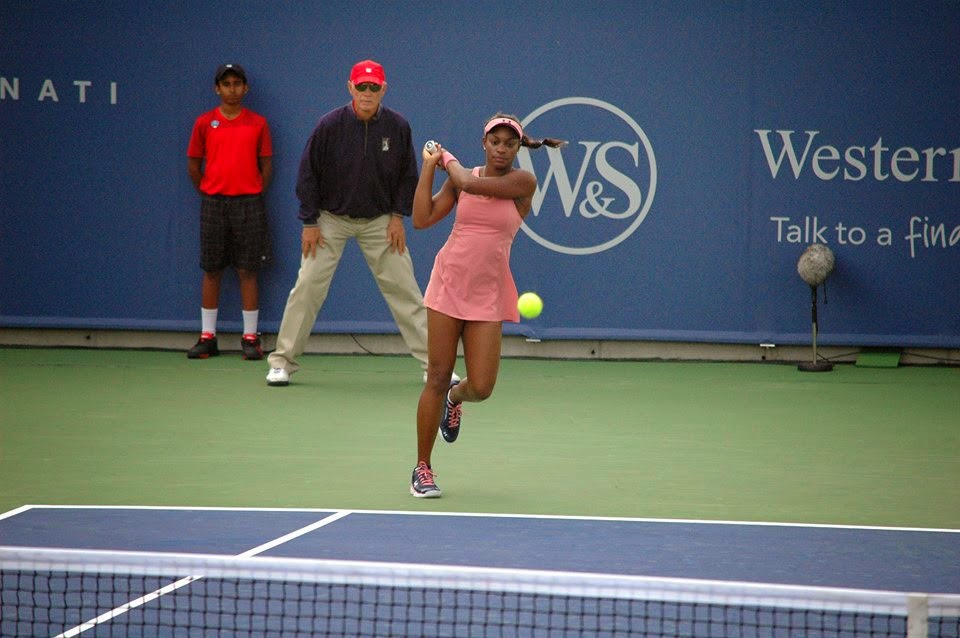
Now here is a picture of Sloane Stephens hitting a backhand.

In contrast, notice how casually she is hitting the ball. This looks more like the kind of shot you would see in a practice session, where players aren’t trying to hit that hard. So I think there is some truth to their hypothesis that she is afraid to play her best tennis.

In psychology, this phenomenon is called self-handicapping, and it is fairly common. I have worked with students who were so afraid that they would not get an A that they didn’t turn in any work and got an F in the class instead. They all believed that if they had put in the effort, they probably could have gotten an A, which helped to preserve their self-esteem. Sort of. Because they ended up on academic probation, which they were embarrassed and ashamed about.

To my knowledge, I have never sabotaged my chances of succeeding, but I can relate to the fear that my best effort might not be good enough. I have always wanted to be a therapist and thought I could be a good one–until I got to the clinical portion of my training in grad school. Then I started to worry: What if I suck at it? What if I’m no good at this thing that I’ve wanted to do all my life? What am I supposed to do then?

My worst fear came true: I did suck at it at first. I had several supervisors tell me that my anxiety was interfering with my ability to do therapy. (This was the first time I contemplated the possibility that I may have an anxiety disorder). Even though I ordinarily freak out when I’m given negative feedback, I wasn’t that upset. I knew that I could get better if I worked at it. And I think I’m a decent therapist now–although there’s always room for improvement.

The same is true for tennis. I’m not really afraid to go out there and play my best and lose, because my best performance today isn’t the best I can ever hope to play. At least I don’t think so. I always think I can get better, even as I get older. If this is a delusion, then at least it is one that serves me well. That’s why I look so intimidating in this photo:

So if you see me on the court, watch out!

Choices

When it comes to money, my mom and dad are on the opposite ends of the spectrum. My dad loves to buy things and does so often and freely with no regard for cost. My mom, on the other hand, doesn’t buy something unless it’s “half of half of half” off. Depending on the day, I can be on either end of the spectrum, but most of the time I am more like my mom. As a result, my relationship with money is plagued with anxiety and guilt.

For example, when my ex and I were at the airport on the way to our honeymoon, I bought a neck pillow because we had a long flight ahead of us. It had one of those tags that they have on mattresses that you aren’t supposed to remove under penalty of law, but it was annoying me, so I ripped it off, anyway.

Apparently this law exists for a reason, because after I ripped it off, all of those little white things started coming out of the gigantic hole I had created and were spilling all over the place. I had to throw the darn thing away. I was distraught about destroying my pillow less than 5 minutes after purchasing it and wasting $15. It was only fitting that I should have to spend the next 10 hours on the plane with an unsupported neck.

While I was berating myself for my obsessiveness, my ex bought another neck pillow and snuck behind me and put it around my neck. Unlike me, he did not obsess over buying stuff. This became a source of many arguments later, but at the time it was a sweet and loving gesture. He was not great with words, but this one action said everything I needed to know: it’s OK by me that you’re obsessive, and you still deserve a neck pillow.

When memories like these pop up, it activates the same cycle of thoughts. Am I doing the right thing? Is there anything more I could do to make things work? I go through the scenario of what it would be like if we got back together, and I always come to the same conclusion: things would be exactly as they were before.

I wish choices could be more clear-cut, like on a test. But life isn’t like school: answers are rarely 100% right or wrong. I have to remind myself that with any decision, there are things that I will lose. I can’t make the perfect choice. I cannot escape the sadness of having to give up the good parts of our relationship.

Memories like this one make me want to cry. But at the same time, I am also thankful. Even if things didn’t work out, he was a good guy. He was a good choice for many reasons. And even as we finalize our divorce, he continues to be kind and helpful. Not many people can say that at the end of a relationship.