Tag Archives: warriorism

Competitive Latch-Hooking

When we were kids, my mom got my brothers and me to entertain ourselves through arts and crafts. One year she bought us latch hook kits. 

My first project was a picture of Scooter from the Muppets, which she turned into a pillow. I quickly moved on to a picture of Linus. I can’t remember what my brother Jr.’s project was, but I do remember that what began as a fun activity for the 4 of us turned into a fierce competition between him and me.

My brothers and I had this unspoken code of ethics. If there were a box of 12 Fudgesicles, we were each allotted 3. Once my brother Romeo was looking for something to eat and my mom told him that there was a Fudgesicle in the freezer. He had already eaten his share so he didn’t take it. He knew better. She was confused, though.

When someone left the room, their seat was saved. This is because whoever was closest to the phone had to answer it and hunt my dad down, because it was almost always for him, and he was never close by. We would pull in every chair possible into the TV room to avoid sitting next to that phone.

Of the 4 of us, Jr. was the most law-abiding. He never cursed. He followed all the rules. He never lied or cheated. Unless we were playing Trivial Pursuit, when he tried to memorize the first few cards. Or when he was competing against me in something like latch-hooking.

As I reached the end of my Linus project, I ran out of yarn. Which really pissed me off. What kind of project lacks the necessary supplies to complete it? I thought it was only fair that he stop working on his rug until I bought more yarn. Since I’m the oldest, I made up and enforced most of the rules, so I took his latch hook. He did not protest because this was consistent with his sense of fairness, too.

But he wanted to win so badly that he secretly worked on his project without the latch hook. Because you don’t need it if you’re really determined. You can just do it with your hands. He quickly gave himself away though with his guilty laughter, so he didn’t get very far. Still, I took his rug from him, just to be safe.

I don’t even remember who won. He probably does, though. But we both remember how fun it was to compete against each other–in that instance, at least.

I realize that this fiercely competitive attitude is not the norm. Yet it still surprises me when people don’t feel the same way. I don’t understand why my colleagues don’t rush to turn in their paper work first. Or why some players don’t play in tournaments or leagues because they don’t like the pressure. Or why more people don’t read my posts about sacrificing my health for the sake of my team.

It’s not that I have to win. I often play in leagues above my level, so I lose quite a bit. It’s more about being fully engaged in whatever I’m doing. In psychology, this is called the state of flow, and it’s one of the experiences that leads to happiness. Competition puts me in flow. That’s why I do things like spend 4 months knitting a dress for my niece by Christmas.

I’m so proud of that dress that I thought I’d show you a picture of it, even though it is only tangentially related to this post.

In Times of War

I find it fascinating to read accounts of the things people do to survive in times of war.  I will never forget reading this memoir of a refugee from Korea.  She described how one mother threw her baby in the river while she was fleeing. That has become my symbol of survival at all costs–throwing your baby in the river.

One of the things I love about tennis is that you get to see what people would be like in times of war. Competition can bring out the best and worst in people. There are tennis players like Federer and Nadal, who are warriors but also class acts on and off the court.

And then there are players who couldn’t be nicer off the court, but once get them in a losing match, then you’ve got rackets, curse words, and insults flying everywhere. They question every line call. They cheat. They resort to gamesmanship. They do whatever it takes to win, no holds barred. You probably know some of these people. I have no doubt that in a war, these people would have a better chance of surviving than I would.

I read this book called The Noonday Demon where the author interviewed people all over the world to get different perspectives on depression. One of the interviews was with this tribe that fought bitterly in a civil war to survive, but once the war was over many of them committed suicide. I couldn’t understand it. But my husband at the time said that he totally got it, because he had to do whatever it took to survive.

Apparently, the things you have to do to survive make it hard to live with yourself after you’ve won.

I try to play with people who are competitive but are still the same person on and off the court. That’s why in my mixed doubles partner ad, I said I wanted a partner who demonstrates good sportsmanship, has a positive attitude, and never stops fighting for the win. I want to win, but most importantly, I want to be around people whose company I enjoy. And I want to have fun. Because the winning lasts a moment. But it’s the act of playing that is the living part. That’s what really counts. Living to play.

I think that for the most part, I am the person I strive to be on the court. In fact, I find it easier to be the person I want to be in tennis than I do in real life because I’m very intentional about everything I do in tennis. But, in all honesty, because I don’t want to win at all costs, combined with the excessive empathy problem, I’d probably reduce my chances of survival by doing something like helping someone who has no chance of making it.

But then again, we never know how things are going to turn out. We don’t know if we’re going to win or lose, survive or perish–because all the factors aren’t in our control.  So I try to make choices that I can live with, regardless of the outcome. And helping someone who may seem like they have no chance to win while trying to survive myself is exactly the kind of person I want to be.

Thanksgiving

There was a time when I questioned whether miracles really occur.  I could not understand why God would intervene in some people’s lives but not others in a way that appealed to my sense of justice.  Now I realize that you don’t have to understand why for something to be true.

As I await my parents’ arrival, I can’t help but remember when they came to my house for Thanksgiving two years ago.  At the time, my mom was obsessed with learning how to type to prepare for the dreaded electronic medical records implementation. 

My dad was still in the midst of the worst depression he’d ever experienced.  He was somewhat better than he had been two years prior, but still a shell of the larger-than-life person I had known all my life.  Still, in his compromised state he decided that he, too, would practice typing.  I was encouraged by this, because in his darker moments he barely had the motivation to exist.

Several hours later, he asked me for help.  When I looked at what he was working on, I saw that he had been trying to log on to his email account all of that time.  I wanted to cry.  But at the same time, I admired his determination to master the computer, even though he was no longer practicing medicine and did not have to worry about electronic medical records, and even though his cognitive abilities were greatly diminished. 

I write a lot of blog posts about my affinity for challenges.  It is definitely something that has been instilled in me by my parents, whose favorite motivational poster says “Don’t quit.”  On that day two years ago I was thankful that the depression had not destroyed my dad’s fight.  He was still a warrior, albeit a wounded one.

Last year around Thanksgiving, somehow the depression completely lifted after 3 years, even though nothing had changed in his meds.  It’s as though his personality finally broke through and he was exactly the way he had always been, which was essentially in a sustained hypomanic state.  It was truly like seeing someone come back to life. 

These days, he is constantly on FB, commenting on people’s pictures and posting copies of every photo album my parents own.  In fact, the only reason he is not on FB right now is because he is on his way to Knoxville.

My dad’s recovery is nothing short of a miracle, and every time I think of him I say a prayer of thanks–even though he tells me that I need to lose weight and gives me appetite suppressants.  Actually, he read that post, so now he tells me I look good.  So I’m thankful for blogs, too!

And wouldn’t you know that my parents showed up right as I finish this blog post.  God has perfect timing. 

I even have a picture for you today.

Meet the Drill Sergeant

Allow me to introduce you to the drill sergeant–one of my most challenging parts. Many of you may have a similar part. My drill sergeant demands productivity at all costs, and not in a nice way.

I am not a morning person, as I indicated in my first post. The drill sergeant doesn’t give a crap. He (I think of it as a he) doesn’t give a crap if it’s a weekend, either. He still wants me to get up. I don’t listen to him, of course, but I pay the price. For every extra hour of sleep I try to get, the drill sergeant yells at me, telling me how other people are up doing normal people productive things, while I am lying in bed wasting my life away.

It doesn’t matter if I don’t have anything pressing to do. The drill sergeant will make up random to do lists as though these things are of the utmost importance. You need to wash those bath mats! There are scraps of paper all over the house that need to be put in the recycling! I’m pretty sure there’s a mug in the sink that needs to be washed! Get up!

I have been sick for the last few days, which is very frustrating for the drill sergeant. I always get sick at this time of the year because, despite my best attempts to manage the stress of my job, I still get exhausted and can’t function. The drill sergeant is frustrated because I was just two days from making it to Thanksgiving break, but I had to miss a day of work, anyway. And I have to say, that frustrates me, too. But what can I do? I don’t even feel like playing tennis. Or eating! If you know me, you know that’s bad if I don’t want to play tennis or eat.

In my efforts to practice self-acceptance, I’m trying to get to know the drill sergeant better, understand his point of view. I can see how he’s trying to prevent me from a life of sloth-hood. And I do have to wake up early to get to work. And occasionally you really do need your drill sergeant–like when you have to channel your inner warrior on the tennis court.

So I’ve struck a deal with my drill sergeant. As long as I am waking up when I need to, fulfilling my obligations, and being a productive member of society, he can be on leave. But I have promised to call upon him when I am in need of some ass-kicking motivation.

So far, it seems to be working.

This doodle reflects my less positive emotional state at the moment. I think it looks like some kind of scary octopus with floating eyeballs, albeit in pretty colors.


Warriorism

Warriorism

I captained 5 tennis leagues this year, which most people would describe as an exercise in torture. Rescheduling matches is a pain, and it’s hard to make everyone happy, but for the most part I enjoy it. I see it as an opportunity to be a sports psychologist. 

One of the messages I try to instill is the idea that, just as we all have inner children (Sophie, for me) we also have an inner warrior. A good time to channel your inner warrior is when there is a crucial point, like serving at 30-40 at 3-3. Granted, some warriors are more deeply buried and out of shape mentally and physically than others. For those players on the team, we have the Warrior in Training program (WIT).  

The levels of warriorism have evolved over the years.  Last year I had an asthma attack during a singles match. I’d had a few of them before but I just assumed I was out of shape. Which made no sense, since I played 5-7x/week. But that’s how your brain works.

My friends saw that my lips turned blue and I was wheezing, so after the match they told me I was having an asthma attack and that I should have retired. It was this match that made me finally go to the doctor, which is how I found out that, in addition to allergies and exercise-induced asthma, I also have GERD. 

For these reasons, I no longer play singles. But at the time, I just thought I needed an extra-strength dose of warriorism. I channeled my inner drill sergeant (we all have one of those, too) and started yelling at myself: soldiers in the jungles of Vietnam didn’t get to quit! They had to deal with fatigue and lack of sleep and mosquitos and rain and fear of getting killed. So what if you can’t breathe?  So what if you’re losing?  So what if you can’t move? You still have to finish the match!

My friends thought is was so funny that I used soldiers in the jungles of Vietnam for motivation that this became our new rally cry. Before a team mate got on the court, we would yell “jungles of Vietnam!” Later this got abbreviated to Jungles! for short. I even got my team mates pins to put on their tennis bags with the word JUNGLES on it in an army-looking font. 

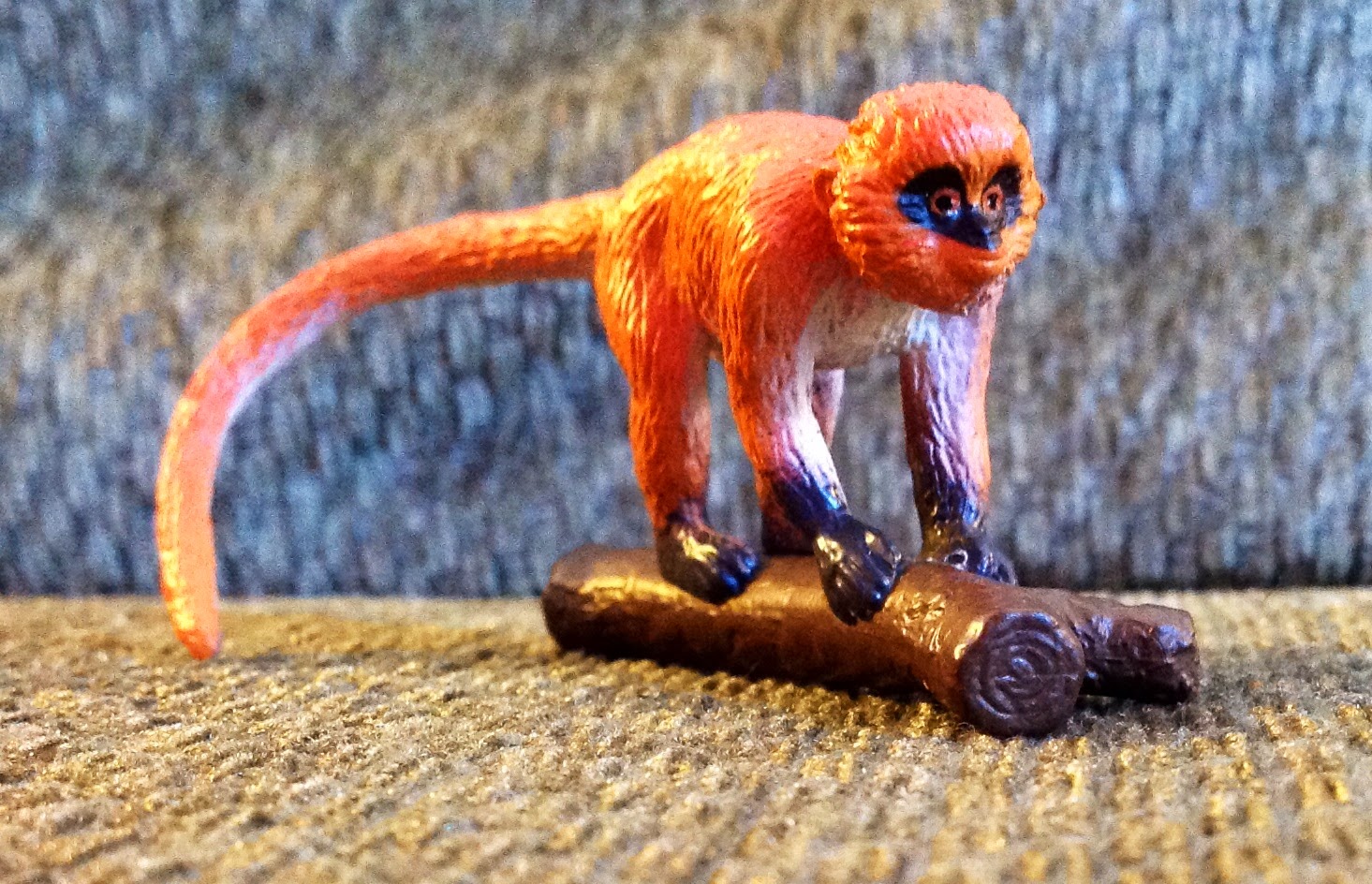
I also found some monkeys and apes, so I bought those, too.  I would have preferred a variety of jungle animals, but it was pretty amazing that they sold apes and monkeys at all, with exactly 12 per pack–one for each team member.  Even more amazing is that I was able to pick a monkey that represented each player.  So then our rally cry became ape and monkey calls for those team members who can imitate them. I can’t, so I still yell jungles.

The last level of warriorism is when you are in the trenches of the jungles of Vietnam.  This would apply when you’ve lost the first set and are down match point in the second set.  Or when you haven’t slept in over 24 hours and have to play at districts in the deciding match, which happened to me this past summer. Because it requires you to channel so deeply, this level should only be used in dire circumstances. The hill you are willing to die on.

I remember at the end of that match, after mentally preparing myself for battle the entire day and spending a good amount of time in the trenches, I was shocked that we still ended up losing. Then I realized that in war, there are warriors on both sides, and half of them will lose. In fact, a bunch of warriors on the winning side will get killed, too. So it’s not a fail-proof strategy.

Still, if I’m going to be in the trenches, I’d rather be there with my warrior in charge than any other part.