Category Archives: Relationships
In Agreement

In Need
I don’t like the word needy. I much prefer the word crazy to needy. Crazy can have many meanings, and not all of them are negative. Sometimes crazy can be a compliment. At least that’s how I interpret it when I’m feeling good about myself. Neediness, on the other hand, is never a compliment.
I admit I am sensitive to the word because I have been accused of being too needy, too demanding. I have tried to correct for this, but I don’t know how to distinguish my unreasonable demands from my needs.
I’ve tried to deal with it by giving my partner the benefit of the doubt. If he couldn’t give me what I needed, then perhaps it was a demand that I mistook for a need. How important is meaningful conversation anyway, really? How much contact is actually necessary for the survival of the relationship?
This approach hasn’t gotten me very far. I seem to have overshot my mark. My therapist tells me that I cannot disavow my needs in order to make my relationships work. Sounds good to me. But how do you separate the needs that are necessary for survival from the ones that make people accuse you of being needy?
Let’s say that you came across a boy who you met in the woods while hiking one day, like the wild boy of Aveyron. You feel bad for him so you invite him over for dinner. But he’s really hungry, so he eats all the food in your house and still wants more. Obviously, you wouldn’t blame the kid for this. You wouldn’t accuse him of being too hungry, because it’s not his fault he was abandoned in the woods to fend for himself.
Psychological needs are no different. Neediness is the product of prolonged emotional starvation. You may not be able to give the person what they need to feel satisfied, but that’s not their fault. It’s not yours, either.
But it feels like it should be someone’s fault, doesn’t it? Someone should take the blame!
I prefer to reframe a needy person as someone who is in need. Perhaps their needs are so great that I can’t help them. That’s OK; I don’t have to be able to help everyone–although I do still try.
I am trying to think of myself as someone in need, too. I am just learning what these needs are, because I’ve spent my life focusing on other people. There are a lot of them, and they have gone unfulfilled for a long time. I’m not blaming anyone for this, but I’m trying not to blame myself, either.
I’m just trying to make my way out of the woods.

Honesty and Trust
I have often been accused of being too trusting. Like it’s a bad thing. And maybe it is. It’s caused a lot of problems in my relationships.
My first husband described himself as a poor, half-breed bastard. As a result, he had a less trusting world view than I did. He could spot a liar from a mile away. Once when I was making conversation with his brother’s girlfriend about her studies in nursing, he told me afterwards that she was lying. That people often lie while making conversation. I didn’t know that.
This was a downright foreign concept to me. I figured you should at least have a good reason to lie, even if it didn’t make it excusable.
Once my purse was stolen at Burger King on the way to a bowl game. I forgot to get it when we walked out the door. I realized it about a minute later, but in that small amount of time, they took it. My ex knew who stole it right away and he knew that the employee who took our order was in on it. He even went up to the guy and confronted him.
While there were some advantages to his street smarts, ultimately, his lies destroyed our marriage. I tried to trust him again, but he didn’t trust himself, so we agreed to get a divorce. That was one of the many lessons I learned from my first marriage: be wary of people who don’t trust others, because they probably lie, too.
I wish I could say I have been more careful about who I’ve trusted since then, but sadly, I have not. I seem to be pathologically trusting.
I dated someone who told me straight up that he had problems with lying. And I caught him lying several times right away. Like my first husband, he didn’t think he could be honest, either, but he wanted to change. I kept rooting for him. You can do it! I have faith in you!
My therapist would repeatedly tell me that if the person says they can’t do it, believe them. I guess this was the most honest thing they had said to me, but I didn’t want to believe it. I never wanted to give up on anyone.
But I finally get it: you can’t trust people who don’t trust themselves. You can’t will someone to have faith. They have to choose it.
Some people have suggested that perhaps we can be friends down the road. Yes, he lies, but it won’t matter in a friendship. Except that it does.
In the second half of my life, I want to surround myself with people who are honest and trustworthy. I want to choose people who believe in themselves, so that we can believe in ourselves together.
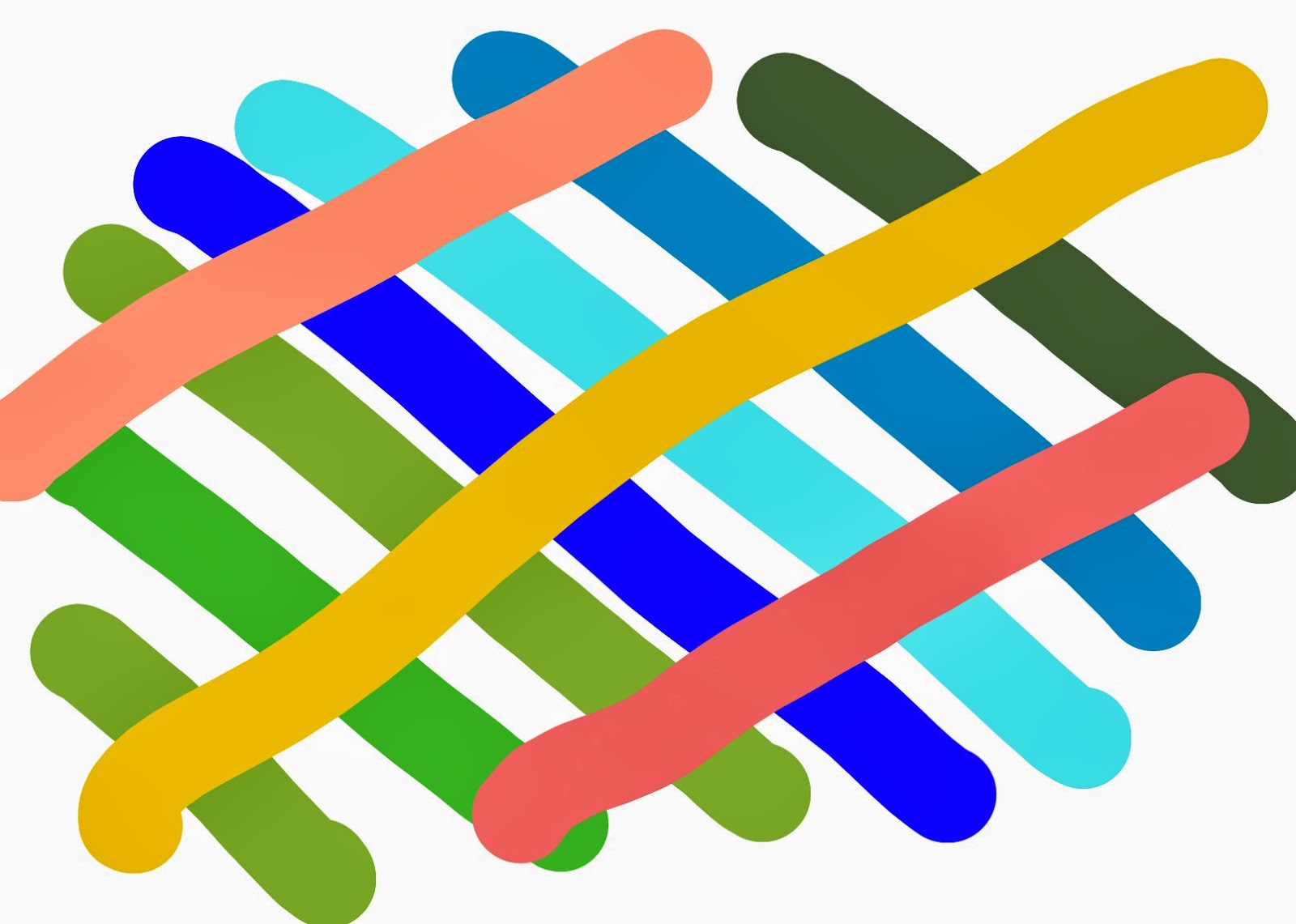
I found a new art app that creates patterns using mathematical properties. Artsy and nerdy at the same time. How cool is that?

Competitive Latch-Hooking
When we were kids, my mom got my brothers and me to entertain ourselves through arts and crafts. One year she bought us latch hook kits.
My first project was a picture of Scooter from the Muppets, which she turned into a pillow. I quickly moved on to a picture of Linus. I can’t remember what my brother Jr.’s project was, but I do remember that what began as a fun activity for the 4 of us turned into a fierce competition between him and me.
My brothers and I had this unspoken code of ethics. If there were a box of 12 Fudgesicles, we were each allotted 3. Once my brother Romeo was looking for something to eat and my mom told him that there was a Fudgesicle in the freezer. He had already eaten his share so he didn’t take it. He knew better. She was confused, though.
When someone left the room, their seat was saved. This is because whoever was closest to the phone had to answer it and hunt my dad down, because it was almost always for him, and he was never close by. We would pull in every chair possible into the TV room to avoid sitting next to that phone.
Of the 4 of us, Jr. was the most law-abiding. He never cursed. He followed all the rules. He never lied or cheated. Unless we were playing Trivial Pursuit, when he tried to memorize the first few cards. Or when he was competing against me in something like latch-hooking.
As I reached the end of my Linus project, I ran out of yarn. Which really pissed me off. What kind of project lacks the necessary supplies to complete it? I thought it was only fair that he stop working on his rug until I bought more yarn. Since I’m the oldest, I made up and enforced most of the rules, so I took his latch hook. He did not protest because this was consistent with his sense of fairness, too.
But he wanted to win so badly that he secretly worked on his project without the latch hook. Because you don’t need it if you’re really determined. You can just do it with your hands. He quickly gave himself away though with his guilty laughter, so he didn’t get very far. Still, I took his rug from him, just to be safe.
I don’t even remember who won. He probably does, though. But we both remember how fun it was to compete against each other–in that instance, at least.
I realize that this fiercely competitive attitude is not the norm. Yet it still surprises me when people don’t feel the same way. I don’t understand why my colleagues don’t rush to turn in their paper work first. Or why some players don’t play in tournaments or leagues because they don’t like the pressure. Or why more people don’t read my posts about sacrificing my health for the sake of my team.
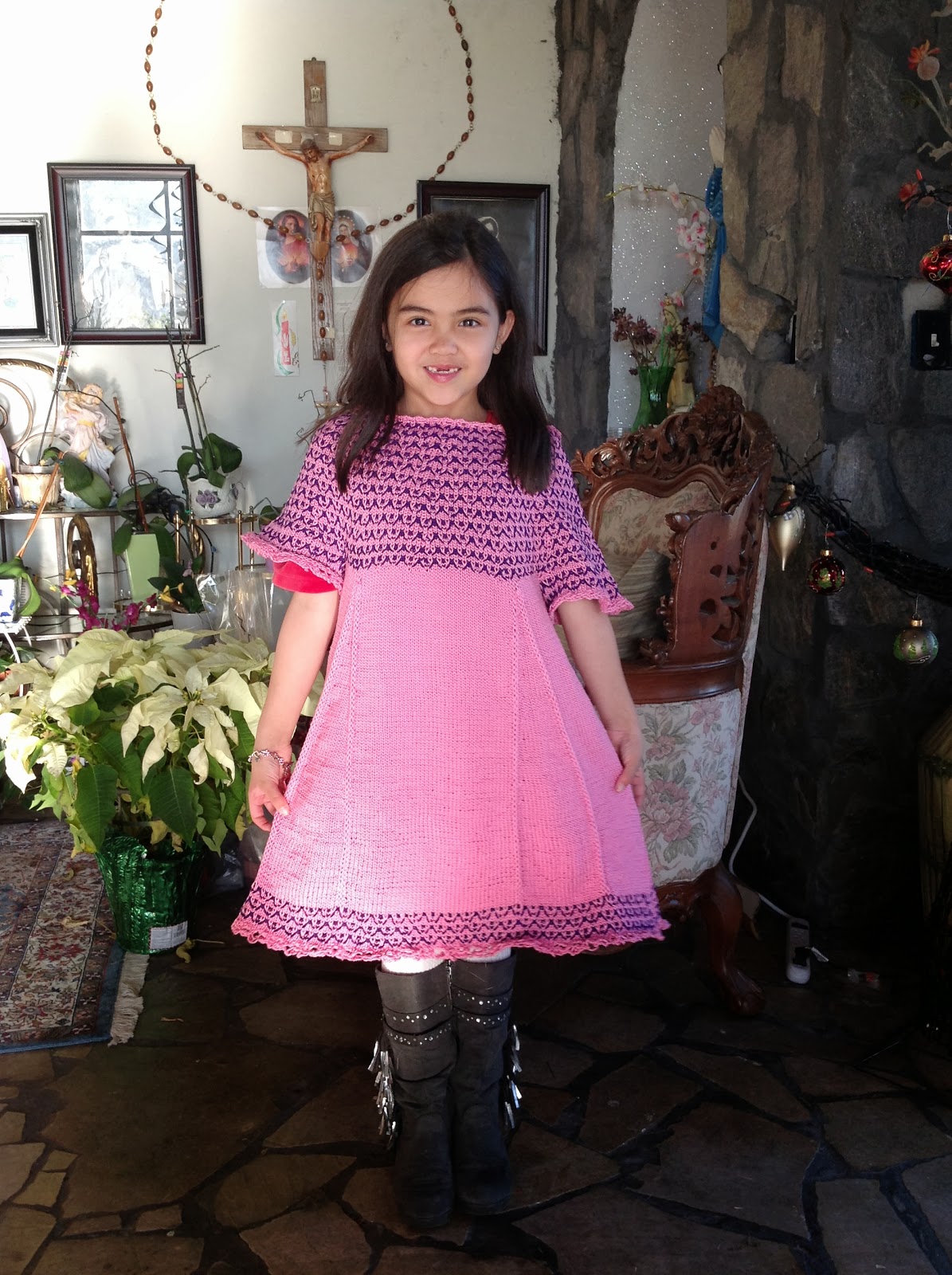
It’s not that I have to win. I often play in leagues above my level, so I lose quite a bit. It’s more about being fully engaged in whatever I’m doing. In psychology, this is called the state of flow, and it’s one of the experiences that leads to happiness. Competition puts me in flow. That’s why I do things like spend 4 months knitting a dress for my niece by Christmas.
I’m so proud of that dress that I thought I’d show you a picture of it, even though it is only tangentially related to this post.

Moms
I watched the Secret Life of Walter Mitty on Christmas (Warning: Spoiler Alert!). In addition to the theme of what it means to live a full life, I also liked the more subtle theme about how mom’s save the day.
For example, it is the mom’s cake that is used as currency for passage into forbidden territories. The mom’s piano is sold to cover Mitty’s worldly adventures. The mom’s photograph of the piano leads Mitty to Sean O’Connell. And ultimately, it is the mom’s rescue of the wallet that allows us to find out what the shot was on negative 25.
Yes, we want a life filled with risks and adventures. But these risks and adventures are often made possible thanks to the home base that mom’s provide through their more mundane, everyday activities.
My mom is a superhero. While I was home for Christmas, she hosted our Christmas Eve party. She cooked every day. She went to work on Thursday and Friday–as a physician, no less–while the rest of us lounged around the house. She carefully packed up our food in ice as my brothers and I left for home, one by one. The only gift she asked for was that we all come home for Christmas. This is the only gift she ever asks for, regardless of the occasion.
But there are disadvantages to having a superhero for a mom. It’s impossible to live up to the example that she has set. She often does know best, and I hate being wrong. She is aware of her superhero status and takes every opportunity to remind me of it. But I guess she has earned her bragging rights, and then some.
Often it is when children become parents themselves that they fully appreciate all that their moms have done for them. I do not have children and do not plan on having any unless it is through divine intervention. So the best I can do is to practice gratitude for all the big and small things that my mom has done to help me become the person I am today.
So this blog is dedicated to her, and to moms everywhere.

Forgetting
Based on people’s comments about my post on forgiveness, it seems that forgiving others is more of a problem for most people than forgiving oneself. So I thought I’d say more about that.
It’s important to distinguish between forgiving and forgetting. We can do one without doing the other. We have memories and feelings for a reason; they are survival mechanisms. If someone has hurt you or someone can’t be trusted, you want to remember that. You want to avoid people who can hurt you and cause you pain–especially if they have no remorse for doing so. And you don’t want to continue to put yourself in harm’s way.
Forgiveness does not condone the other person’s actions. And the other person doesn’t have to earn your forgiveness by apologizing. In fact, someone can apologize without really knowing what they’ve done wrong and without any intention of changing their behavior. So you’re not forgiving them for them. You forgive them because it benefits you to let go of your anger at some point. When you’re ready. Because it allows you to take away their power to hurt you.
Although we always deserve an apology when someone has wronged us, we don’t always get one. Sometimes it has to be enough to know that you were wronged and to forgive so that you can control the suffering that is in your control. Because really, there is so little that is in our control.
However, you might want to reconsider being in a relationship with someone who never apologizes for hurting you. Which is more about boundaries than forgiveness. You can have forgiveness with boundaries.
The part of our brain that houses emotional memories makes no distinction between past, present, or future. It does not know whether the pain is real or imagined. It does not remember whether the person apologized or whether you have forgiven them. The pain is always fresh and new when we are experiencing it. This is why people have flashbacks in Post-Traumatic Stress Disorder (PTSD).
I don’t have PTSD, but I am an emotional person with an excellent memory. So it doesn’t take much to trigger a memory of something that someone has said or done to hurt me. When that happens, it is as though I am living that moment all over again, and my feelings are as intense as they were when it first happened.
This is why forgiveness is an on-going process. You don’t decide to forgive and suddenly all the anger and hurt are gone. You forgive, and then the memory comes up, and you forgive again. And again. And again. And maybe in some moments you decide not to forgive because you’re really mad this time. And then you start all over.
Forgiveness requires patience, because our heart does not follow the time table of our mind. You cannot will yourself to be ready to forgive; you just have to be open to forgiveness and wait for your heart to follow.
I find great comfort in this because of my excessive guilt problem. Wherever I am in the forgiveness process is OK–even if it’s more on the “I hate this person” end–because in Buddhism, you accept all of your thoughts and feelings without judgment or criticism. At some point, I trust that my heart will be in a different place.
I may not be there today, or tomorrow, or next week even, but at some point I will be at peace. Because I am choosing to move in that direction. That is something I have control over.
Breakups
I have always found it strange that you can be so close to someone that you know all their habits, quirks, and life history, and then you break up and you have nothing to do with them.
Before, you knew what their schedule was for the day, what they ate for breakfast, what deep and meaningful thoughts they’ve had, if any, that day. Now you don’t know anything because you’re not there anymore, sharing the same space, sleeping in the same bed, sharing the minutia of your day.
But, with time, you also find out that you didn’t know the person as well as you thought. The process of breaking up itself teaches you things about your partner that you didn’t know about. Like how they deal with loss, how important you are, how hard they’ll fight for something they believe in. And what they weren’t communicating to you all along.
To me, the saddest thing of all is how cruel the other person can be in the breaking up process. How they can act like someone who never loved you at all. As though you had never made vows to spend the rest of your lives together. Or never intended to take them seriously. Suddenly, they can become a person who despises you and your sadness for making them feel guilty.
I’ve had the good fortune of not being broken up with in this way, but I have to admit, I understand why people do it. Personally, I preferred the passive approach. I always had an exit strategy–a guy who conveniently falls in love with me and can convince me to leave. A guy whose needs I could focus on to drown out the pain of hurting the other person.
It’s shameful to admit, and it’s so inconsistent with the person I see myself as being. The person that I strive to be. But there it is, example after example of exit strategies in my relationship history.
In my second marriage, I toyed with anger and exit strategies, but in the end I decided that I was going to have to stay in the relationship until I could leave in a respectful way. I tried to do it a few times in a disrespectful way and he wouldn’t let me. He wanted me to stay anyway. And that made me feel guilty enough to stay for a while longer. Eventually, I either had to find a way to be loving to both of us, or I wasn’t going to let myself leave at all.
I am proud that I did at least honor that commitment. To leave with love. But I can see why people don’t leave in this way. It’s easier to vilify the person to justify why you’ve left. Much easier than it is to hurt a good person who didn’t do anything to deserve it.
This is the hardest part of having so much empathy. Because no matter what happens, you’re still going to get hurt. My friends would tell me that I was more upset than he was because he’s on the spectrum and his feelings weren’t as apparent as mine are. But I could feel them, even if they couldn’t.
To this day, it still makes me cry, even as I write this, knowing that I caused him pain. I think I might even be sadder about the breakup than he is. This is why I stay in unhealthy relationships. It’s unbearable to consciously, intentionally break someone’s heart, even if it’s the right thing to do for both of you.
The only consolation I can find is that if you at least try to leave in love rather than hate, you minimize whatever pain is in your control. And experience some pride to mitigate some of the self-loathing.

Empathy
Sometimes you can have too much empathy. People call it compassion fatigue, but I found out during a compassion retreat that it’s actually empathy fatigue. Because empathy knows no boundaries, but compassion has boundaries.
One of the reasons why it seems like I want to save the world (which I don’t–just the people I’ve met) is because I can feel other people’s pain as though it were my own. When they are hurting, I’m hurting. So it’s really for selfish reasons that I help other people; I don’t like being in pain.
When I worked in day care after I graduated from college, the children who had the most difficult time adjusting were the ones who were attached to me. In case you are worried about your children being in day care, rest assured that there were some kids who loved it so much that they didn’t want to go home. They didn’t cry when their parents showed up; they just wanted to keep playing.
But not these kids. These were the kids who cried from the moment their parents dropped them off until they picked them up in the afternoon. And this would go on for weeks. It actually drove me crazy. I didn’t feel positively towards those kids at all. I mean, I didn’t think negative thoughts about them. They just caused me unbearable pain. Which is why I could never understand why they were attached to me.
Now, looking back, because I could feel their pain, I would break the rules and hold them all day because it’s the only thing that comforted them. Back then you weren’t aloud to hold or carry the kids because you didn’t want them to get too attached to you. Which I thought was ridiculous even before I started grad school.
It turns out that being held is one of the best ways to soothe people. So next time you’re feeling upset, ask for a hug from someone you care about. Or do something that feels like a hug, like take a warm bath or wrap yourself up in a weighted blanket.
Sometimes I feel like I’m a receiver that picks up the emotional equivalent of radio waves. I’m bombarded by all of these feelings, all the time. Sometimes I don’t even know where they’re coming from. I wish I could just turn the receiver off every now and then. Or at least turn the volume down. Anything to have some relief from the constant noise.
The best solution I’ve been able to come up with is the yes and no thing–yes to what I want, no to what I don’t want. I need to choose the people who I’m around more carefully. If it’s someone who doesn’t take responsibility for dealing with their own feelings, I need to stay away. I can barely deal with my own feelings.
Maybe it sounds cold and calculated. Or maybe it only sounds mean to me. Maybe for normal people this is status quo in terms of how to keep other people from overwhelming you.
I always tell clients that if it comes down to you and someone else, you have to pick you, because there’s no guarantee that anyone else will. So from now on, I’m going to try to pick me.
Friendship
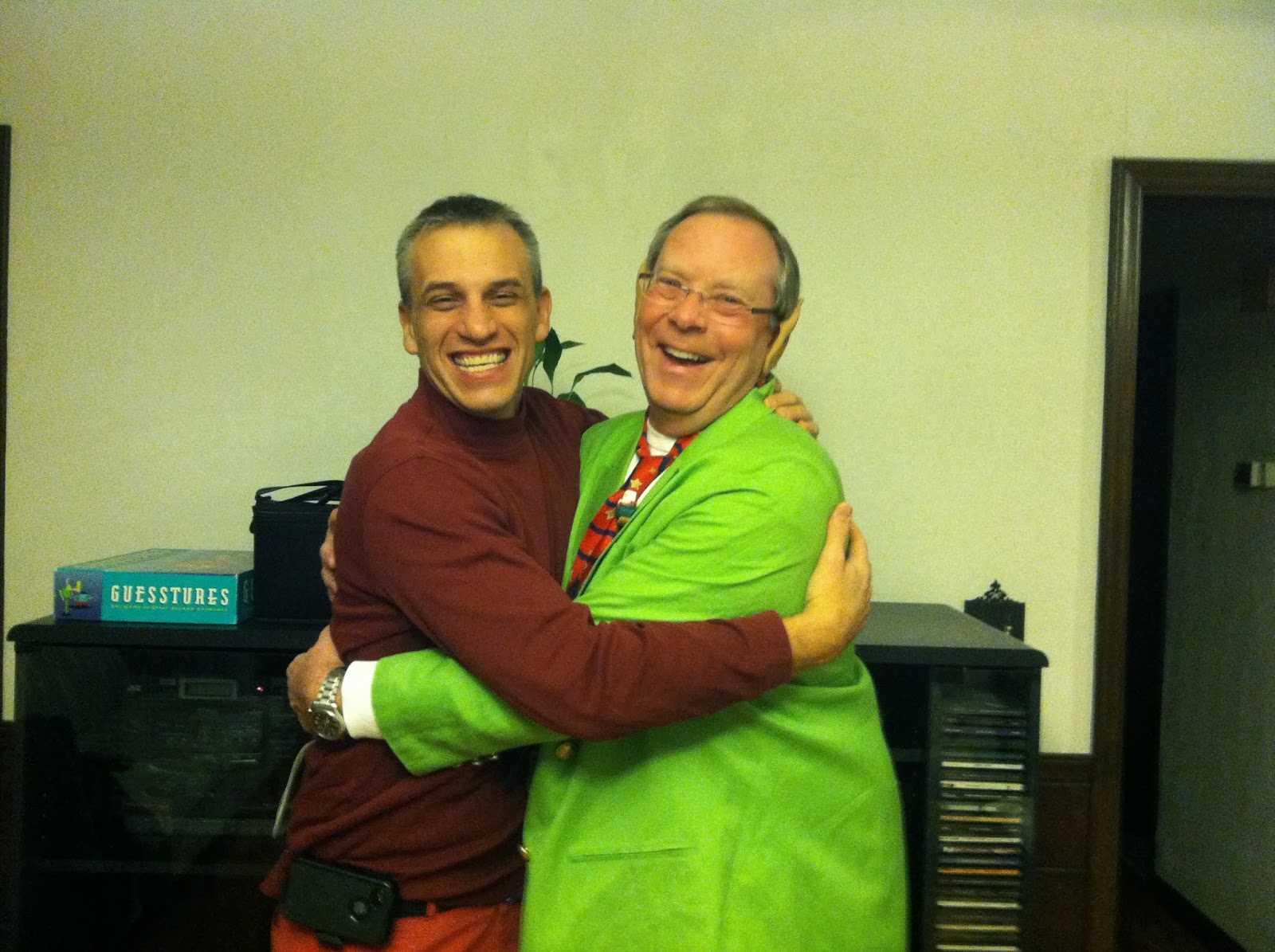
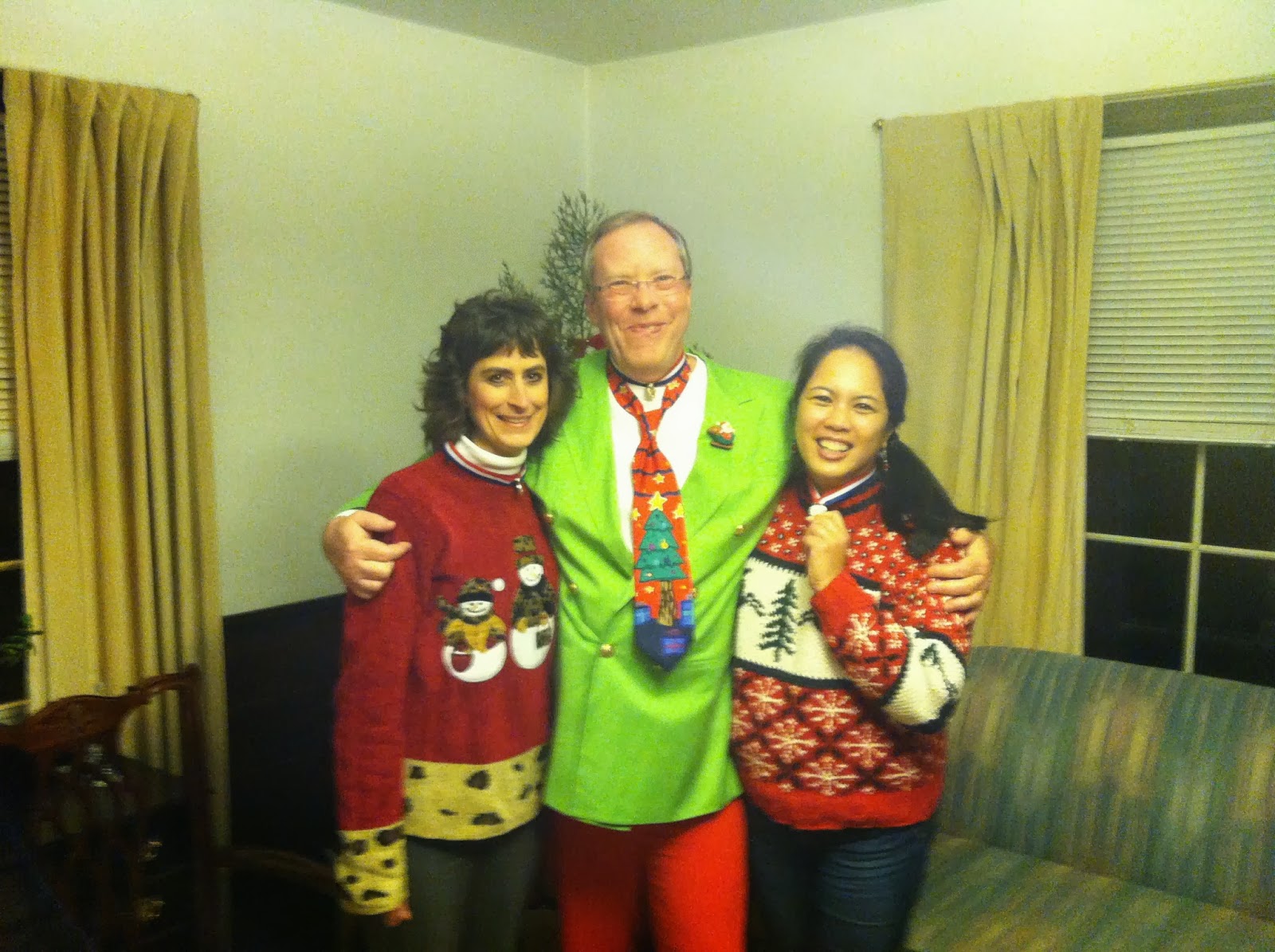
We even had prizes for Christmas attire: Ugliest sweater, Most Festive, and Prettiest Sweater. Guess which person won each prize from the picture below:
I am so thankful to have such good friends.
In my first marriage my husband and I were everything to each other–just like in love songs and romantic movies–but we didn’t have many friends. Perhaps at some level we feared that if we told people what our relationship was really like, they would see how fragile our marriage was.
I believe that lessons are often learned from tragedy, pain, and hardship–particularly lessons you don’t want to learn. What I learned from that relationship is that no single person can be everything you need. And when you lose that person who has tried to be your everything, you are left with nothing.
So I vowed never to allow myself to be that socially isolated again, and I have done a pretty good job of honoring that commitment. In addition to playing and captaining all of those tennis teams, I also organize most of our social events and play the MC at the parties, making sure that our time is evenly spent between eating, singing karaoke, and playing board games.
However, I am still more inclined to play the role of therapist with my friends than friend in need. And I use all the same excuses that my clients use for not asking for help: I am a burden, a broken record, a person whose feelings may be too much for other people to handle. A person who is too needy, too demanding.
I’ve spent today the way I spend most Saturdays–tired and alone. I did text a few friends. And I talked to my brother. And I’m writing this blog post. So I’m trying to reach out. But it will always be more natural for me to help than to be helped.
Perhaps whenever I have doubts about whether my friends want to be there for me, I can look at the deranged elf pictured above and remind myself that only someone who cared deeply about me would pose for a picture that can be posted for all the world to see.
Yes and No
Being alone isn’t as bad as I thought it would be. Relationships are an area where I take on challenges without asking myself whether it is worth the effort, so it’s a nice change of pace to have energy to expend on myself.
When I was in school, the reason why I was a good student is that I did what teachers told me to do. It never occurred to me that not doing the reading or homework and not studying were an option. I also try to fulfill my job responsibilities because I’m afraid that if I make one mistake I’ll get fired.
I think it’s partly due to my Catholic upbringing. I’m a rule-follower to begin with, but I also fear that if I break the rules I will go to hell. If I call a ball out, I’m afraid I’ll go to hell because I wanted the point so badly. So usually I just call everything in, which is sometimes to my advantage because my opponent wasn’t expecting to play a ball that was a foot out.
I used to have this prayer where I would ask God to forgive me for all my sins, intentional and unintentional, because I thought, what if I’ve sinned and I didn’t realize it? Then I couldn’t ask for forgiveness and I might go to hell. So I figured this prayer covered all the bases.
Most of my relationships weren’t of my choosing. If someone liked me, I would date him because I thought that would make him happy. And it was all about making the other person happy. Feeling ambivalent was not a good enough reason to say no because my feelings didn’t count. And it’s hard for me to end relationships because I’m not allowed to hurt anyone. Although I often ended up hurting them, anyway.
This is also the reason I became a psychologist and feel compelled to save the world. If someone is hurting, then it’s my job to help them if I’m able to do so. It doesn’t matter if I want to do so, whether I like the person or not, how stressed I am, or how much energy I have to expend.
My superhero family members also share this sentiment, as I mentioned in a previous post. They are even more extreme in terms of putting other people’s needs first, even if it hurts them. So I really haven’t had good role models for setting limits.
But thanks to this blog, I’m beginning to set limits. I’ve quit that crazy writing job where I was spending 10-12 hours on articles that gave the most superficial advice possible for $25 a pop. I ended a relationship and am learning to be alone. I have narrowed down my extra-curricular activities to tennis, knitting that dress for my niece, and writing/promoting my blog. Which is still a lot, but it’s an improvement for me.
My new rule is to say yes to what I want and no to what I don’t want. I said this 3 years ago, but sometimes it takes awhile to do what you know you need to do. So I’m trying not to beat myself up about that.
So from now on, it’s yes and no. Hopefully.