Category Archives: Mental Health

Guess What? I’m Neurodivergent!

I see a lot of women diagnosed with ADHD in adulthood because they had managed to compensate and succeed with considerable effort, despite having the disorder. It took a while for adults with ADHD to be noticed at all, since the stereotype of ADHD is the boy who can’t sit still in his seat and runs to the window when an ambulance passes by. But it’s even more difficult to diagnose in women because they usually don’t have the hyperactive symptoms that lead to recklessness, impulsivity, and sensation-seeking.

Now in the literature the same phenomenon is happening with people on the autism spectrum. In fact, Autism, ADHD, and Bipolar Disorder are all a part of a larger category called neurodivergence. If that word calls to mind the movie or novel Divergent, it’s actually kind of fitting. People who were different in some way were isolated and seen as a potential danger or threat to society. Not so different from what many people think now.

What’s strange, though, is that many of these women who show traits of being on the spectrum want to be formally diagnosed with Autism. I would explain to them that it wouldn’t really benefit them now because they are adults, and they no longer get accommodations, IEP’s, early intervention programs, and other resources that neurodivergent children can take advantage of. But after reading Divergent Mind, now I do. They wanted to know that their experiences are a known entity with a label and that other people share their sensitivities.

Because I have so many of these clients, I decided to read the book Divergent Mind. And it literally blew my mind. Like, I could feel the neurons in my brain firing, making connections between bits of information I have gathered throughout my life. It was like the equivalent of runner’s high, but a kind of intellectual high that you get when you have a Eureka moment. Or like Neo in the Matrix when he could finally read the code.

Nerenberg describes neurodivergence as simply cognitive differences rather than mental disorders. And there are lots of characteristics of neurodivergence that aren’t considered abnormal but make it difficult for people to navigate the world, nonetheless. Often they are diagnosed with depression or anxiety, because living in a neurotypical world sucks the life out of them. Or they are in a constant hypervigilant state.

The geniuses I went to high school with (you know who you are) are also neurodivergent. But since it’s not a bad thing to be brilliant, no one includes them in this category.

I kind of figured my whole family was neurodivergent, because half of them have bipolar disorder and the other half have anxiety. Some of them have both. I have known for some time that I am a highly sensitive person (HSP) because I read The Highly Sensitive Person decades ago.

In particular, I have mirror synesthesia. I can’t watch horror films because when someone’s arm gets cut off with a chainsaw, it hurts my arm. And I don’t like reading or watching anything that depicts the Holocaust in great detail, because their pain overwhelms me.

I also have a sensory processing disorder (SPD). My brother once told me I had supersonic smell. I don’t like the tickers on ESPN because I get distracted by them and stop watching the game. I don’t like hugs. I’m constantly adjusting the volume on the TV because music makes it louder.

I have insensitivities in proprioception, which means I have difficulty judging my body in space. Consequently, I have bruises all over my arms and legs and have no idea where they came from. Or perhaps because of my sensitivities I don’t have enough bandwidth to calculate my dimensions in space.

I have the same problem with interoception, which is why hunger and depression feel the same to me. And anxiety and having to pee feel the same. I tighten all my muscles when I’m concentrating even if those muscles aren’t needed when I’m playing a song with one finger on Duolingo.

None of these things are necessarily disorders. In fact, Nerenberg refers to them as potential superpowers—IF someone can learn what their sensitives are and learn how to self-sooth when they feel overwhelmed.

Medication and therapy can be helpful, but another possible resource that I didn’t know about is occupational therapy (OT). An occupational therapist can help you identify what your sensitivities are and develop specific coping strategies so that you don’t become overwhelmed and shut down, melt down, or stay in fight/flight/freeze.

After I found this out, I told all of my clients about this resource. Even clients who have stopped seeing me, perhaps because I couldn’t help them with their sensitivities. And I have to say, because I now recognize what my clients’ sensitivities are, or at least recognize that they become dysregulated because of some sensitivity, I feel like the knowledge itself has also become a superpower.

As a result, the mindfulness book that I told you I was going to write is going to specifically address people on the spectrum. Because mindfulness is about being more aware of what’s going on inside you and around you. While everyone can benefit from mindfulness, perhaps people who are on the spectrum who don’t want medication and/or therapy can read this book and learn how to develop tools on their own that can help them thrive.

So stay tuned! Reserve your copy today!

Just kidding. It’s going to take a while.

But definitely check out Divergent Mind!

I’m Ready to Write My Book!

Photo by Mike on Pexels.com

Last week on September 24 my blog turned 12. I have learned a lot about myself, relationships, human nature, love, and life through blogging. But that wasn’t the reason why I started my blog. If you’ve been reading it since I started it, then you already know that I started a blog because I wanted to write a book. But no one had ever read any of my writing, so I didn’t even know if I was any good at it.

Well, now I feel pretty confident that I can write in a way that sounds like me. I’m less focused on being good than I am on being authentic. And my posts are definitely authentic. Thank goodness you have to take a deep dive through hundreds of posts to know what all my flaws are. And for those of you who have done so, thank you for letting me know how helpful it was to hear about my flaws rather than judging me for them. I had no idea that I would be helping so many other people in the process of learning how to be vulnerable, as Brené Brown suggested in Daring Greatly.

Since my hip surgery, I have unconsciously been doing things that have been moving me closer to writing my book. First, instead of resting during that first week after surgery, I was asked to write an article for an online magazine on any topic of my choosing. So of course I chose mindfulness. And since my family was taking care of me at the time, I read the article to them to get feedback from people who knew nothing about mindfulness. My sister-in-law was especially helpful in terms of the questions she asked me about practicing mindfulness.

In the second week of recovery, because working full time 2 weeks after surgery was not enough productivity for my drill sergeant and inner critic, I also started making short videos of the epiphanies I was having about my recovery. All of the epiphanies are rooted in mindfulness and self-compassion, not surprisingly. I thought making videos might also be helpful in securing an actual assignment as a UGC creator.

The third thing that happened is by the 5th week of recovery I hit a wall. I had been working more than I did before hip surgery and was pushing myself on the weekends socially and physically. I realized that it was my blog anniversary last week and I was still struggling to practice self-care and set boundaries–2 of the major topics I blogged about. This epiphany made me step up my game and finally give myself permission to move to 4 days a week in January 2026. That way, I won’t have enough hours in the week to say yes to everyone.

Part of what enabled me to do this is that, despite taking a lot of days off and having a lot of medical bills, I was still able to pay all my bills without using any savings. I think I might have even added a little to savings. So I finally got God’s message: I don’t have to worry about money.

The final sign that I’m ready to write my book came while I was reading “The Let Them Theory.” So many of my clients have mentioned the book and said they found it helpful. And I can see why it’s helpful. It simplifies one of the basic tenets of mindfulness practice, which is called equanimity. The mantra for equanimity is “may we all accept things as they are.” This means 2 things: 1) accept the ups and downs of life, our moods, our successes and failures; and 2) accept that although we may want people to change, we can’t take responsibility for their behavior.

So “let them” eat junk food and watch TV all day. And “let me” learn to regulate my own emotions about losing them to a heart attack. I have recommended the book to many clients since reading it, and I recommend that you read it, too, if you find it hard to let go of controlling other people.

Although I liked the book for my clients, for me personally, I recognized that the Let Them theory is not really a theory. It’s more of a mantra. She admits in the book that she came up with the phrase and found it helpful. Then, after the fact, she found experts who could tell her why it’s helpful and mentioned them briefly in the book. As a psychologist, I prefer books that are rooted in theory and/or research, like The Anxious Generation, which I also highly recommend if you’re wondering why going on social media makes you feel like crap but you doom scroll for hours a day, anyway.

Plus, the goals she suggested in the book are often materialistic and superficial in nature. Which is fine, in that people can set whatever goals they want. I admit, when I first had the idea of writing a book, I wanted fame and fortune. I think that’s why I wasn’t ready to write it. Because those weren’t the appropriate goals for me. I’ve never prioritized making money. I often regret that I didn’t prioritize it, and because I didn’t, that’s why I’m always worried about money. But the truth is, I know what my purpose is. It’s to help people.

For me, mental health isn’t about being sick. People need therapy because life is hard and full of trauma and tragedy. We need help in identifying our values, having some kind of spiritual practice, prioritizing play and creativity, and learning how to love and be loved.

What I am meant to do in this lifetime is help more people find their purpose without having to see each of them individually in therapy. So once I start my 4 day work week, I will start writing my book, which will be called something like How to Practice Mindfulness in Everyday Life.

If you’re interested in watching the videos I’m making, I’m including the latest one below because it’s probably the one that best shows my personality–unatheltically athletic, determined, goofy, and relentlessly optimistic.

Oh, and feel free to follow my Instagram page as well, so that you’ll know when to buy the book!

Hip Recovery Update

For those loyal readers following my hip replacement surgery, I wanted to give you an update.

Despite not playing pickleball, not being able to go to barre classes with my family, and being far less social this summer, I was in fairly good spirits until a few weeks before surgery. I had to start asking for help from my family, and I hate asking for help. Or perhaps it would be more accurate to say that I don’t like asking for help because I’m sensitive to rejection. My inner critic is always telling me no one cares about me, so it’s easy for me to interpret people’s actions as not caring.

In addition, my surgery got moved up by a week. To most “normal” people, that would be good news. But I had been planning for 3 months to have the surgery on a particular day, and the change required me to cancel additional appointments, cancel my friend’s visit–which I had been looking forward to all summer–and stop my pain meds immediately. Not that they were helping. But still. It required a lot of change.

I was also dreading feeling more pain than I was already experiencing, since it had become excruciating. And I was determined to do my exercises every day until the surgery. I ended up skipping my exercises the night before surgery because I had to wake up super early and by that point it seemed irrelevant.

The good news is that I was super relaxed and joking with all the staff, nurses, and doctors while I waited for my surgery. I fell asleep before they even started the anesthesia because they gave me something for anxiety. And after I could feel my legs and they made me walk, I walked effortlessly. And because they gave me an epidural, I wasn’t in pain until about 12:30 am Saturday morning.

I have to admit, the next 2 days were pretty excruciating. Mainly because I was trying to be compliant and get up and walk every hour or 2 while I was awake, and it was torture getting on and off the couch. l only used the pain meds to sleep because I was so paranoid about addiction, so mainly I sucked it up. Luckily by Monday I was good.

This was also when I had my first PT session and he said I was in the top 5% of people in recovery. And you know how I like getting A’s. He said I didn’t need to use the walker anymore and that I would be able to drive later in the week, which is 3 weeks earlier than expected. And as he predicted, by Thursday night I moved back home and by Friday I was walking unassisted and drove 3 times.

My progress has continued to improve rapidly, but because my entire body had been compensating for my hip, I have become more aware of my back pain, which had been present before the surgery but I guess I didn’t register it. But since I dove into work the second week because of my irrational fear of not having money, I had a knot in my back that I had to try to massage and stretch out 5-6 times a day. I would have much preferred to take all the time I had set aside to be off and watch the U.S. Open but the drill sergeant was not having it.

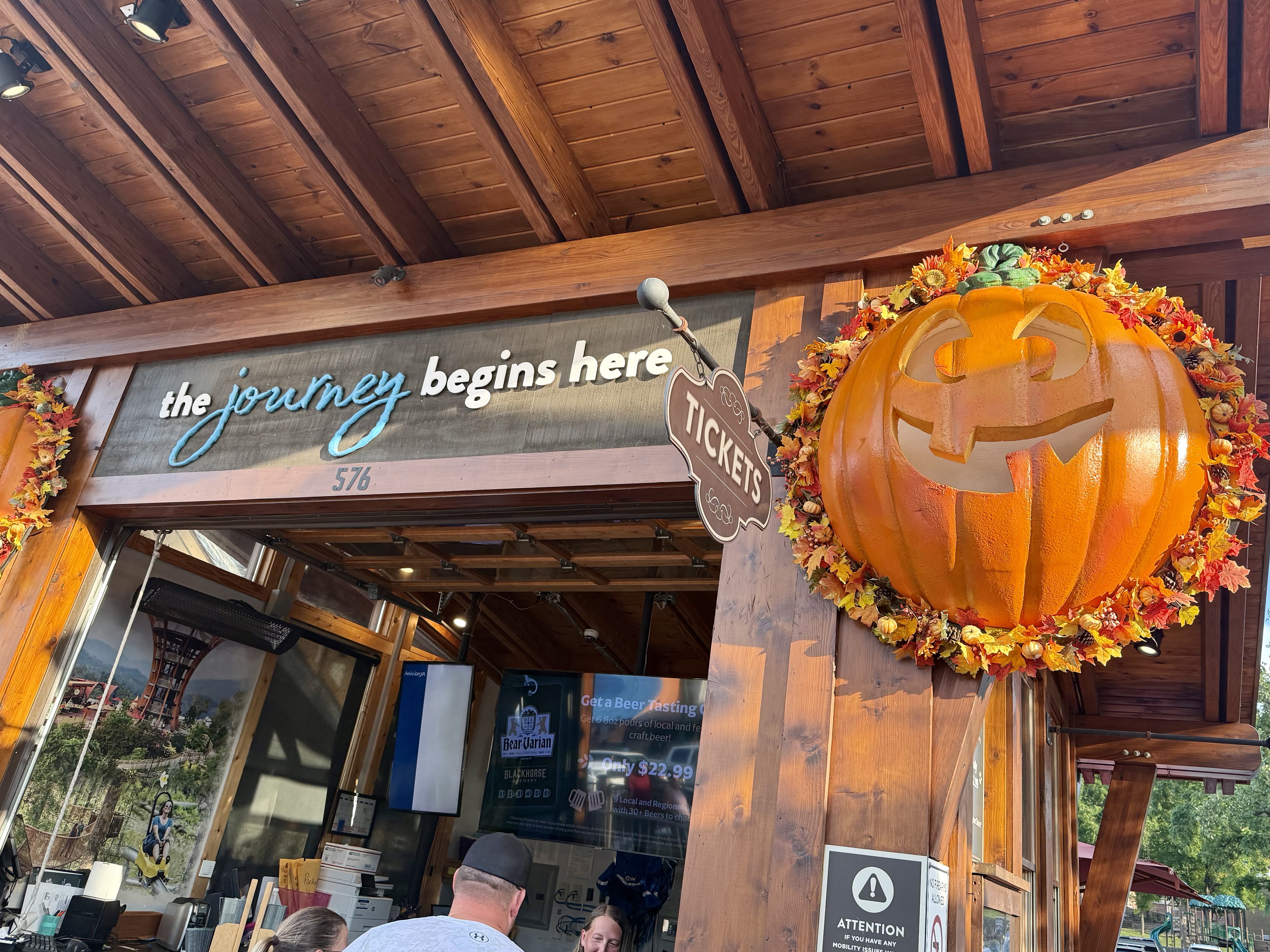
On a positive note, my friend did get to visit me over Labor Day weekend, which worked out better because I was able to walk and drive. We even went to Anakeesta, which ended up being a bust. But I made a video about it that I thought was funny, even if no one else on the trip did.

I’ve learned a lot of lessons from this experience, some of which I’ve shared on my Instagram page if you want to check them out. But I’ll share theme here, too.

  1. People care. As always, when I’m vulnerable, my inner critic is the loudest, but it is always wrong. My family took great care of me. My friend drove for me and gave me tons of positive reinforcement. My friends checked on me. Even my clients asked about me. It’s true that it is an illusion that we are separated from love. We are always connected.
  2. Pain tolerance is a mixed blessing. Had I gone to the orthopedist sooner, like 3 years ago when I had planned, perhaps I could have delayed my surgery. But if it weren’t for my determination to be as strong as possible and do the exercises for 3 months before my surgery, perhaps I wouldn’t have recovered so quickly.
  3. Patience is a virtue. I argued in a former blog post that it is not, but that’s because I was, and still am, impatient. But having to wait for hip surgery, and having to wait another 4 weeks to play is helping me practice, and I think I’m the better for it.
  4. I have much to be grateful for. It’s true that in any given moment, we can look at what we don’t have, or we can look at what we have. We can look at both, even, and perhaps that’s the better option. Rather than “bright-siding” it, which is dismissive of our pain, we acknowledge everything and then decide what in this moment we want to focus on. Right now, the thing that keeps me going is the hope that I can play tennis again, after 6 long years of not being able to. And even if I can’t, I want to be active and see my friends again.

Birthday Reflections, Part 2

You know how people ask you how you feel to be a year older and you usually say the same? Well this year I felt great! And I haven’t felt great in a long time. Which is why I haven’t written a blog post about myself for a few years. So I figured it was time for an update.

It’s been almost 4 years since I’ve moved, and it has taken a long time for me to feel like myself again. Like, in the past few months I had gone through a long depressive episode that was the worst I had ever experienced. And I was already feeling pretty bad, since I moved because I was under so much stress I thought I was going to die before I got to retirement age. So to think that things were going to get better and instead have them get worse for 2-3 years really made me question my relentless optimism.

But I still pushed myself to make a life here–without friends who I considered family, without tennis, which was my life, without financial security, and without a partner. I did lots of things out of my comfort zone. I went to Meetups. I forced myself to go to fitness classes. I started playing pickleball even though I sucked at it. I went on dating apps even though I hated it.

The only things that were successful were pickleball and dating apps. I have made some good friends now, and I met someone who I’m still seeing. He’s a lot younger than me, which was hard to reconcile at first, but now it actually helps me feel younger. In my first birthday blog post I said that I didn’t feel that mature, and I still kinda don’t. Maybe it’s because I am so in touch with my inner child. I don’t know if the relationship is going to last, but I’m becoming more comfortable with not knowing and just accepting what is.

I’m also trying a lot of new things this year, which is also helping me feel more joyful. I’m into Lego flower sets, in addition to my other hobbies. I signed an acting contract with a local talent agency in December and last month I signed a contract as a UGC creator, despite not having any acting experience or not knowing what a UGC creator was. So it’s been an interesting journey. I’m not expecting to make a lot of money, but it gives me other ways to express myself and be creative. And just to see what happens without any expectations.

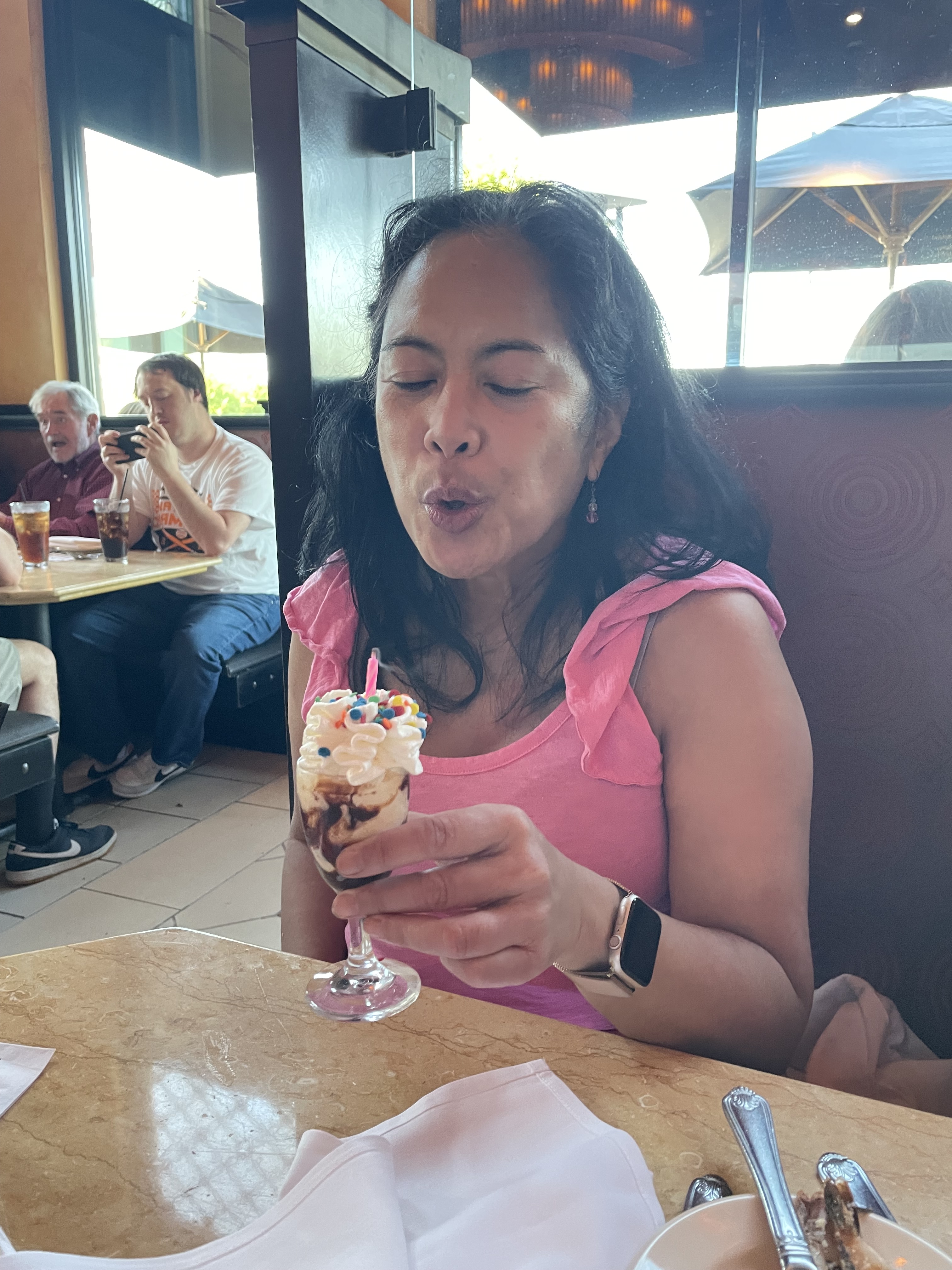
For my birthday, one good friend came down to visit me, another good friend sent me a meal, the guy I’m seeing came down to surprise me, and I celebrated dinner with my family and with one of my pickleball groups. So I ate well for several days. And all of the Happy Birthday wishes really moved me. I feel so grateful that people took out time to wish me happy birthday. Sometimes several times. Although that might have been an accident. I do that, too. Now I understand what senior moments are. Or what I like to call brain farts.

The other evidence that I’m getting older is that I’m scheduled for hip replacement surgery on August 21. I’ve obviously had arthritis for decades, and I knew my hip was hurting, but I didn’t realize how advanced it was until I fell while playing pickleball back in January. We were going to Disney World in February and I was going to have to walk 20,000 steps a day, so I decided to go to an orthopedic doctor. For some reason, it never occurred to me that the pain could be arthritis. Even more shocking was that it was so advanced that he didn’t think the injection would help and that I would need hip surgery soon. I didn’t believe him but he was right. The first injection lasted just short of 3 months, and the 2nd injection didn’t work at all.

Despite these telltale signs of aging, I’m still in pretty good spirits about it. The prognosis looks good. I should be able to return to pickleball pretty quickly. And I have people to look after me while I’m healing. Financial insecurity and not having anyone to rely on have been 2 of the biggest anxieties of late. It turns out I don’t have to worry about either. For now.

But that is another place where I’m trying to practice mindfulness and be in the moment. My favorite quote is that mindfulness is the process of constantly letting go. Maybe one of the reasons I started practicing is because I knew it was going to be hard to let go of all of the things you lose in life. And to accept all of the things that I had already lost. Plus I wanted to be aware of all of the things I still have to be thankful for. And since I’ve started practicing lovingkindness as well, I’m better able to feel other people’s love rather than question it, worry about losing it, or be anxious about not being loved at all.

I also mentioned in my first birthday blog post that having people read my blog was a gift that I had not anticipated. People would tell me how much it meant to them, when I was just sharing the things that made me feel so flawed. I had no idea how great that would feel. Now I only write occasionally, but people still read my blog, even though I do nothing to promote it anymore. And I’m thankful for that, too.

So brain farts and hip replacement surgery vs. all of the love and new experiences I have in my life. I’ll take that ratio. And speaking of numbers, 56 is divisible by 2 and 7, and is therefore not a prime number. If you read my first birthday post, you know how I feel about prime numbers.

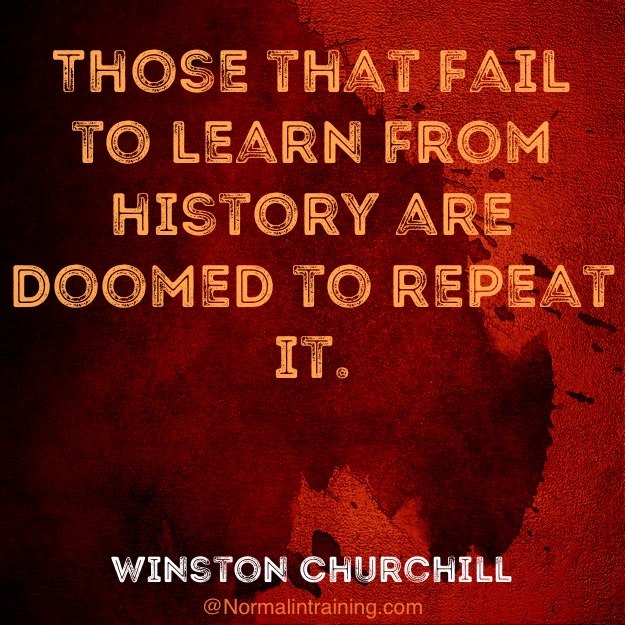
Can We Really Learn From the Past?

We are facing a difficult time in American history. A time that is eerily similar to previous periods of history where lots of bad things happened–in our country and around the world. People often say that we study history so that we can avoid repeating it. But I’m not sure that’s a given. Take the Bible, for example. In Genesis we learn early on about a sibling rivalry that turned murderous. And when God asked Cain where his brother was, he asked sarcastiically if he was his brother’s keeper. So murdering of family members, denial, lies, and gaslighting have been around for the entire existence of the human race.

Moreover, when Jesus was preaching about how to enter the kingdom of God, he did not primarily use history lessons from the Old Testament as teaching tools. He didn’t have a parable on the Ten Commandments that talked about how not killing others came from the first murder with Cain slaying his brother Abel. In fact, he primarily utilized parables about made-up people like the Prodigal Son, the Good Samaritan, and that poor guy who made a donation even though he had nothing, and therefore will more likely make it to the kingdom of God than some rich dude who donates a lot of money.

For those of you who don’t take the Bible literally or don’t see it as a historical text to be studied in this manner, I’ll use some examples from history. While it’s true that I’m no historian, I read a lot of historical fiction, and I’ve learned a lot more about history from books than I ever did in history classes. And in piecing together all the information I’ve learned from different books, it has become clear to me that war never ends. There is rarely a period of peace before we have to worry about another enemy who we eventually end up fighting.

For example, I just finished reading The Huntress, by Kate Quinn, which I highly recommend. This is not an important detail of the story, so just as a heads up, I’m not ruining anything for you. I learned from the book that after WWII, the US was not particularly concerned about bringing Nazis to justice. That was in the past, and we should just forget about it and move on. In addition, I remember from the movie Oppenheimer that even before we got involved in the war, we were much more worried about Communists. And as soon as WWII was over, we went back to snuffing out Communists. And this fear of Communism eventually led to another war, the Vietnam War, among other related wars around the world, without a whole lot of peace resulting from the war that was supposed to end all wars.

As a psychologist, I do feel confident in my observations about whether knowing about our personal history can help us from repeating our past, both from a personal perspective and from being a licensed therapist for 25 years. Spoiler alert: the short answer is yes, it’s possible, but it’s not easy, and in my opinion, not common.

A lot of psychologists have discredited Freud, the grandfather of talk therapy, but he actually made some fairly astute observations, in addition to his wacky ones. One of the astute observations was the idea of the repetition compulsion. This term refers to a pattern of behavior in which we continue to choose partners who are similar to someone from our past where the relationship didn’t go so well. Usually this person is a parent, since they are the first people we have a meaningful relationship with. Often this repetition is unconscious, and our goal, unbeknownst to us, is to have a similar relationship to the one from our past and to have it turn out better than it did the first time. We believe this will give us some sense of mastery, some assurance that it wasn’t our fault, a sense of agency, and hope that that not everyone who is broken (our parent, ourselves) is doomed to a miserable existence. Unfortunately, usually what happens in a repetition compulsion is that things turn out exactly as they did in the past, and we end up getting hurt over and over again in the exact same way.

One of the goals of therapy is to help the person see that they are making the same mistake over and over again in their choice of partner so that they can learn to choose something different and have a chance of a different outcome. But this is not easy to do. People like Cain, who hurt others and use denial, lies, and gaslighting to blame others for their mistakes, don’t usually go to therapy, and when they’re forced to go they don’t usually benefit from therapy. They don’t learn why they were so jealous in the first place, and what they can do besides murdering people when jealousy arises. So the violence usually gets repeated.

Even with the people who are sincere about wanting to change, to learn from their mistakes, change happens very slowly. Take me and my blog, for example. If you’ve been reading it all these years, then you know that I keep making the same mistakes over again, despite practicing, being in therapy, being a therapist, and writing about my experiences. Have things gotten better? Yes. I’m way better off than before I started therapy, my blog, my job, and my mindfulness practice. But it has taken a long time. And I’m still in therapy. And I still keep making the same mistakes.

Changing history is akin to making a big life change, like changing your eating and exercise habits because you’ve had a heart attack. It’s a lifelong practice that you have to work on regularly. The more effort you put in, the sooner you see results, but it will still take a while. And as soon as you stop putting in effort, you lose all your progress and have to start over again.

So can we learn from our mistakes and keep from repeating history? Yes, but it will require hard work. And we all have to be on board, because like in the military or as a member of a sports team, one person’s mistake makes the whole group suffer.

Going back to the Bible, the best way to start is by taking Jesus’s non-historical advice: rather than looking at the speck in your brother’s eye, pay attention to the log in your own eye. In other words, spend less time worrying about what’s wrong with what other people are doing and think about how you can free yourself from your own mistakes.

P.S. For a closer read on the sibling rivalry between Cain and Abel, check out John Steinbeck’s East of Eden.

Loneliness and Lovingkindness

A few weeks ago I went with Sadie’s parents to drop her off to college. I was honored to be invited to this rite of passage because I’ve been babysitting Sadie since she was 3. If you’ve been following my blog, then you know that Sadie is more than a niece to me. She’s the twin sister to my inner child Sophie. When she was younger she always wanted to pretend we were sisters. I was more than happy to be the age she picked for me, which was usually something like 16 while she was 7. Still a large age gap between sisters but in reality I’m older than her parents.

Because she is an empath, emotionally intelligent, and wise beyond her years, she worries about my mental health. She knows that I feel lonely when their family goes on vacation so she’ll often call me while they’re in France or Italy or wherever they are. I feel guilty that she can feel it and tries to make me feel better, but that is definitely one of the reasons why we are so similar, since I obviously do the same thing, being a therapist and all.

My dad got depressed when I went to college, and because I am also an empath, I got depressed, too, although I didn’t realize that was the reason at the time. In some ways, he never recovered. I was the first of 4, so the nest kept getting emptier and emptier year after year. My dad coped with his loneliness by living in a state of mania. Ironically, in the end this has resulted in him being completely cut off from the family. But in his fantasies he wins the lottery and he buys a hotel and we all leave our jobs and work at the hotel together, running the family business. Strange how our coping mechanisms for loneliness end up leaving us feeling even lonelier than we were before.

To make matters worse, I’ve been seeing someone for the past few months who often leaves me feeling lonely because he’s long distance and doesn’t need a lot of contact to feel connected. Or perhaps more accurately, he doesn’t want to feel lonely so he doesn’t let anyone get too close. I often wonder if this is some repetition of my own trauma to be with someone who makes me feel lonely. I talk to my therapist about it a lot, and she and I both think it’s me. I read a book about parentified children that captured my loneliness well. When you’ve had to be the one to tend to other people’s feelings and haven’t had someone care about your feelings, you always feel lonely, like you have to it all on your own.

I think there’s something about the immigrant experience that heightens the feeling of loneliness because you are so far away from your family and you don’t go back often. It leads to intergenerational trauma for the descendants of immigrants. Whether parents tell you or not, you carry the struggle with how to feel connected to a place with people who are different from you, who may not even accept you.

My dad’s first depression was when he came to the U.S. for residency in medicine. He wanted to go back to the Philippines but Marcos had declared martial law so going home wasn’t an option. I think he married quickly and had children as an antidote to his loneliness. In fact, my younger brother and I were both born while my parents were still in residency, which is pretty rare.

So far it hasn’t been too bad since Sadie left, thanks to cell phones. We’ve talked several times, we text. Also, because I’ve been practicing lovingkindness regularly and in my weekly meditation, I am constantly reminded that we are always connected, and that loneliness is an illusion. Just like my not feeling loved is an illusion. When I first started meditating, I could feel other people’s feelings more clearly–new clients, friends I hadn’t seen. Several months ago I made a deal with a client that we would practice lovingkindness as a way to heal our country, and since then I have felt other people’s feelings even more intensely. As a result, I started wondering about how a particular client was doing who I was no longer seeing. I reached out to her and found out that she was not doing well and was feeling lonely so we start meeting again. It is because of her that I started the lovingkindness group and have started blogging again. In fact, she gives me more homework than I give her. So although I reached out to her because I felt her loneliness, it turns out that she has helped me feel more connected, as well.

Lovingkindness is like a boomerang–it always comes back to you. So now when I’m feeling lonely, I send lovingkindness to the person I’m missing and ask them how they’re doing. Most of the time I feel connected again.

If you’d like to join the weekly meditation, send me an email at cbarongan@gmail.com and I’ll put you on the list. There’s no cost, no obligation to attend, or even to stay for the full meditation. I’ll also send a recording of the meditation for that week so that you can listen to it on your own time if you prefer. Hope to see you there. It truly is an antidote to loneliness.

Lovingkindness Experiment: Month 1

Since my announcement that I am offering a group lovingkindness meditation once a week to anyone who is interested, I’ve had 5 meditation sessions so far with varying numbers of people attending. I wasn’t really sure what to expect, and so far the group meditation has been small in number but powerful in impact. Here are some of the things I’ve witnessed so far:

  1. It really works. I’ve been doing the lovingkindness meditation on my own for several months and I can already tell it’s changing me. Like, one day I was lost in this huge medical complex and couldn’t figure out what building I was supposed to go to for my appointment. When I parked and got out of my car, after driving the entire perimeter of the complex, I looked around and thought, wow, so many people hurting in this small space. So I decided to send out lovingkindness to everyone in the area. It was just a spur or the moment thing. I had even forgotten that I had done it until much letter. But lately, I’ve had the urge to do that sort of thing.
  2. It’s even more powerful with others. I know Jesus said something like “when 2 or more are gathered together in my name…” something happens. Maybe it’s something like your prayers will be answered, but I don’t necessarily believe that all prayers are answered. Like God is a genie in a bottle or something. But I think when people come together for loving purposes, the love is magnified. A synergistic effect. Like mixing benzos with alcohol. But don’t do that. That’s bad for you. Come to the meditation instead and see what it’s like to feel the power of love magnified.
  3. We can ease our own pain. I decided on a whim that rather than just focusing on the lovingkindness I would start with a breathing meditation and body scan just to give people the feel of what a full meditation is like. After the first session, the people who had attended that session acknowledged that they had all been experiencing chronic pain but by the end of the meditation it was gone. Not forever, of course. But that’s why it’s called a practice. Check in with yourself every now and then. Send comfort to where you feel pain. It will make you feel better.
  4. It’s getting easier to “love my enemy.” This step is one of the hardest parts of the practice–sending lovingkindness to someone who you find difficult to love. Perhaps because they’ve hurt you, someone you care about, or people in general. But people who hurt are hurting, and if they weren’t hurting they might be lifting others up instead, as this group has committed to do. Sometimes you have to send them different gifts. Maybe things like, may they feel compassion. May they be self-aware. May they feel their feelings. These are, after all, the things that help people in therapy.
  5. I will show up for myself. In my first post, I said that even if only one person shows up, I will meditate with them. It has never been the case yet that no one has shown up, but if that happens, I’ve decided that I’m going to do the lovingkindness meditation anyway and send the recording out to people on the list. Maybe no one will listen, but maybe someone will and it will make a difference. And ultimately, the practice is for me first and foremost. So I will show up for myself every week.

I’m continuing to do the weekly lovingkindness meditation, so if you were toying with the idea of joining before, you can still do so and see for yourself if it has any benefits for you. There are no obligations to stay the whole session, to speak, or to continue to participate after signing up. Just email me at cbarongan@gmail.com and let me know that you’d like the information.

Hope to see you there!

Client Spotlight: Meet Dee

“They”

I am currently working with a client who is smart, funny, irreverent, and inspires me so much that I asked her if I could write a blog post about her. Dee is 73 years old and entered therapy for the first time 2 years ago during the pandemic. Although Dee knew that she needed help since she was a teenager, she was not given the opportunity to go as child because her mom didn’t believe in therapy. As an adult she didn’t have insurance until she started receiving Medicare. Nevertheless, she didn’t resign herself to a life of suffering and sought therapy when it became an option.

Therapists often say that they learn as much from their clients as clients learn from them. Here are some of the things I’ve learned from Dee:

  1. If you live long enough, you will probably experience trauma. Dee lost her dad when she was 15 and her mom was not able to help her navigate her grief. As a result she turned to her first boyfriend for support, only to lose him to a motorcycle accident, thereby doubling her grief. After that she had several more relationships with men who were bad for her in different ways–several of whom were outright abusive. Trauma inevitable if you live long enough. It would do us all some good to give ourselves permission to get help when we need it.
  2. Change is possible if you work hard at it. Even though change is possible, it isn’t probable unless you really want it, and most people don’t like change. Dee is diagnosed with depression, anxiety, trauma, and binge eating, and these conditions were exacerbated with the isolation of the pandemic, as it was for many people. The turnaround she was able to experience in improving her condition in a 2 year time frame is remarkable.
  3. A long life is a sign of resilience. Without access to therapy, Dee unknowingly created her own treatment to cope with her suffering: she began a business working one-on-one with individuals and families to train their own service dogs. These dogs were trained to the same high standards as national service dog organizations – a process that took 1-3 years. Partnering with her clients, she trained autism, medical alert, psychiatric, and mobility service dogs. And she was really good at her job. She found a way to combine her passion for dogs, the need for social connection and self-soothing, and with her need to make a living.
  4. Growth is always possible. In addition to focusing on ways to address her depression, anxiety, trauma, and eating issues, our work focuses on developing spiritual growth, gender identity, and intellectual and creative interests. Dee often talks about how lucky kids are today who have labels like transgender and nonbinary so that they don’t have to force themselves into a category that doesn’t fit. In the last few weeks Dee has begun exploring her identity as a lesbian–literally trying on new clothes, joining Facebook groups, and giving herself the opportunity for the social connection that she has gone without for her entire life.
  5. You can teach an old dog new tricks. Less than a year ago Dee decided to take up painting, even though she had never done it before. In that short amount of time, she has her work shown in several local galleries and has sold several of her paintings–one of them to me! Dee recently decided to use her art to bring awareness to social justice issues by linking some of her pieces with information related to causes that are important to her. I encourage you to check out her art work at http://fullcircleartworkx.com. The painting above is a self-portrait that explores the commingling of masculinity and femininity that she entitled They. I bought the piece below, entitled Heartfelt. Which I find poetic because Dee told me in a session that she always knew that she would fall in love later in life, and she did–with painting.
“Heartfelt”

It’s Time

So I had been on a pretty steady writing roll at the beginning of the year, publishing about a post a week, when something unfortunate happened. My psychiatrist thought that my antidepressant wasn’t working so she recommended that I taper off of it. She thought the problem was that I have PTSD and should do some trauma-based therapy instead.

My therapist didn’t think it was a good idea to taper off my meds while depressed without adding anything, and she did not think trauma-based therapy would be helpful at this time. I completely agreed with her. I’m not used to having my providers be on different pages. She and my previous psychiatrist used to work closely together and often gave each other updates. I try to do what my doctors tell me to do but I was at a loss as to how to do so in this case. So I listened to my psychiatrist about the meds and went down on my dose, and I listened to my therapist about the therapy and did not start trauma-based treatment.

Guess what happened? My therapist was right about both things. She has known me for over 20 years, whereas my psychiatrist has known me less than a year. My therapist also has more than 40 years of clinical experience, and my psychiatrist is at the beginning of her career. So really I should have just listened to my therapist from the get go. I don’t really know why I didn’t. It was a costly error in judgment because I got severely depressed and anxious a few weeks after lowering my meds.

In a previous post, 50 Shades of Blue, I talked about how there are a lot of different flavors of depression. When my psychiatrist thought my meds weren’t controlling my depression in March I was still highly functional and I didn’t think it was that bad, relatively speaking. Maybe a light to medium blue. At the lowest point of this depressive episode in April I would describe it as an inky blue-black. Things got better for a little while in June but then by July my depression was more of a cold grayish blue.

What really sucks about going off of your meds is that simply going back up on them doesn’t correct the problem. Sort of like how it takes months to lose weight but just a few weeks to gain it all back. So for the past 5 months I have led a fairly marginal existence, mainly saving up my energy for my clients and working on self-care. I would try to get a little exercise, some sunlight, meditate and pray, eat, see my family. I even started playing pickleball, because it’s easier on my body than tennis, and I could have some social interaction, since I don’t have friends here yet. But I could not get myself to write. Could not blog, write in my journal, or even jot down writing ideas in my Notes app.

But here’s the good news. A week and a half ago I suddenly decided that it was time to write my book, and I knew this meant I was finally getting better. If you’ve been with me since the birth of my blog, which was almost 9 years ago, you know that the purpose of this whole endeavor was to get me to write a book. And now that this goal feels like my destiny again I finally feel alive, fully like myself again. I write in my journal. I read books on writing books. I jot down lots of ideas for posts and chapters. I’m blogging at this very moment. There are interesting ideas in my brain other than worrying about my lack of funds and when I’m going to start my new job. I feel joy and excitement rather than feeling empty and dead inside. I finally feel awake.

I’m sharing this with all of you because if it weren’t for you, dear readers, I would have never been ready to write my book. I would have never known whether or not what I had to say was interesting or funny or meaningful or relatable. I wouldn’t have felt the joy of having someone tell me that sometimes they feel the exact same way and it gave them comfort to know that they’re not alone. I wouldn’t have received the encouragement to write the book that many of you have given me. I’m going to continue to rely on you for support as I go through this process. In fact, in next post I’m going to ask you a favor, so I hope you’ll participate.

Self-Care, Part 3

Lately I’ve been reading old blog posts in an effort to reconnect with myself. I have gotten better at practicing self-care. I am better able to recognize when I’m hungry, when I’m anxious, and when I have to pee. Those 3 used to feel really similar for some reason. Now I feed myself. Last week I cooked 3 meals, and I hate cooking. I just came back from the grocery store, which I also hate. My sleep cycle is more similar to the average person, although still night owlish. I don’t go to bed past 1 am, and I don’t sleep past 10 am anymore. I even do chores on the weekend, rather than lie around because I’m too exhausted to do anything. I don’t overstimulate my brain with games in an effort to prepare for some kind of mental apocalypse.

I’m working on taking care of my health. I just went to an orthopedic appointment last week because my shoulder hurts so much that I can’t even swing a racket. When the woman took me back for an x-ray she asked me how long it has been hurting, and I said since January. She was like, that long? What, did you think it was just going to get better on its own? It made me realize that I don’t take my pain seriously. I wanted to get my hip checked out, too, but I have to schedule a separate appointment. It’s been hurting for several years so I wonder what she’s going to say about that.

I also realized that I don’t get to decide what is strenuous enough to require an inhaler. My body decides. I may think it’s pathetic to need to take a few puffs to bring my trash can up and down the hill, which only takes about a minute. Or that cleaning doesn’t count as exercise. But if it makes me throw up, then I have to accept that my asthma is that bad and just take the darn thing.

I’ve gotten better at solitude. In one of my first posts, I talk about my newly single status and how challenging it is to live and be alone. At that time, I had never been without a romantic relationship because I thought being alone was worse than being miserable. I was terrified of something happening to me and no one knowing about it so I played tennis every night just so that people would worry if I didn’t show up.

At the time I figured out that feeling bad about yourself for being in a sucky relationship was not better than being alone. But I had no clue the extent to which boundaries were an issue for me. Now I do, and I feel fiercely protective of my boundaries. My home has become my safe space, and I am happy to have it all to myself. I am happy that everything in it, including the color of the paint on the walls and the art work that I created, is a projection of myself. I am not ready to have anyone in my space. If someone else is in it, then I feel them instead of me, and I need to know what’s me. I need to know what it is that I want. Even if the other person doesn’t ask, I intuit what they want and give it to them anyway without asking myself how I feel.

I try not to beat myself up for my codependency. It’s not my fault that I had to develop this skill. I’ve always told my therapist that I feel like I have a crack in my foundation. That something was broken from the very beginning, although I didn’t know what it was at the time. Recently she told me that those cracks can be repaired. That a house is a metaphor for our personality, and the first floor is our relationship to ourselves. Only after we’ve spent time on the first floor can we move to the second floor.

I do have some advantages this time around that I didn’t have last time. One is that my family lives nearby, so if I’m too tired to eat I don’t have to lie on my couch and starve to death. I can just go over there and let them feed me, which I do with some regularity.

The other advantage is my Apple Watch. Before I used to obsess about throwing out my back and not being able to crawl to my phone to call for help. Because one time my back was in spasm and I couldn’t move for a few minutes. I used to try to remember to keep a device in every room and to tell my friends that if they received a text or saw a Facebook post saying Help! I’ve fallen and I can’t get up! to take it seriously. They suggested getting one of those Life Alert buttons to wear around my neck, but that seemed extreme. But now that I have my Apple Watch, I will be able to call for help in any room of my house even if I can’t move thanks to Siri.

So thank you, Apple, for making solitude a little less scary.